

A Dynamic Model of a Submerged Plasma Slag Fuming Process
243
Scenario 2
In this scenario, it is assumed that the process has kinetic limitations. Here, the
calculated ZnO content in the slag is fitted to the measured value using a kinetic
parameter called tuyere gas efficiency, which is the amount of tuyere gas in equilibrium with the slag bath. The remaining tuyere gas bypasses the slag bath; therefore,
the reactor is split into two reaction zones: slag bath and above slag bath. Since the
T SB,i is unknown, three cases were simulated where T SB,i is set to T liq (case 2.1),
T liq —10 °C (case 2.2), and T liq —20 °C (case 2.3). The T SB,i is chosen close to the
liquidus temperature of the slag because most pyro-metallurgical processes occur
close to the liquidus temperature of the material.
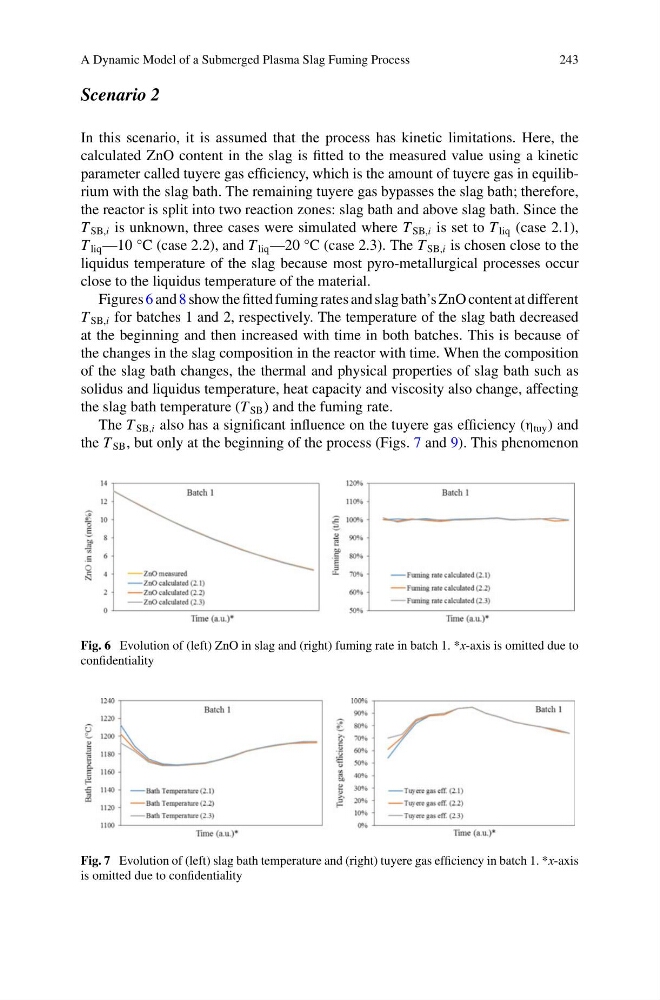
Figures 6 and 8 show the fitted fuming rates and slag bath’s ZnO content at different
T SB,i for batches 1 and 2, respectively. The temperature of the slag bath decreased
at the beginning and then increased with time in both batches. This is because of
the changes in the slag composition in the reactor with time. When the composition
of the slag bath changes, the thermal and physical properties of slag bath such as
solidus and liquidus temperature, heat capacity and viscosity also change, affecting
the slag bath temperature (T SB ) and the fuming rate.
The T SB,i also has a significant influence on the tuyere gas efficiency (η tuy ) and
the T SB , but only at the beginning of the process (Figs. 7 and 9). This phenomenon
Fig. 6 Evolution of (left) ZnO in slag and (right) fuming rate in batch 1. *x-axis is omitted due to
confidentiality
Fig. 7 Evolution of (left) slag bath temperature and (right) tuyere gas efficiency in batch 1. *x-axis
is omitted due to confidentiality
243
Scenario 2
In this scenario, it is assumed that the process has kinetic limitations. Here, the
calculated ZnO content in the slag is fitted to the measured value using a kinetic
parameter called tuyere gas efficiency, which is the amount of tuyere gas in equilibrium with the slag bath. The remaining tuyere gas bypasses the slag bath; therefore,
the reactor is split into two reaction zones: slag bath and above slag bath. Since the
T SB,i is unknown, three cases were simulated where T SB,i is set to T liq (case 2.1),
T liq —10 °C (case 2.2), and T liq —20 °C (case 2.3). The T SB,i is chosen close to the
liquidus temperature of the slag because most pyro-metallurgical processes occur
close to the liquidus temperature of the material.
Figures 6 and 8 show the fitted fuming rates and slag bath’s ZnO content at different
T SB,i for batches 1 and 2, respectively. The temperature of the slag bath decreased
at the beginning and then increased with time in both batches. This is because of
the changes in the slag composition in the reactor with time. When the composition
of the slag bath changes, the thermal and physical properties of slag bath such as
solidus and liquidus temperature, heat capacity and viscosity also change, affecting
the slag bath temperature (T SB ) and the fuming rate.
The T SB,i also has a significant influence on the tuyere gas efficiency (η tuy ) and
the T SB , but only at the beginning of the process (Figs. 7 and 9). This phenomenon
Fig. 6 Evolution of (left) ZnO in slag and (right) fuming rate in batch 1. *x-axis is omitted due to
confidentiality
Fig. 7 Evolution of (left) slag bath temperature and (right) tuyere gas efficiency in batch 1. *x-axis
is omitted due to confidentiality