

242
S. Nagraj et al.
Scenario 1
In this scenario, it is assumed that the fuming process happens at thermodynamic
equilibrium, and no kinetic factors are involved. Ten fuming batches were selected,
and three cases were simulated with initial slag temperatures T liq °C (case 1.1),
1170 °C (case 1.2), and 1180 °C (case 1.3). The temperatures 1170 and 1180 °C were
chosen as they are close to typical tapping temperatures, and the liquidus temperature
of the slag was chosen as most pyro-metallurgical processes occur close to liquidus
temperature of the material.
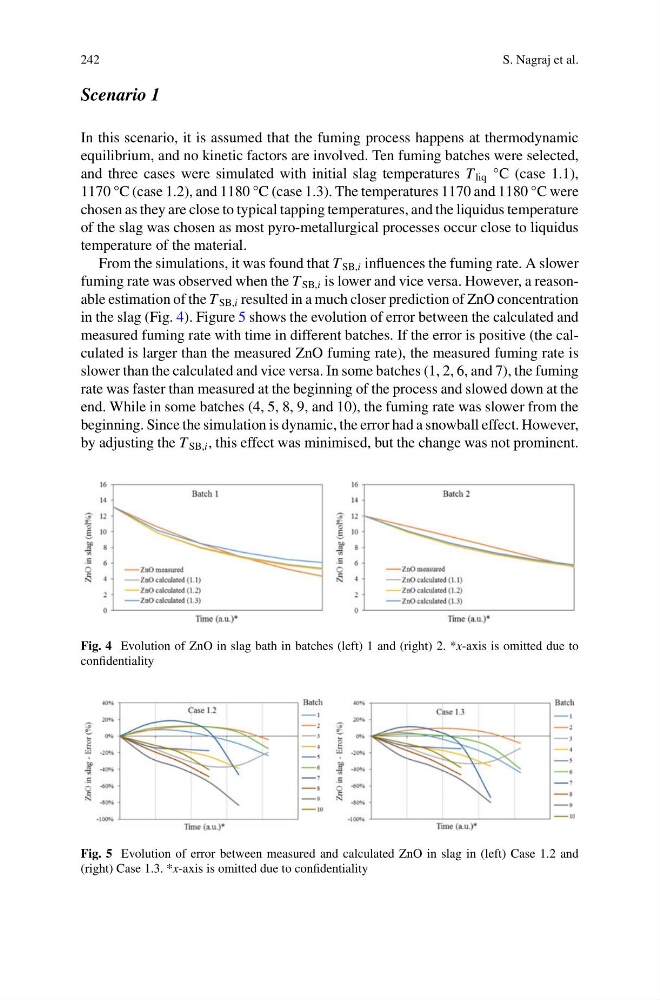
From the simulations, it was found that T SB,i influences the fuming rate. A slower
fuming rate was observed when the T SB,i is lower and vice versa. However, a reasonable estimation of the T SB,i resulted in a much closer prediction of ZnO concentration
in the slag (Fig. 4). Figure 5 shows the evolution of error between the calculated and
measured fuming rate with time in different batches. If the error is positive (the calculated is larger than the measured ZnO fuming rate), the measured fuming rate is
slower than the calculated and vice versa. In some batches (1, 2, 6, and 7), the fuming
rate was faster than measured at the beginning of the process and slowed down at the
end. While in some batches (4, 5, 8, 9, and 10), the fuming rate was slower from the
beginning. Since the simulation is dynamic, the error had a snowball effect. However,
by adjusting the T SB,i , this effect was minimised, but the change was not prominent.
Fig. 4 Evolution of ZnO in slag bath in batches (left) 1 and (right) 2. *x-axis is omitted due to
confidentiality
Fig. 5 Evolution of error between measured and calculated ZnO in slag in (left) Case 1.2 and
(right) Case 1.3. *x-axis is omitted due to confidentiality
S. Nagraj et al.
Scenario 1
In this scenario, it is assumed that the fuming process happens at thermodynamic
equilibrium, and no kinetic factors are involved. Ten fuming batches were selected,
and three cases were simulated with initial slag temperatures T liq °C (case 1.1),
1170 °C (case 1.2), and 1180 °C (case 1.3). The temperatures 1170 and 1180 °C were
chosen as they are close to typical tapping temperatures, and the liquidus temperature
of the slag was chosen as most pyro-metallurgical processes occur close to liquidus
temperature of the material.
From the simulations, it was found that T SB,i influences the fuming rate. A slower
fuming rate was observed when the T SB,i is lower and vice versa. However, a reasonable estimation of the T SB,i resulted in a much closer prediction of ZnO concentration
in the slag (Fig. 4). Figure 5 shows the evolution of error between the calculated and
measured fuming rate with time in different batches. If the error is positive (the calculated is larger than the measured ZnO fuming rate), the measured fuming rate is
slower than the calculated and vice versa. In some batches (1, 2, 6, and 7), the fuming
rate was faster than measured at the beginning of the process and slowed down at the
end. While in some batches (4, 5, 8, 9, and 10), the fuming rate was slower from the
beginning. Since the simulation is dynamic, the error had a snowball effect. However,
by adjusting the T SB,i , this effect was minimised, but the change was not prominent.
Fig. 4 Evolution of ZnO in slag bath in batches (left) 1 and (right) 2. *x-axis is omitted due to
confidentiality
Fig. 5 Evolution of error between measured and calculated ZnO in slag in (left) Case 1.2 and
(right) Case 1.3. *x-axis is omitted due to confidentiality