

Reduction of Lead-Rich Slags with Coke in the Lead Blast Furnace
177
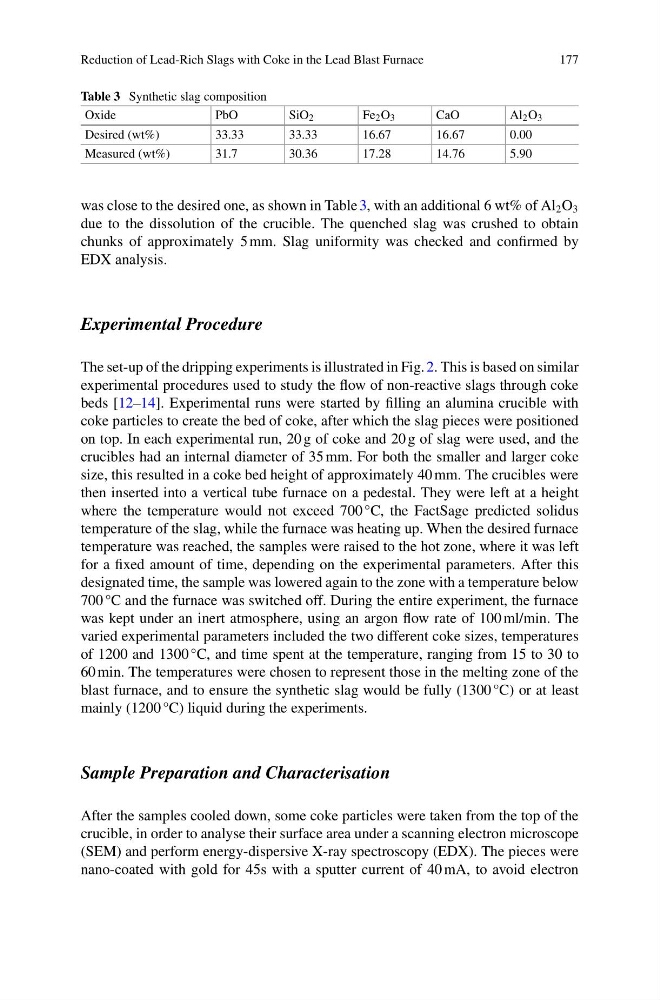
Table 3 Synthetic slag composition
Oxide
PbO
SiO 2
Fe 2 O 3
CaO
Al 2 O 3
Desired (wt%)
33.33
33.33
16.67
16.67
0.00
Measured (wt%)
31.7
30.36
17.28
14.76
5.90
was close to the desired one, as shown in Table 3, with an additional 6 wt% of Al 2 O 3
due to the dissolution of the crucible. The quenched slag was crushed to obtain
chunks of approximately 5 mm. Slag uniformity was checked and confirmed by
EDX analysis.
Experimental Procedure
The set-up of the dripping experiments is illustrated in Fig. 2. This is based on similar
experimental procedures used to study the flow of non-reactive slags through coke
beds [12–14]. Experimental runs were started by filling an alumina crucible with
coke particles to create the bed of coke, after which the slag pieces were positioned
on top. In each experimental run, 20 g of coke and 20 g of slag were used, and the
crucibles had an internal diameter of 35 mm. For both the smaller and larger coke
size, this resulted in a coke bed height of approximately 40 mm. The crucibles were
then inserted into a vertical tube furnace on a pedestal. They were left at a height
where the temperature would not exceed 700 °C, the FactSage predicted solidus
temperature of the slag, while the furnace was heating up. When the desired furnace
temperature was reached, the samples were raised to the hot zone, where it was left
for a fixed amount of time, depending on the experimental parameters. After this
designated time, the sample was lowered again to the zone with a temperature below
700 °C and the furnace was switched off. During the entire experiment, the furnace
was kept under an inert atmosphere, using an argon flow rate of 100 ml/min. The
varied experimental parameters included the two different coke sizes, temperatures
of 1200 and 1300 °C, and time spent at the temperature, ranging from 15 to 30 to
60 min. The temperatures were chosen to represent those in the melting zone of the
blast furnace, and to ensure the synthetic slag would be fully (1300 °C) or at least
mainly (1200 °C) liquid during the experiments.
Sample Preparation and Characterisation
After the samples cooled down, some coke particles were taken from the top of the
crucible, in order to analyse their surface area under a scanning electron microscope
(SEM) and perform energy-dispersive X-ray spectroscopy (EDX). The pieces were
nano-coated with gold for 45s with a sputter current of 40 mA, to avoid electron
177
Table 3 Synthetic slag composition
Oxide
PbO
SiO 2
Fe 2 O 3
CaO
Al 2 O 3
Desired (wt%)
33.33
33.33
16.67
16.67
0.00
Measured (wt%)
31.7
30.36
17.28
14.76
5.90
was close to the desired one, as shown in Table 3, with an additional 6 wt% of Al 2 O 3
due to the dissolution of the crucible. The quenched slag was crushed to obtain
chunks of approximately 5 mm. Slag uniformity was checked and confirmed by
EDX analysis.
Experimental Procedure
The set-up of the dripping experiments is illustrated in Fig. 2. This is based on similar
experimental procedures used to study the flow of non-reactive slags through coke
beds [12–14]. Experimental runs were started by filling an alumina crucible with
coke particles to create the bed of coke, after which the slag pieces were positioned
on top. In each experimental run, 20 g of coke and 20 g of slag were used, and the
crucibles had an internal diameter of 35 mm. For both the smaller and larger coke
size, this resulted in a coke bed height of approximately 40 mm. The crucibles were
then inserted into a vertical tube furnace on a pedestal. They were left at a height
where the temperature would not exceed 700 °C, the FactSage predicted solidus
temperature of the slag, while the furnace was heating up. When the desired furnace
temperature was reached, the samples were raised to the hot zone, where it was left
for a fixed amount of time, depending on the experimental parameters. After this
designated time, the sample was lowered again to the zone with a temperature below
700 °C and the furnace was switched off. During the entire experiment, the furnace
was kept under an inert atmosphere, using an argon flow rate of 100 ml/min. The
varied experimental parameters included the two different coke sizes, temperatures
of 1200 and 1300 °C, and time spent at the temperature, ranging from 15 to 30 to
60 min. The temperatures were chosen to represent those in the melting zone of the
blast furnace, and to ensure the synthetic slag would be fully (1300 °C) or at least
mainly (1200 °C) liquid during the experiments.
Sample Preparation and Characterisation
After the samples cooled down, some coke particles were taken from the top of the
crucible, in order to analyse their surface area under a scanning electron microscope
(SEM) and perform energy-dispersive X-ray spectroscopy (EDX). The pieces were
nano-coated with gold for 45s with a sputter current of 40 mA, to avoid electron