

176
R. Vanparys et al.
Slag and Coke Preparation
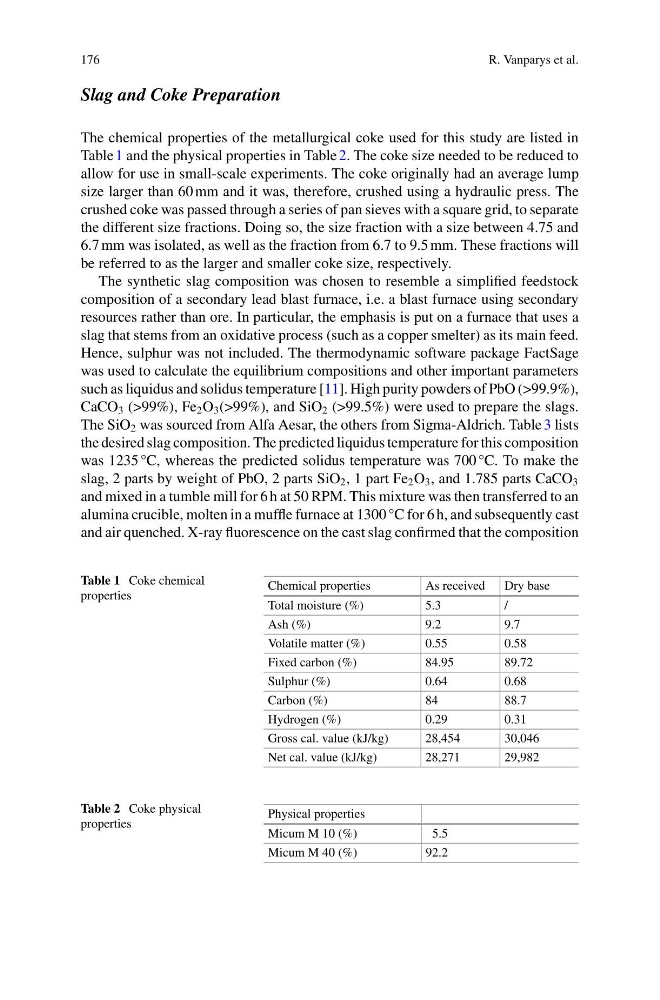
The chemical properties of the metallurgical coke used for this study are listed in
Table 1 and the physical properties in Table 2. The coke size needed to be reduced to
allow for use in small-scale experiments. The coke originally had an average lump
size larger than 60 mm and it was, therefore, crushed using a hydraulic press. The
crushed coke was passed through a series of pan sieves with a square grid, to separate
the different size fractions. Doing so, the size fraction with a size between 4.75 and
6.7 mm was isolated, as well as the fraction from 6.7 to 9.5 mm. These fractions will
be referred to as the larger and smaller coke size, respectively.
The synthetic slag composition was chosen to resemble a simplified feedstock
composition of a secondary lead blast furnace, i.e. a blast furnace using secondary
resources rather than ore. In particular, the emphasis is put on a furnace that uses a
slag that stems from an oxidative process (such as a copper smelter) as its main feed.
Hence, sulphur was not included. The thermodynamic software package FactSage
was used to calculate the equilibrium compositions and other important parameters
such as liquidus and solidus temperature [11]. High purity powders of PbO (>99.9%),
CaCO 3 (>99%), Fe 2 O 3 (>99%), and SiO 2 (>99.5%) were used to prepare the slags.
The SiO 2 was sourced from Alfa Aesar, the others from Sigma-Aldrich. Table 3 lists
the desired slag composition. The predicted liquidus temperature for this composition
was 1235 °C, whereas the predicted solidus temperature was 700 °C. To make the
slag, 2 parts by weight of PbO, 2 parts SiO 2 , 1 part Fe 2 O 3 , and 1.785 parts CaCO 3
and mixed in a tumble mill for 6 h at 50 RPM. This mixture was then transferred to an
alumina crucible, molten in a muffle furnace at 1300 °C for 6 h, and subsequently cast
and air quenched. X-ray fluorescence on the cast slag confirmed that the composition
Table 1 Coke chemical
properties
Chemical properties
As received
Dry base
Total moisture (%)
5.3
/
Ash (%)
9.2
9.7
Volatile matter (%)
0.55
0.58
Fixed carbon (%)
84.95
89.72
Sulphur (%)
0.64
0.68
Carbon (%)
84
88.7
Hydrogen (%)
0.29
0.31
Gross cal. value (kJ/kg)
28,454
30,046
Net cal. value (kJ/kg)
28,271
29,982
Table 2 Coke physical
properties
Physical properties
Micum M 10 (%)
5.5
Micum M 40 (%)
92.2
R. Vanparys et al.
Slag and Coke Preparation
The chemical properties of the metallurgical coke used for this study are listed in
Table 1 and the physical properties in Table 2. The coke size needed to be reduced to
allow for use in small-scale experiments. The coke originally had an average lump
size larger than 60 mm and it was, therefore, crushed using a hydraulic press. The
crushed coke was passed through a series of pan sieves with a square grid, to separate
the different size fractions. Doing so, the size fraction with a size between 4.75 and
6.7 mm was isolated, as well as the fraction from 6.7 to 9.5 mm. These fractions will
be referred to as the larger and smaller coke size, respectively.
The synthetic slag composition was chosen to resemble a simplified feedstock
composition of a secondary lead blast furnace, i.e. a blast furnace using secondary
resources rather than ore. In particular, the emphasis is put on a furnace that uses a
slag that stems from an oxidative process (such as a copper smelter) as its main feed.
Hence, sulphur was not included. The thermodynamic software package FactSage
was used to calculate the equilibrium compositions and other important parameters
such as liquidus and solidus temperature [11]. High purity powders of PbO (>99.9%),
CaCO 3 (>99%), Fe 2 O 3 (>99%), and SiO 2 (>99.5%) were used to prepare the slags.
The SiO 2 was sourced from Alfa Aesar, the others from Sigma-Aldrich. Table 3 lists
the desired slag composition. The predicted liquidus temperature for this composition
was 1235 °C, whereas the predicted solidus temperature was 700 °C. To make the
slag, 2 parts by weight of PbO, 2 parts SiO 2 , 1 part Fe 2 O 3 , and 1.785 parts CaCO 3
and mixed in a tumble mill for 6 h at 50 RPM. This mixture was then transferred to an
alumina crucible, molten in a muffle furnace at 1300 °C for 6 h, and subsequently cast
and air quenched. X-ray fluorescence on the cast slag confirmed that the composition
Table 1 Coke chemical
properties
Chemical properties
As received
Dry base
Total moisture (%)
5.3
/
Ash (%)
9.2
9.7
Volatile matter (%)
0.55
0.58
Fixed carbon (%)
84.95
89.72
Sulphur (%)
0.64
0.68
Carbon (%)
84
88.7
Hydrogen (%)
0.29
0.31
Gross cal. value (kJ/kg)
28,454
30,046
Net cal. value (kJ/kg)
28,271
29,982
Table 2 Coke physical
properties
Physical properties
Micum M 10 (%)
5.5
Micum M 40 (%)
92.2