

64
5 Mechanisms Involved in the Electrolytic Fabrication …
5.2 Thermokinetic Characteristics of LiCl
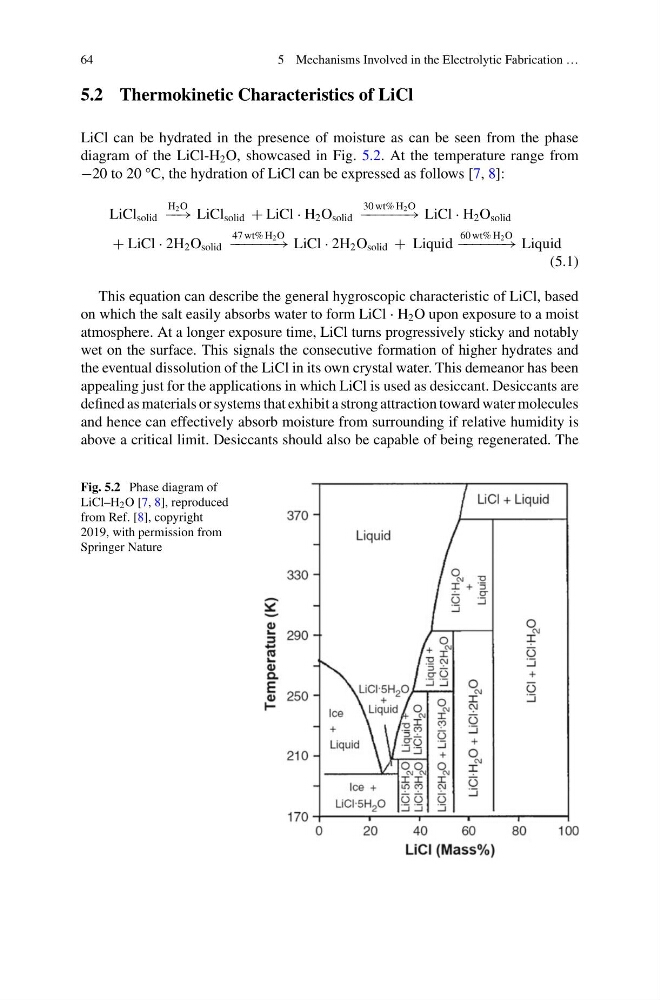
LiCl can be hydrated in the presence of moisture as can be seen from the phase
diagram of the LiCl-H 2 O, showcased in Fig. 5.2. At the temperature range from
−20 to 20 °C, the hydration of LiCl can be expressed as follows [7, 8]:
LiCl solid
H 2 O
− − → LiCl solid + LiCl · H 2 O solid
30 wt% H 2 O
− −−−−− → LiCl · H 2 O solid
+ LiCl · 2H 2 O solid
47 wt% H 2 O
− −−−−− → LiCl · 2H 2 O solid + Liquid
60 wt% H 2 O
− −−−−− → Liquid
(5.1)
This equation can describe the general hygroscopic characteristic of LiCl, based
on which the salt easily absorbs water to form LiCl · H 2 O upon exposure to a moist
atmosphere. At a longer exposure time, LiCl turns progressively sticky and notably
wet on the surface. This signals the consecutive formation of higher hydrates and
the eventual dissolution of the LiCl in its own crystal water. This demeanor has been
appealing just for the applications in which LiCl is used as desiccant. Desiccants are
defined as materials or systems that exhibit a strong attraction toward water molecules
and hence can effectively absorb moisture from surrounding if relative humidity is
above a critical limit. Desiccants should also be capable of being regenerated. The
Fig. 5.2 Phase diagram of
LiCl–H 2 O [7, 8], reproduced
from Ref. [8], copyright
2019, with permission from
Springer Nature
5 Mechanisms Involved in the Electrolytic Fabrication …
5.2 Thermokinetic Characteristics of LiCl
LiCl can be hydrated in the presence of moisture as can be seen from the phase
diagram of the LiCl-H 2 O, showcased in Fig. 5.2. At the temperature range from
−20 to 20 °C, the hydration of LiCl can be expressed as follows [7, 8]:
LiCl solid
H 2 O
− − → LiCl solid + LiCl · H 2 O solid
30 wt% H 2 O
− −−−−− → LiCl · H 2 O solid
+ LiCl · 2H 2 O solid
47 wt% H 2 O
− −−−−− → LiCl · 2H 2 O solid + Liquid
60 wt% H 2 O
− −−−−− → Liquid
(5.1)
This equation can describe the general hygroscopic characteristic of LiCl, based
on which the salt easily absorbs water to form LiCl · H 2 O upon exposure to a moist
atmosphere. At a longer exposure time, LiCl turns progressively sticky and notably
wet on the surface. This signals the consecutive formation of higher hydrates and
the eventual dissolution of the LiCl in its own crystal water. This demeanor has been
appealing just for the applications in which LiCl is used as desiccant. Desiccants are
defined as materials or systems that exhibit a strong attraction toward water molecules
and hence can effectively absorb moisture from surrounding if relative humidity is
above a critical limit. Desiccants should also be capable of being regenerated. The
Fig. 5.2 Phase diagram of
LiCl–H 2 O [7, 8], reproduced
from Ref. [8], copyright
2019, with permission from
Springer Nature