

5.1 Electrochemical Erosion of Graphite Under Nominally Dry Ar
63
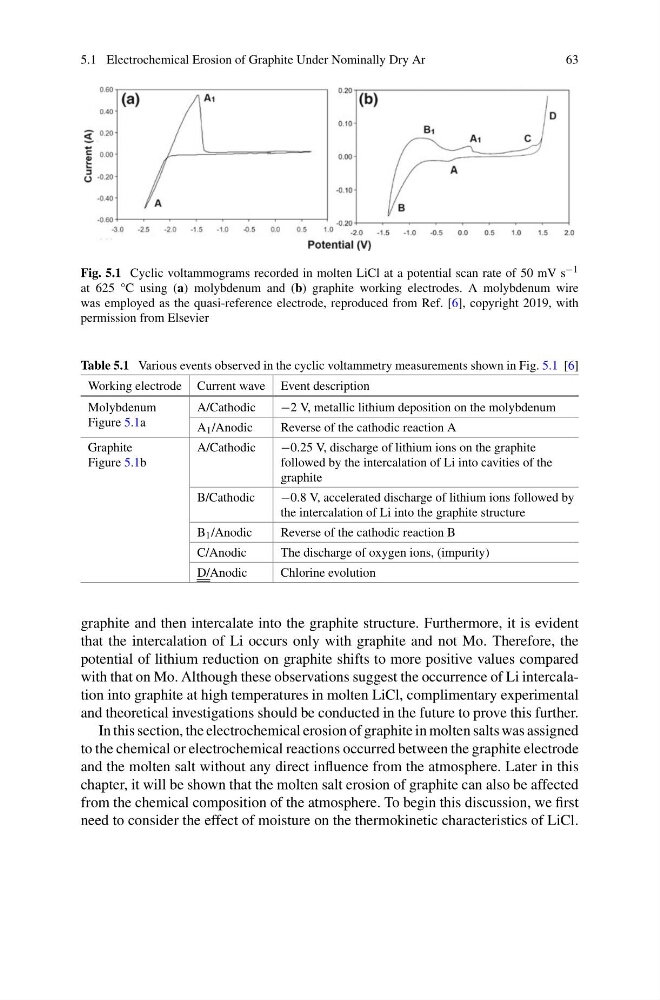
Fig. 5.1 Cyclic voltammograms recorded in molten LiCl at a potential scan rate of 50 mV s −1
at 625 °C using (a) molybdenum and (b) graphite working electrodes. A molybdenum wire
was employed as the quasi-reference electrode, reproduced from Ref. [6], copyright 2019, with
permission from Elsevier
Table 5.1 Various events observed in the cyclic voltammetry measurements shown in Fig. 5.1 [6]
Working electrode Current wave Event description
Molybdenum
Figure 5.1a
A/Cathodic
−2 V, metallic lithium deposition on the molybdenum
A 1 /Anodic
Reverse of the cathodic reaction A
Graphite
Figure 5.1b
A/Cathodic
−0.25 V, discharge of lithium ions on the graphite
followed by the intercalation of Li into cavities of the
graphite
B/Cathodic
−0.8 V, accelerated discharge of lithium ions followed by
the intercalation of Li into the graphite structure
B 1 /Anodic
Reverse of the cathodic reaction B
C/Anodic
The discharge of oxygen ions, (impurity)
D/Anodic
Chlorine evolution
graphite and then intercalate into the graphite structure. Furthermore, it is evident
that the intercalation of Li occurs only with graphite and not Mo. Therefore, the
potential of lithium reduction on graphite shifts to more positive values compared
with that on Mo. Although these observations suggest the occurrence of Li intercalation into graphite at high temperatures in molten LiCl, complimentary experimental
and theoretical investigations should be conducted in the future to prove this further.
In this section, the electrochemical erosion of graphite in molten salts was assigned
to the chemical or electrochemical reactions occurred between the graphite electrode
and the molten salt without any direct influence from the atmosphere. Later in this
chapter, it will be shown that the molten salt erosion of graphite can also be affected
from the chemical composition of the atmosphere. To begin this discussion, we first
need to consider the effect of moisture on the thermokinetic characteristics of LiCl.
63
Fig. 5.1 Cyclic voltammograms recorded in molten LiCl at a potential scan rate of 50 mV s −1
at 625 °C using (a) molybdenum and (b) graphite working electrodes. A molybdenum wire
was employed as the quasi-reference electrode, reproduced from Ref. [6], copyright 2019, with
permission from Elsevier
Table 5.1 Various events observed in the cyclic voltammetry measurements shown in Fig. 5.1 [6]
Working electrode Current wave Event description
Molybdenum
Figure 5.1a
A/Cathodic
−2 V, metallic lithium deposition on the molybdenum
A 1 /Anodic
Reverse of the cathodic reaction A
Graphite
Figure 5.1b
A/Cathodic
−0.25 V, discharge of lithium ions on the graphite
followed by the intercalation of Li into cavities of the
graphite
B/Cathodic
−0.8 V, accelerated discharge of lithium ions followed by
the intercalation of Li into the graphite structure
B 1 /Anodic
Reverse of the cathodic reaction B
C/Anodic
The discharge of oxygen ions, (impurity)
D/Anodic
Chlorine evolution
graphite and then intercalate into the graphite structure. Furthermore, it is evident
that the intercalation of Li occurs only with graphite and not Mo. Therefore, the
potential of lithium reduction on graphite shifts to more positive values compared
with that on Mo. Although these observations suggest the occurrence of Li intercalation into graphite at high temperatures in molten LiCl, complimentary experimental
and theoretical investigations should be conducted in the future to prove this further.
In this section, the electrochemical erosion of graphite in molten salts was assigned
to the chemical or electrochemical reactions occurred between the graphite electrode
and the molten salt without any direct influence from the atmosphere. Later in this
chapter, it will be shown that the molten salt erosion of graphite can also be affected
from the chemical composition of the atmosphere. To begin this discussion, we first
need to consider the effect of moisture on the thermokinetic characteristics of LiCl.