

28
3 Interaction of Molten Salts with Graphite
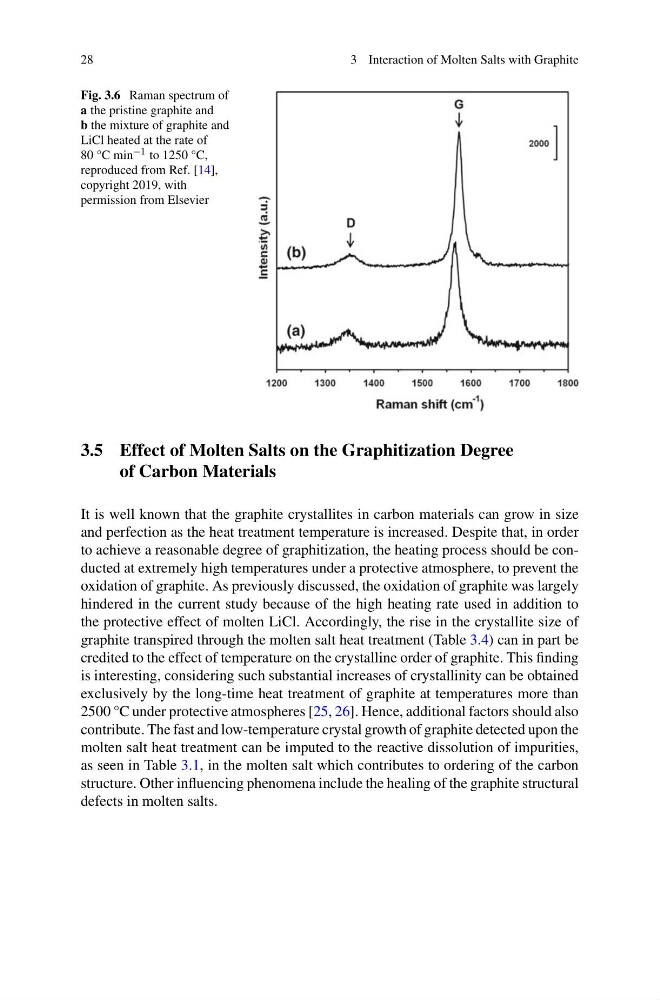
Fig. 3.6 Raman spectrum of
a the pristine graphite and
b the mixture of graphite and
LiCl heated at the rate of
80 °C min −1 to 1250 °C,
reproduced from Ref. [14],
copyright 2019, with
permission from Elsevier
3.5 Effect of Molten Salts on the Graphitization Degree
of Carbon Materials
It is well known that the graphite crystallites in carbon materials can grow in size
and perfection as the heat treatment temperature is increased. Despite that, in order
to achieve a reasonable degree of graphitization, the heating process should be conducted at extremely high temperatures under a protective atmosphere, to prevent the
oxidation of graphite. As previously discussed, the oxidation of graphite was largely
hindered in the current study because of the high heating rate used in addition to
the protective effect of molten LiCl. Accordingly, the rise in the crystallite size of
graphite transpired through the molten salt heat treatment (Table 3.4) can in part be
credited to the effect of temperature on the crystalline order of graphite. This finding
is interesting, considering such substantial increases of crystallinity can be obtained
exclusively by the long-time heat treatment of graphite at temperatures more than
2500 °C under protective atmospheres [25, 26]. Hence, additional factors should also
contribute. The fast and low-temperature crystal growth of graphite detected upon the
molten salt heat treatment can be imputed to the reactive dissolution of impurities,
as seen in Table 3.1, in the molten salt which contributes to ordering of the carbon
structure. Other influencing phenomena include the healing of the graphite structural
defects in molten salts.
3 Interaction of Molten Salts with Graphite
Fig. 3.6 Raman spectrum of
a the pristine graphite and
b the mixture of graphite and
LiCl heated at the rate of
80 °C min −1 to 1250 °C,
reproduced from Ref. [14],
copyright 2019, with
permission from Elsevier
3.5 Effect of Molten Salts on the Graphitization Degree
of Carbon Materials
It is well known that the graphite crystallites in carbon materials can grow in size
and perfection as the heat treatment temperature is increased. Despite that, in order
to achieve a reasonable degree of graphitization, the heating process should be conducted at extremely high temperatures under a protective atmosphere, to prevent the
oxidation of graphite. As previously discussed, the oxidation of graphite was largely
hindered in the current study because of the high heating rate used in addition to
the protective effect of molten LiCl. Accordingly, the rise in the crystallite size of
graphite transpired through the molten salt heat treatment (Table 3.4) can in part be
credited to the effect of temperature on the crystalline order of graphite. This finding
is interesting, considering such substantial increases of crystallinity can be obtained
exclusively by the long-time heat treatment of graphite at temperatures more than
2500 °C under protective atmospheres [25, 26]. Hence, additional factors should also
contribute. The fast and low-temperature crystal growth of graphite detected upon the
molten salt heat treatment can be imputed to the reactive dissolution of impurities,
as seen in Table 3.1, in the molten salt which contributes to ordering of the carbon
structure. Other influencing phenomena include the healing of the graphite structural
defects in molten salts.