

3.6 Effect of Molten LiCl on the Microstructure of Graphite
29
3.6 Effect of Molten LiCl on the Microstructure
of Graphite
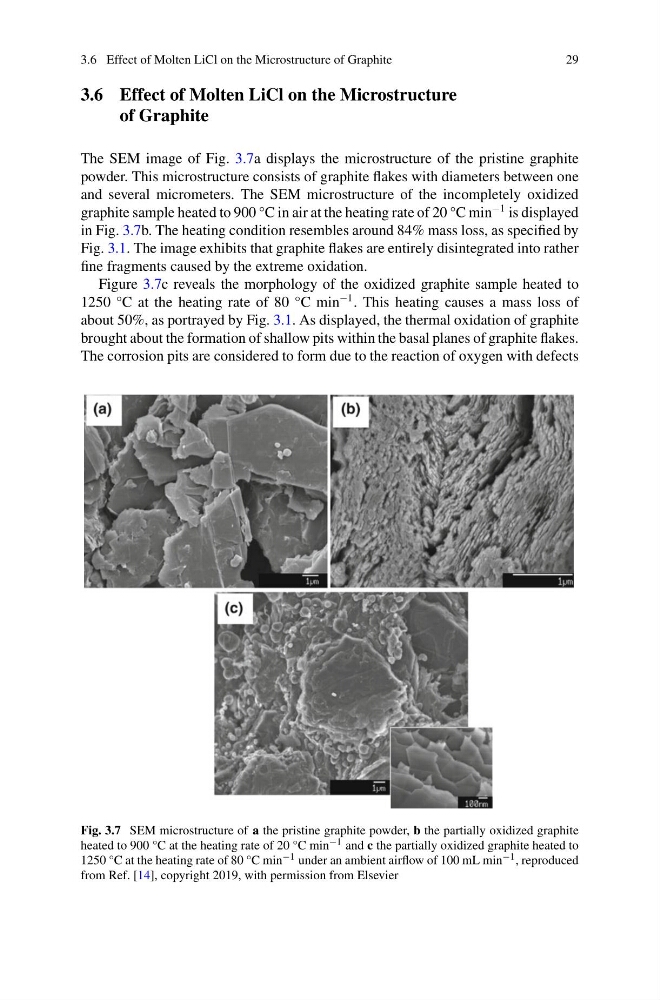
The SEM image of Fig. 3.7a displays the microstructure of the pristine graphite
powder. This microstructure consists of graphite flakes with diameters between one
and several micrometers. The SEM microstructure of the incompletely oxidized
graphite sample heated to 900 °C in air at the heating rate of 20 °C min
−1 is displayed
in Fig. 3.7b. The heating condition resembles around 84% mass loss, as specified by
Fig. 3.1. The image exhibits that graphite flakes are entirely disintegrated into rather
fine fragments caused by the extreme oxidation.
Figure 3.7c reveals the morphology of the oxidized graphite sample heated to
1250 °C at the heating rate of 80 °C min
−1 . This heating causes a mass loss of
about 50%, as portrayed by Fig. 3.1. As displayed, the thermal oxidation of graphite
brought about the formation of shallow pits within the basal planes of graphite flakes.
The corrosion pits are considered to form due to the reaction of oxygen with defects
Fig. 3.7 SEM microstructure of a the pristine graphite powder, b the partially oxidized graphite
heated to 900 °C at the heating rate of 20 °C min −1 and c the partially oxidized graphite heated to
1250 °C at the heating rate of 80 °C min −1 under an ambient airflow of 100 mL min −1 , reproduced
from Ref. [14], copyright 2019, with permission from Elsevier
29
3.6 Effect of Molten LiCl on the Microstructure
of Graphite
The SEM image of Fig. 3.7a displays the microstructure of the pristine graphite
powder. This microstructure consists of graphite flakes with diameters between one
and several micrometers. The SEM microstructure of the incompletely oxidized
graphite sample heated to 900 °C in air at the heating rate of 20 °C min
−1 is displayed
in Fig. 3.7b. The heating condition resembles around 84% mass loss, as specified by
Fig. 3.1. The image exhibits that graphite flakes are entirely disintegrated into rather
fine fragments caused by the extreme oxidation.
Figure 3.7c reveals the morphology of the oxidized graphite sample heated to
1250 °C at the heating rate of 80 °C min
−1 . This heating causes a mass loss of
about 50%, as portrayed by Fig. 3.1. As displayed, the thermal oxidation of graphite
brought about the formation of shallow pits within the basal planes of graphite flakes.
The corrosion pits are considered to form due to the reaction of oxygen with defects
Fig. 3.7 SEM microstructure of a the pristine graphite powder, b the partially oxidized graphite
heated to 900 °C at the heating rate of 20 °C min −1 and c the partially oxidized graphite heated to
1250 °C at the heating rate of 80 °C min −1 under an ambient airflow of 100 mL min −1 , reproduced
from Ref. [14], copyright 2019, with permission from Elsevier