

14
2 Production of Advanced Materials in Molten Salts
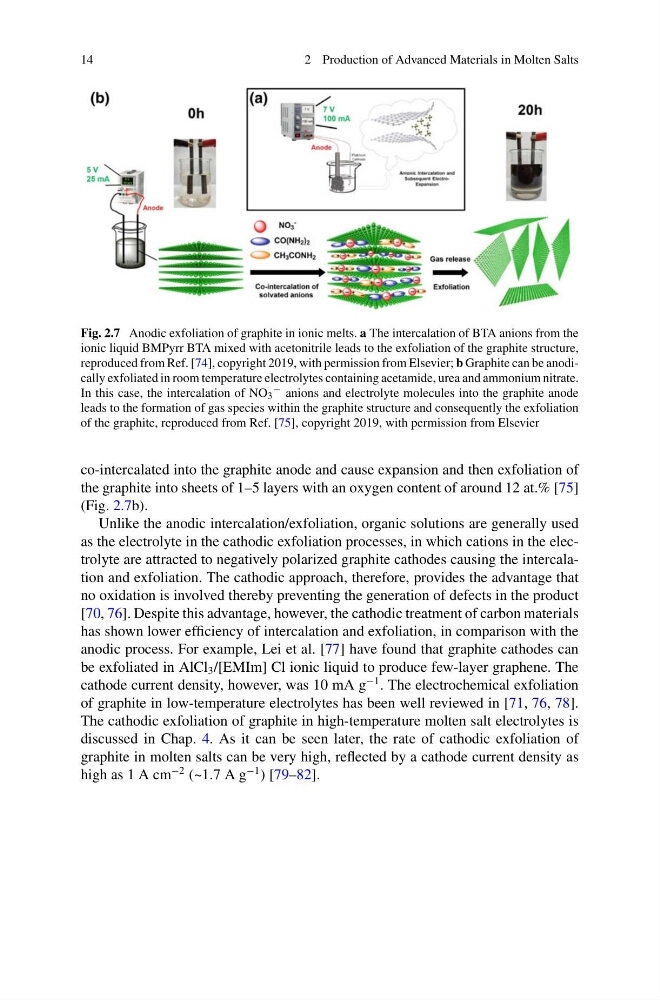
Fig. 2.7 Anodic exfoliation of graphite in ionic melts. a The intercalation of BTA anions from the
ionic liquid BMPyrr BTA mixed with acetonitrile leads to the exfoliation of the graphite structure,
reproduced from Ref. [74], copyright 2019, with permission from Elsevier; b Graphite can be anodically exfoliated in room temperature electrolytes containing acetamide, urea and ammonium nitrate.
In this case, the intercalation of NO 3
− anions and electrolyte molecules into the graphite anode
leads to the formation of gas species within the graphite structure and consequently the exfoliation
of the graphite, reproduced from Ref. [75], copyright 2019, with permission from Elsevier
co-intercalated into the graphite anode and cause expansion and then exfoliation of
the graphite into sheets of 1–5 layers with an oxygen content of around 12 at.% [75]
(Fig. 2.7b).
Unlike the anodic intercalation/exfoliation, organic solutions are generally used
as the electrolyte in the cathodic exfoliation processes, in which cations in the electrolyte are attracted to negatively polarized graphite cathodes causing the intercalation and exfoliation. The cathodic approach, therefore, provides the advantage that
no oxidation is involved thereby preventing the generation of defects in the product
[70, 76]. Despite this advantage, however, the cathodic treatment of carbon materials
has shown lower efficiency of intercalation and exfoliation, in comparison with the
anodic process. For example, Lei et al. [77] have found that graphite cathodes can
be exfoliated in AlCl 3 /[EMIm] Cl ionic liquid to produce few-layer graphene. The
cathode current density, however, was 10 mA g
−1 . The electrochemical exfoliation
of graphite in low-temperature electrolytes has been well reviewed in [71, 76, 78].
The cathodic exfoliation of graphite in high-temperature molten salt electrolytes is
discussed in Chap. 4. As it can be seen later, the rate of cathodic exfoliation of
graphite in molten salts can be very high, reflected by a cathode current density as
high as 1 A cm
−2 (~1.7 A g
−1 ) [79–82].
2 Production of Advanced Materials in Molten Salts
Fig. 2.7 Anodic exfoliation of graphite in ionic melts. a The intercalation of BTA anions from the
ionic liquid BMPyrr BTA mixed with acetonitrile leads to the exfoliation of the graphite structure,
reproduced from Ref. [74], copyright 2019, with permission from Elsevier; b Graphite can be anodically exfoliated in room temperature electrolytes containing acetamide, urea and ammonium nitrate.
In this case, the intercalation of NO 3
− anions and electrolyte molecules into the graphite anode
leads to the formation of gas species within the graphite structure and consequently the exfoliation
of the graphite, reproduced from Ref. [75], copyright 2019, with permission from Elsevier
co-intercalated into the graphite anode and cause expansion and then exfoliation of
the graphite into sheets of 1–5 layers with an oxygen content of around 12 at.% [75]
(Fig. 2.7b).
Unlike the anodic intercalation/exfoliation, organic solutions are generally used
as the electrolyte in the cathodic exfoliation processes, in which cations in the electrolyte are attracted to negatively polarized graphite cathodes causing the intercalation and exfoliation. The cathodic approach, therefore, provides the advantage that
no oxidation is involved thereby preventing the generation of defects in the product
[70, 76]. Despite this advantage, however, the cathodic treatment of carbon materials
has shown lower efficiency of intercalation and exfoliation, in comparison with the
anodic process. For example, Lei et al. [77] have found that graphite cathodes can
be exfoliated in AlCl 3 /[EMIm] Cl ionic liquid to produce few-layer graphene. The
cathode current density, however, was 10 mA g
−1 . The electrochemical exfoliation
of graphite in low-temperature electrolytes has been well reviewed in [71, 76, 78].
The cathodic exfoliation of graphite in high-temperature molten salt electrolytes is
discussed in Chap. 4. As it can be seen later, the rate of cathodic exfoliation of
graphite in molten salts can be very high, reflected by a cathode current density as
high as 1 A cm
−2 (~1.7 A g
−1 ) [79–82].