

7.5 Electrical and Electrochemical Characterization …
127
intrinsic sp
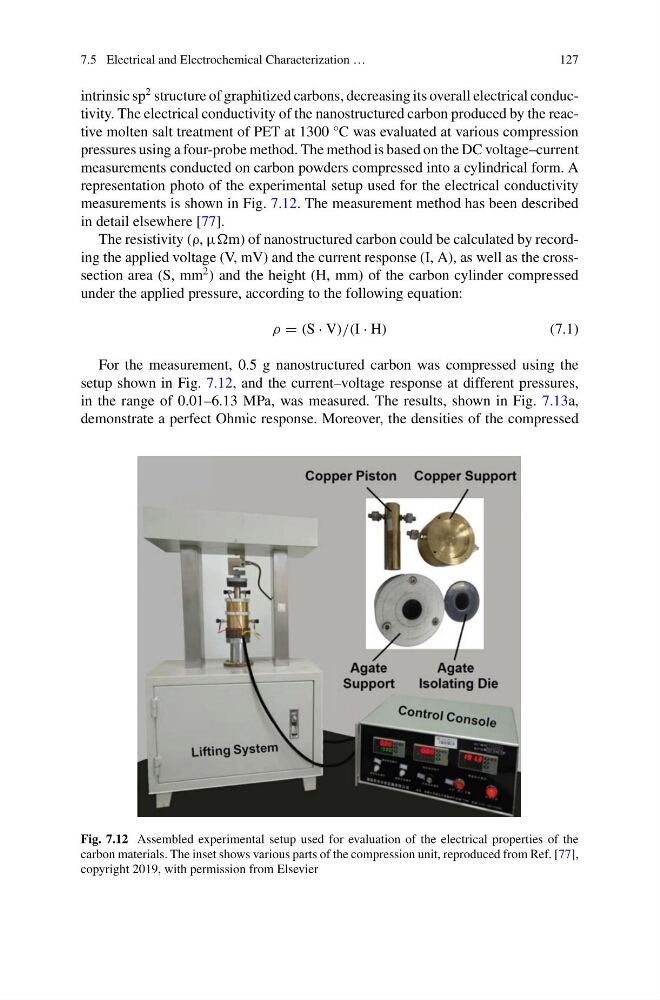
2 structure of graphitized carbons, decreasing its overall electrical conductivity. The electrical conductivity of the nanostructured carbon produced by the reactive molten salt treatment of PET at 1300 °C was evaluated at various compression
pressures using a four-probe method. The method is based on the DC voltage–current
measurements conducted on carbon powders compressed into a cylindrical form. A
representation photo of the experimental setup used for the electrical conductivity
measurements is shown in Fig. 7.12. The measurement method has been described
in detail elsewhere [77].
The resistivity (ρ, μm) of nanostructured carbon could be calculated by recording the applied voltage (V, mV) and the current response (I, A), as well as the crosssection area (S, mm
2 ) and the height (H, mm) of the carbon cylinder compressed
under the applied pressure, according to the following equation:
ρ = (S · V)/(I · H)
(7.1)
For the measurement, 0.5 g nanostructured carbon was compressed using the
setup shown in Fig. 7.12, and the current–voltage response at different pressures,
in the range of 0.01–6.13 MPa, was measured. The results, shown in Fig. 7.13a,
demonstrate a perfect Ohmic response. Moreover, the densities of the compressed
Fig. 7.12 Assembled experimental setup used for evaluation of the electrical properties of the
carbon materials. The inset shows various parts of the compression unit, reproduced from Ref. [77],
copyright 2019, with permission from Elsevier
127
intrinsic sp
2 structure of graphitized carbons, decreasing its overall electrical conductivity. The electrical conductivity of the nanostructured carbon produced by the reactive molten salt treatment of PET at 1300 °C was evaluated at various compression
pressures using a four-probe method. The method is based on the DC voltage–current
measurements conducted on carbon powders compressed into a cylindrical form. A
representation photo of the experimental setup used for the electrical conductivity
measurements is shown in Fig. 7.12. The measurement method has been described
in detail elsewhere [77].
The resistivity (ρ, μm) of nanostructured carbon could be calculated by recording the applied voltage (V, mV) and the current response (I, A), as well as the crosssection area (S, mm
2 ) and the height (H, mm) of the carbon cylinder compressed
under the applied pressure, according to the following equation:
ρ = (S · V)/(I · H)
(7.1)
For the measurement, 0.5 g nanostructured carbon was compressed using the
setup shown in Fig. 7.12, and the current–voltage response at different pressures,
in the range of 0.01–6.13 MPa, was measured. The results, shown in Fig. 7.13a,
demonstrate a perfect Ohmic response. Moreover, the densities of the compressed
Fig. 7.12 Assembled experimental setup used for evaluation of the electrical properties of the
carbon materials. The inset shows various parts of the compression unit, reproduced from Ref. [77],
copyright 2019, with permission from Elsevier