

126
7 Molten Salt Conversion of Plastics into Highly Conductive …
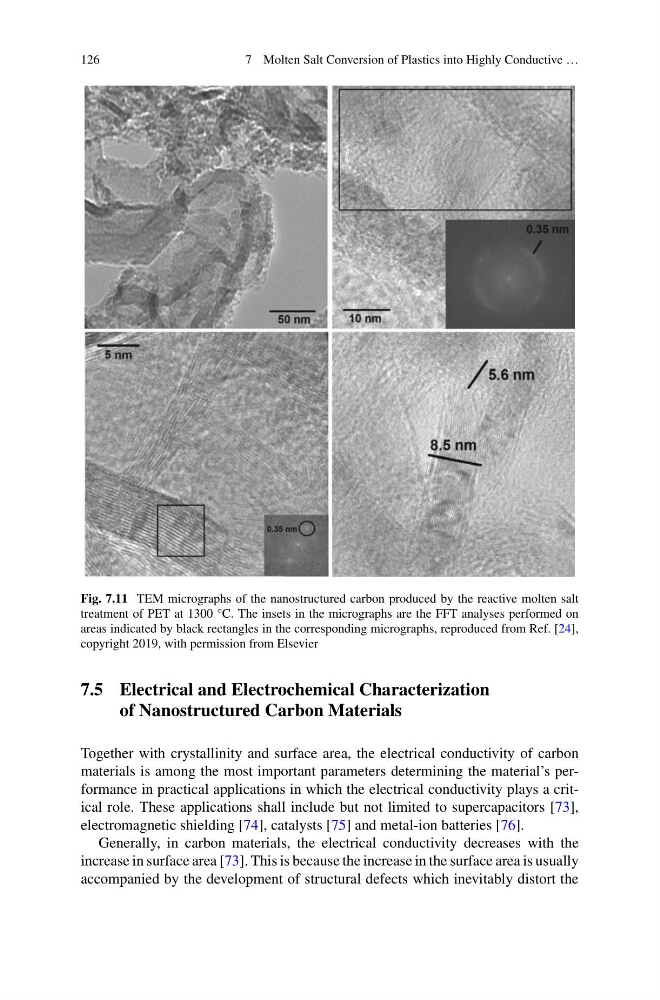
Fig. 7.11 TEM micrographs of the nanostructured carbon produced by the reactive molten salt
treatment of PET at 1300 °C. The insets in the micrographs are the FFT analyses performed on
areas indicated by black rectangles in the corresponding micrographs, reproduced from Ref. [24],
copyright 2019, with permission from Elsevier
7.5 Electrical and Electrochemical Characterization
of Nanostructured Carbon Materials
Together with crystallinity and surface area, the electrical conductivity of carbon
materials is among the most important parameters determining the material’s performance in practical applications in which the electrical conductivity plays a critical role. These applications shall include but not limited to supercapacitors [73],
electromagnetic shielding [74], catalysts [75] and metal-ion batteries [76].
Generally, in carbon materials, the electrical conductivity decreases with the
increase in surface area [73]. This is because the increase in the surface area is usually
accompanied by the development of structural defects which inevitably distort the
7 Molten Salt Conversion of Plastics into Highly Conductive …
Fig. 7.11 TEM micrographs of the nanostructured carbon produced by the reactive molten salt
treatment of PET at 1300 °C. The insets in the micrographs are the FFT analyses performed on
areas indicated by black rectangles in the corresponding micrographs, reproduced from Ref. [24],
copyright 2019, with permission from Elsevier
7.5 Electrical and Electrochemical Characterization
of Nanostructured Carbon Materials
Together with crystallinity and surface area, the electrical conductivity of carbon
materials is among the most important parameters determining the material’s performance in practical applications in which the electrical conductivity plays a critical role. These applications shall include but not limited to supercapacitors [73],
electromagnetic shielding [74], catalysts [75] and metal-ion batteries [76].
Generally, in carbon materials, the electrical conductivity decreases with the
increase in surface area [73]. This is because the increase in the surface area is usually
accompanied by the development of structural defects which inevitably distort the