

102
6 Applications of Carbon Nanostructures Produced in Molten Salts
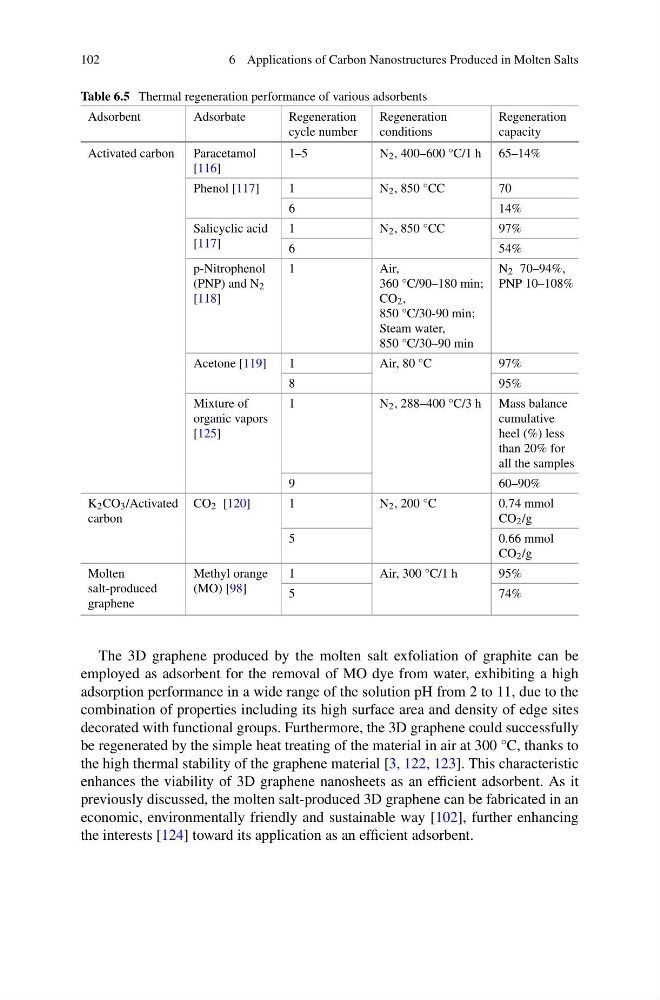
Table 6.5 Thermal regeneration performance of various adsorbents
Adsorbent
Adsorbate
Regeneration
cycle number
Regeneration
conditions
Regeneration
capacity
Activated carbon Paracetamol
[116]
1–5
N 2 , 400–600 °C/1 h 65–14%
Phenol [117]
1
N 2 , 850 °CC
70
6
14%
Salicyclic acid
[117]
1
N 2 , 850 °CC
97%
6
54%
p-Nitrophenol
(PNP) and N 2
[118]
1
Air,
360 °C/90–180 min;
CO 2 ,
850 °C/30-90 min;
Steam water,
850 °C/30–90 min
N 2 70–94%,
PNP 10–108%
Acetone [119]
1
Air, 80 °C
97%
8
95%
Mixture of
organic vapors
[125]
1
N 2 , 288–400 °C/3 h Mass balance
cumulative
heel (%) less
than 20% for
all the samples
9
60–90%
K 2 CO 3 /Activated
carbon
CO 2 [120]
1
N 2 , 200 °C
0.74 mmol
CO 2 /g
5
0.66 mmol
CO 2 /g
Molten
salt-produced
graphene
Methyl orange
(MO) [98]
1
Air, 300 °C/1 h
95%
5
74%
The 3D graphene produced by the molten salt exfoliation of graphite can be
employed as adsorbent for the removal of MO dye from water, exhibiting a high
adsorption performance in a wide range of the solution pH from 2 to 11, due to the
combination of properties including its high surface area and density of edge sites
decorated with functional groups. Furthermore, the 3D graphene could successfully
be regenerated by the simple heat treating of the material in air at 300 °C, thanks to
the high thermal stability of the graphene material [3, 122, 123]. This characteristic
enhances the viability of 3D graphene nanosheets as an efficient adsorbent. As it
previously discussed, the molten salt-produced 3D graphene can be fabricated in an
economic, environmentally friendly and sustainable way [102], further enhancing
the interests [124] toward its application as an efficient adsorbent.
6 Applications of Carbon Nanostructures Produced in Molten Salts
Table 6.5 Thermal regeneration performance of various adsorbents
Adsorbent
Adsorbate
Regeneration
cycle number
Regeneration
conditions
Regeneration
capacity
Activated carbon Paracetamol
[116]
1–5
N 2 , 400–600 °C/1 h 65–14%
Phenol [117]
1
N 2 , 850 °CC
70
6
14%
Salicyclic acid
[117]
1
N 2 , 850 °CC
97%
6
54%
p-Nitrophenol
(PNP) and N 2
[118]
1
Air,
360 °C/90–180 min;
CO 2 ,
850 °C/30-90 min;
Steam water,
850 °C/30–90 min
N 2 70–94%,
PNP 10–108%
Acetone [119]
1
Air, 80 °C
97%
8
95%
Mixture of
organic vapors
[125]
1
N 2 , 288–400 °C/3 h Mass balance
cumulative
heel (%) less
than 20% for
all the samples
9
60–90%
K 2 CO 3 /Activated
carbon
CO 2 [120]
1
N 2 , 200 °C
0.74 mmol
CO 2 /g
5
0.66 mmol
CO 2 /g
Molten
salt-produced
graphene
Methyl orange
(MO) [98]
1
Air, 300 °C/1 h
95%
5
74%
The 3D graphene produced by the molten salt exfoliation of graphite can be
employed as adsorbent for the removal of MO dye from water, exhibiting a high
adsorption performance in a wide range of the solution pH from 2 to 11, due to the
combination of properties including its high surface area and density of edge sites
decorated with functional groups. Furthermore, the 3D graphene could successfully
be regenerated by the simple heat treating of the material in air at 300 °C, thanks to
the high thermal stability of the graphene material [3, 122, 123]. This characteristic
enhances the viability of 3D graphene nanosheets as an efficient adsorbent. As it
previously discussed, the molten salt-produced 3D graphene can be fabricated in an
economic, environmentally friendly and sustainable way [102], further enhancing
the interests [124] toward its application as an efficient adsorbent.