

6.5 Adsorption
101
20
30
40
50
60
70
80
90
MO NaCl NH 4 Cl
Intensity (u.a.)
2 θ (degree)
(a)
(b)
5000
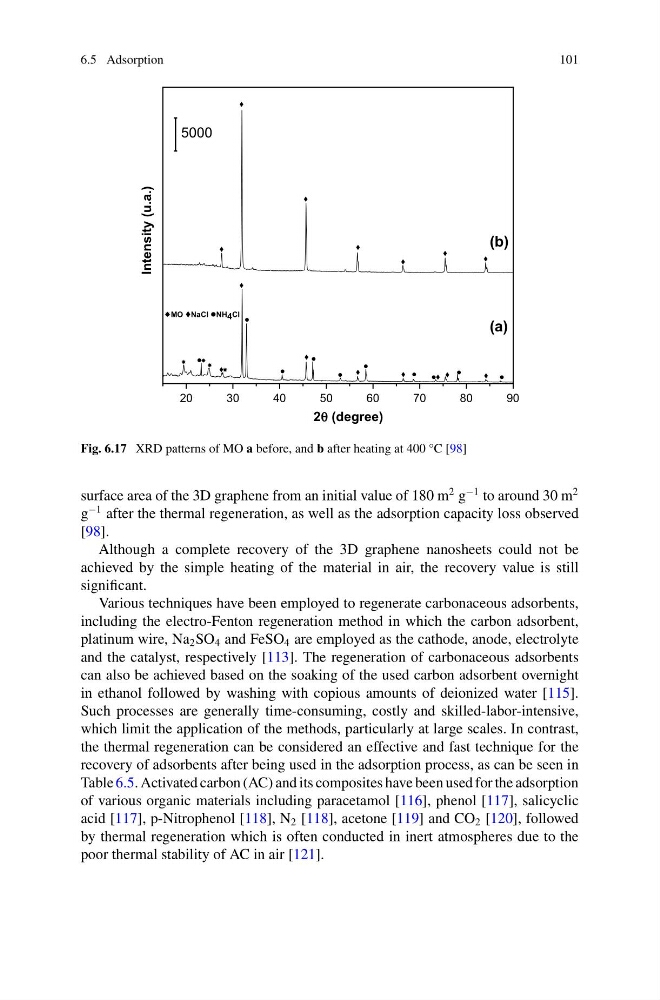
Fig. 6.17 XRD patterns of MO a before, and b after heating at 400 °C [98]
surface area of the 3D graphene from an initial value of 180 m
2 g
−1 to around 30 m
2
g
−1 after the thermal regeneration, as well as the adsorption capacity loss observed
[98].
Although a complete recovery of the 3D graphene nanosheets could not be
achieved by the simple heating of the material in air, the recovery value is still
significant.
Various techniques have been employed to regenerate carbonaceous adsorbents,
including the electro-Fenton regeneration method in which the carbon adsorbent,
platinum wire, Na 2 SO 4 and FeSO 4 are employed as the cathode, anode, electrolyte
and the catalyst, respectively [113]. The regeneration of carbonaceous adsorbents
can also be achieved based on the soaking of the used carbon adsorbent overnight
in ethanol followed by washing with copious amounts of deionized water [115].
Such processes are generally time-consuming, costly and skilled-labor-intensive,
which limit the application of the methods, particularly at large scales. In contrast,
the thermal regeneration can be considered an effective and fast technique for the
recovery of adsorbents after being used in the adsorption process, as can be seen in
Table 6.5. Activated carbon (AC) and its composites have been used for the adsorption
of various organic materials including paracetamol [116], phenol [117], salicyclic
acid [117], p-Nitrophenol [118], N 2 [118], acetone [119] and CO 2 [120], followed
by thermal regeneration which is often conducted in inert atmospheres due to the
poor thermal stability of AC in air [121].
101
20
30
40
50
60
70
80
90
MO NaCl NH 4 Cl
Intensity (u.a.)
2 θ (degree)
(a)
(b)
5000
Fig. 6.17 XRD patterns of MO a before, and b after heating at 400 °C [98]
surface area of the 3D graphene from an initial value of 180 m
2 g
−1 to around 30 m
2
g
−1 after the thermal regeneration, as well as the adsorption capacity loss observed
[98].
Although a complete recovery of the 3D graphene nanosheets could not be
achieved by the simple heating of the material in air, the recovery value is still
significant.
Various techniques have been employed to regenerate carbonaceous adsorbents,
including the electro-Fenton regeneration method in which the carbon adsorbent,
platinum wire, Na 2 SO 4 and FeSO 4 are employed as the cathode, anode, electrolyte
and the catalyst, respectively [113]. The regeneration of carbonaceous adsorbents
can also be achieved based on the soaking of the used carbon adsorbent overnight
in ethanol followed by washing with copious amounts of deionized water [115].
Such processes are generally time-consuming, costly and skilled-labor-intensive,
which limit the application of the methods, particularly at large scales. In contrast,
the thermal regeneration can be considered an effective and fast technique for the
recovery of adsorbents after being used in the adsorption process, as can be seen in
Table 6.5. Activated carbon (AC) and its composites have been used for the adsorption
of various organic materials including paracetamol [116], phenol [117], salicyclic
acid [117], p-Nitrophenol [118], N 2 [118], acetone [119] and CO 2 [120], followed
by thermal regeneration which is often conducted in inert atmospheres due to the
poor thermal stability of AC in air [121].