

100
6 Applications of Carbon Nanostructures Produced in Molten Salts
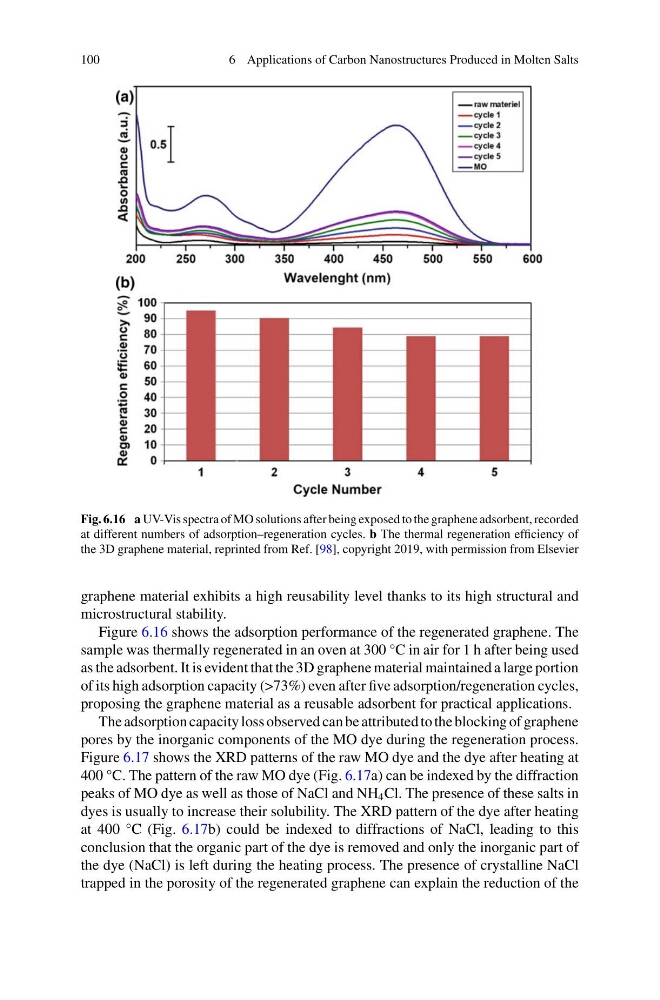
Fig. 6.16 a UV-Vis spectra of MO solutions after being exposed to the graphene adsorbent, recorded
at different numbers of adsorption–regeneration cycles. b The thermal regeneration efficiency of
the 3D graphene material, reprinted from Ref. [98], copyright 2019, with permission from Elsevier
graphene material exhibits a high reusability level thanks to its high structural and
microstructural stability.
Figure 6.16 shows the adsorption performance of the regenerated graphene. The
sample was thermally regenerated in an oven at 300 °C in air for 1 h after being used
as the adsorbent. It is evident that the 3D graphene material maintained a large portion
of its high adsorption capacity (>73%) even after five adsorption/regeneration cycles,
proposing the graphene material as a reusable adsorbent for practical applications.
The adsorption capacity loss observed can be attributed to the blocking of graphene
pores by the inorganic components of the MO dye during the regeneration process.
Figure 6.17 shows the XRD patterns of the raw MO dye and the dye after heating at
400 °C. The pattern of the raw MO dye (Fig. 6.17a) can be indexed by the diffraction
peaks of MO dye as well as those of NaCl and NH 4 Cl. The presence of these salts in
dyes is usually to increase their solubility. The XRD pattern of the dye after heating
at 400 °C (Fig. 6.17b) could be indexed to diffractions of NaCl, leading to this
conclusion that the organic part of the dye is removed and only the inorganic part of
the dye (NaCl) is left during the heating process. The presence of crystalline NaCl
trapped in the porosity of the regenerated graphene can explain the reduction of the
6 Applications of Carbon Nanostructures Produced in Molten Salts
Fig. 6.16 a UV-Vis spectra of MO solutions after being exposed to the graphene adsorbent, recorded
at different numbers of adsorption–regeneration cycles. b The thermal regeneration efficiency of
the 3D graphene material, reprinted from Ref. [98], copyright 2019, with permission from Elsevier
graphene material exhibits a high reusability level thanks to its high structural and
microstructural stability.
Figure 6.16 shows the adsorption performance of the regenerated graphene. The
sample was thermally regenerated in an oven at 300 °C in air for 1 h after being used
as the adsorbent. It is evident that the 3D graphene material maintained a large portion
of its high adsorption capacity (>73%) even after five adsorption/regeneration cycles,
proposing the graphene material as a reusable adsorbent for practical applications.
The adsorption capacity loss observed can be attributed to the blocking of graphene
pores by the inorganic components of the MO dye during the regeneration process.
Figure 6.17 shows the XRD patterns of the raw MO dye and the dye after heating at
400 °C. The pattern of the raw MO dye (Fig. 6.17a) can be indexed by the diffraction
peaks of MO dye as well as those of NaCl and NH 4 Cl. The presence of these salts in
dyes is usually to increase their solubility. The XRD pattern of the dye after heating
at 400 °C (Fig. 6.17b) could be indexed to diffractions of NaCl, leading to this
conclusion that the organic part of the dye is removed and only the inorganic part of
the dye (NaCl) is left during the heating process. The presence of crystalline NaCl
trapped in the porosity of the regenerated graphene can explain the reduction of the