

76
Network-on-Chip
2.5 mm
Tile
Router
2.5 mm
≈20 mm
≈10
mm
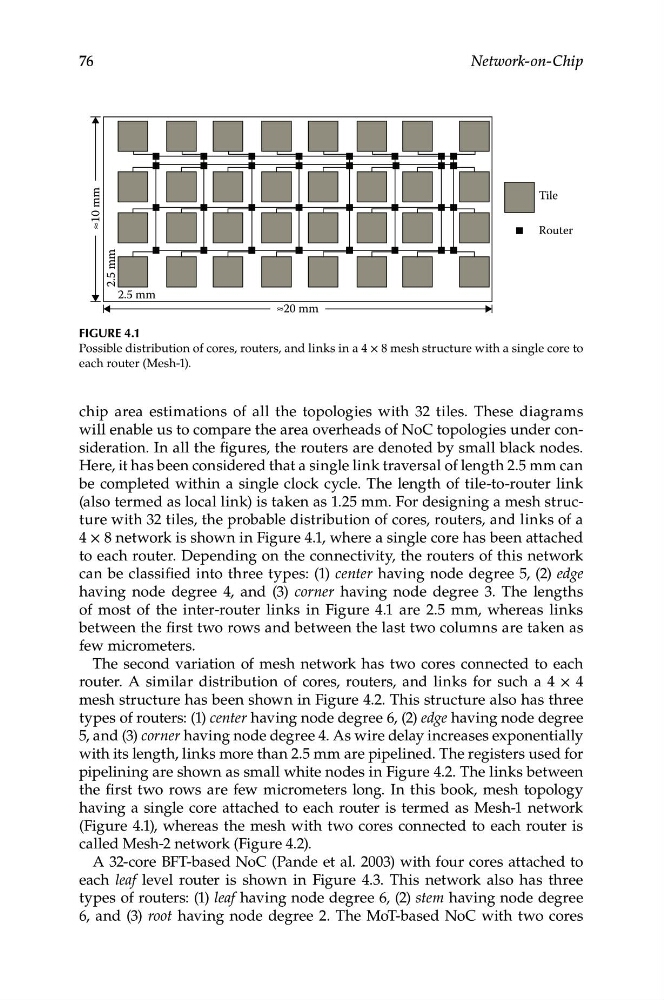
Figure 4.1
Possible distribution of cores, routers, and links in a 4 × 8 mesh structure with a single core to
each router (Mesh-1).
chip area estimations of all the topologies with 32 tiles. These diagrams
will enable us to compare the area overheads of NoC topologies under consideration. In all the figures, the routers are denoted by small black nodes.
Here, it has been considered that a single link traversal of length 2.5 mm can
be completed within a single clock cycle. The length of tile-to-router link
(also termed as local link) is taken as 1.25 mm. For designing a mesh structure with 32 tiles, the probable distribution of cores, routers, and links of a
4 × 8 network is shown in Figure 4.1, where a single core has been attached
to each router. Depending on the connectivity, the routers of this network
can be classified into three types: (1) center having node degree 5, (2) edge
having node degree 4, and (3) corner having node degree 3. The lengths
of most of the inter-router links in Figure 4.1 are 2.5 mm, whereas links
between the first two rows and between the last two columns are taken as
few micrometers.
The second variation of mesh network has two cores connected to each
router. A similar distribution of cores, routers, and links for such a 4 × 4
mesh structure has been shown in Figure 4.2. This structure also has three
types of routers: (1) center having node degree 6, (2) edge having node degree
5, and (3) corner having node degree 4. As wire delay increases exponentially
with its length, links more than 2.5 mm are pipelined. The registers used for
pipelining are shown as small white nodes in Figure 4.2. The links between
the first two rows are few micrometers long. In this book, mesh topology
having a single core attached to each router is termed as Mesh-1 network
(Figure 4.1), whereas the mesh with two cores connected to each router is
called Mesh-2 network (Figure 4.2).
A 32-core BFT-based NoC (Pande et al. 2003) with four cores attached to
each leaf level router is shown in Figure 4.3. This network also has three
types of routers: (1) leaf having node degree 6, (2) stem having node degree
6, and (3) root having node degree 2. The MoT-based NoC with two cores