

in-req1
in-req2
in-req3
R
R
flit1
o
u
flit2
o
u
flit3
t
t
in-val1
e
in-val2
e
in-val3
r
r
wr-clk1
1
wr-clk2
2
wr-clk3
rd-clk1
rd-clk2
57
Architecture Design of Network-on-Chip
3.4 GALS Style of Communication
The communication strategy in NoC follows the GALS style by using a
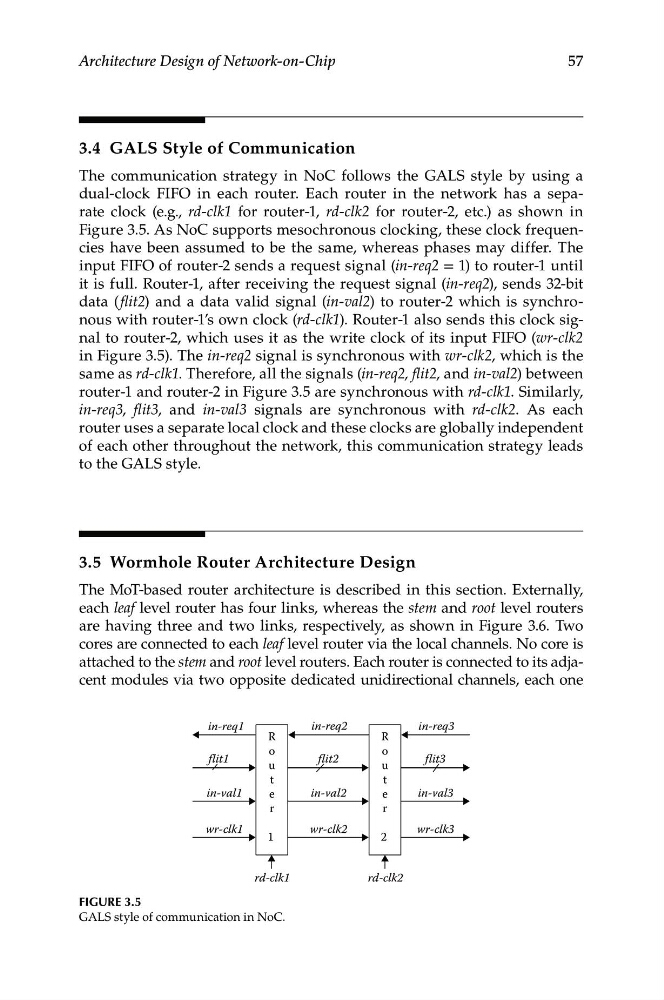
dual-clock FIFO in each router. Each router in the network has a separate clock (e.g., rd-clk1 for router-1, rd-clk2 for router-2, etc.) as shown in
Figure 3.5. As NoC supports mesochronous clocking, these clock frequencies have been assumed to be the same, whereas phases may differ. The
input FIFO of router-2 sends a request signal (in-req2 = 1) to router-1 until
it is full. Router-1, after receiving the request signal (in-req2), sends 32-bit
data (flit2) and a data valid signal (in-val2) to router-2 which is synchronous with router-1’s own clock (rd-clk1). Router-1 also sends this clock signal to router-2, which uses it as the write clock of its input FIFO (wr-clk2
in Figure 3.5). The in-req2 signal is synchronous with wr-clk2, which is the
same as rd-clk1. Therefore, all the signals (in-req2, flit2, and in-val2) between
router-1 and router-2 in Figure 3.5 are synchronous with rd-clk1. Similarly,
in-req3, flit3, and in-val3 signals are synchronous with rd-clk2. As each
router uses a separate local clock and these clocks are globally independent
of each other throughout the network, this communication strategy leads
to the GALS style.
3.5 Wormhole Router Architecture Design
The MoT-based router architecture is described in this section. Externally,
each leaf level router has four links, whereas the stem and root level routers
are having three and two links, respectively, as shown in Figure 3.6. Two
cores are connected to each leaf level router via the local channels. No core is
attached to the stem and root level routers. Each router is connected to its adjacent modules via two opposite dedicated unidirectional channels, each one
Figure 3.5
GALS style of communication in NoC.