

22
Network-on-Chip
IP
IP
IP
IP
IP
IP
IP
IP
IP
IP
IP
IP
IP
IP
IP
IP
IP
IP
IP
IP
IP
IP
IP
IP
IP
IP
IP
IP
IP
IP
IP
IP
IP
IP
IP
IP
IP
IP
IP
IP
IP
IP
IP
IP
IP
IP
IP
IP
IP
IP
IP
IP
IP
IP
IP
IP
IP
IP
IP
IP
IP
IP
R1
R1
R1
R1
R1
R2
R2
R1
R1
R1
R1
R2
R2
R1
R1
R2
R2
R3
R3
R3
R3
R2
R2
R1
R1
R1
R1
R1
IP
IP
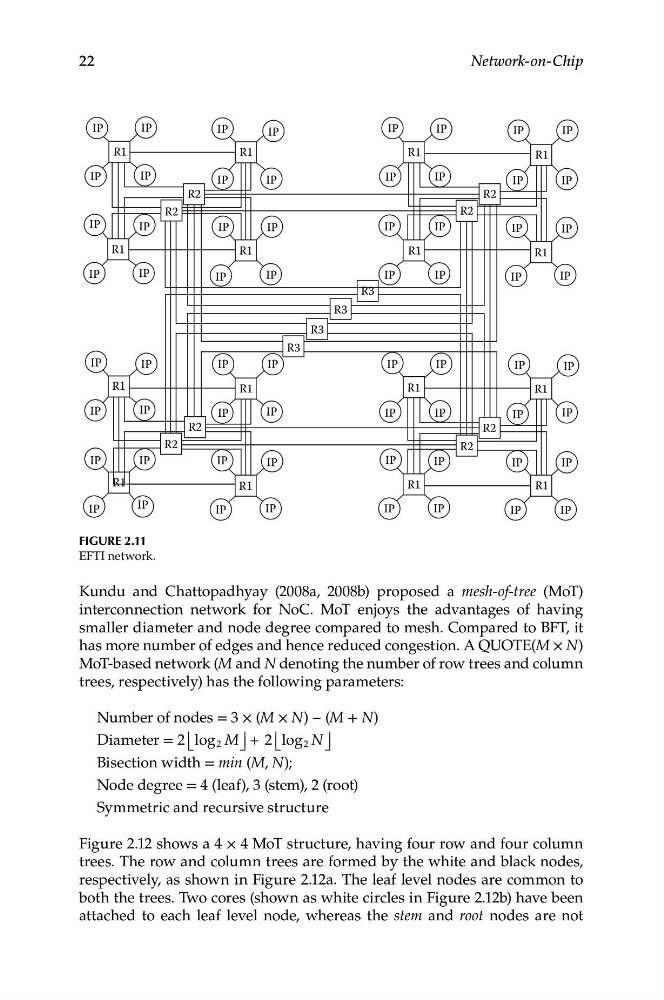
Figure 2.11
EFTI network.
Kundu and Chattopadhyay (2008a, 2008b) proposed a mesh-of-tree (MoT)
interconnection network for NoC. MoT enjoys the advantages of having
smaller diameter and node degree compared to mesh. Compared to BFT, it
has more number of edges and hence reduced congestion. A QUOTE(M × N)
MoT-based network (M and N denoting the number of row trees and column
trees, respectively) has the following parameters:
Number of nodes = 3 × (M × N) − (M + N)
Diameter = 2 ⎢ ⎣ log 2 M⎥ ⎦ + 2 ⎢ ⎣ log 2 N ⎥ ⎦
Bisection width = min (M, N);
Node degree = 4 (leaf), 3 (stem), 2 (root)
Symmetric and recursive structure
Figure 2.12 shows a 4 × 4 MoT structure, having four row and four column
trees. The row and column trees are formed by the white and black nodes,
respectively, as shown in Figure 2.12a. The leaf level nodes are common to
both the trees. Two cores (shown as white circles in Figure 2.12b) have been
attached to each leaf level node, whereas the stem and root nodes are not