

19
Interconnection Networks in Network-on-Chip
Number of routers required: 8 for N ≤ 8 or (8 + 7 ⌊N/8⌋) for N > 8
Node degree: 4 (member node), 7 (bridge node)
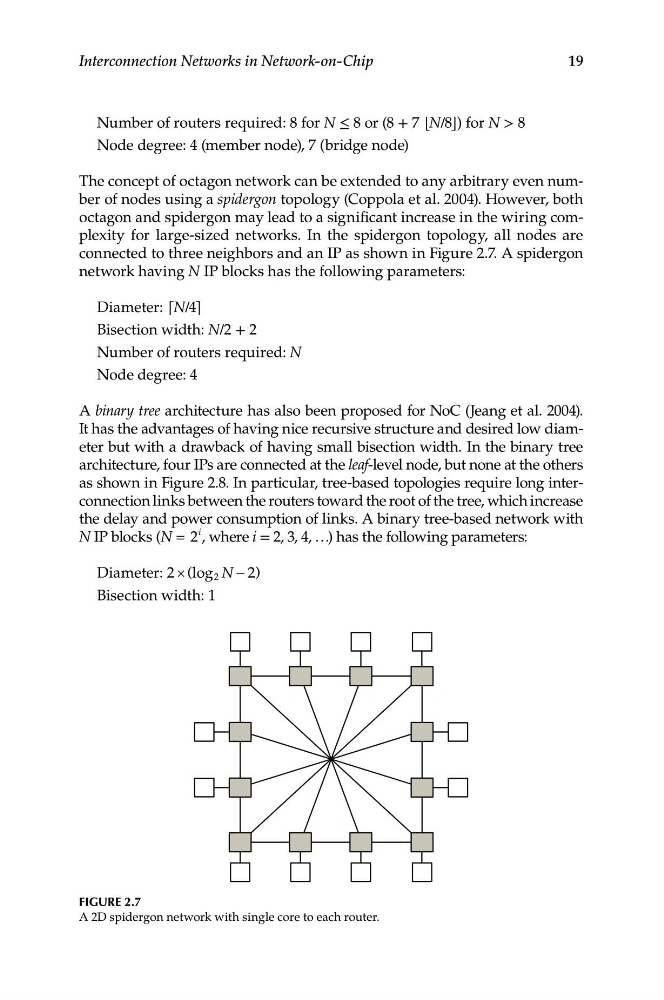
The concept of octagon network can be extended to any arbitrary even number of nodes using a spidergon topology (Coppola et al. 2004). However, both
octagon and spidergon may lead to a significant increase in the wiring complexity for large-sized networks. In the spidergon topology, all nodes are
connected to three neighbors and an IP as shown in Figure 2.7. A spidergon
network having N IP blocks has the following parameters:
Diameter: ⌈N/4⌉
Bisection width: N/2 + 2
Number of routers required: N
Node degree: 4
A binary tree architecture has also been proposed for NoC (Jeang et al. 2004).
It has the advantages of having nice recursive structure and desired low diameter but with a drawback of having small bisection width. In the binary tree
architecture, four IPs are connected at the leaf-level node, but none at the others
as shown in Figure 2.8. In particular, tree-based topologies require long interconnection links between the routers toward the root of the tree, which increase
the delay and power consumption of links. A binary tree-based network with
N IP blocks (N = 2
i , where i = 2, 3, 4, ...) has the following parameters:
Diameter: 2 × (log 2 N − 2)
Bisection width: 1
Figure 2.7
A 2D spidergon network with single core to each router.