

348
Network-on-Chip
TABLe 11.9
Average Energy Consumption per Packet at Saturation by Different Network
Structures Connecting 32 Cores at 2D and 3D Platforms
Average Energy per Packet (nJ) at Saturation
Locality
Locality
Locality
Locality
Factor = 0.0
Factor = 0.3
Factor = 0.5
Factor = 0.8
Networks 2D
3D
2D
3D
2D
3D
2D
3D
Mesh-1
5.15
3.01
4.48
2.76
3.85
2.63
2.92
2.21
Mesh-2
4.02
2.79
3.32
2.41
3.05
2.07
2.02
1.72
BFT
4.47
3.03
3.97
2.91
3.42
2.54
2.54
2.09
MoT
4.52
2.77
3.69
2.38
3.30
2.18
2.27
1.74
consumption per packet reception is a meaningful metric while comparing
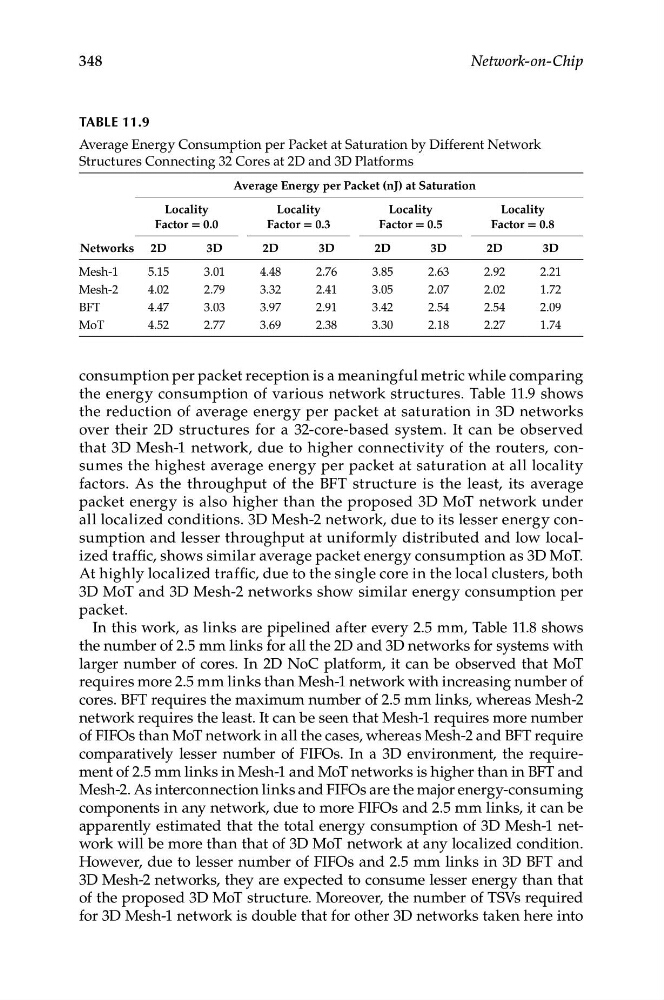
the energy consumption of various network structures. Table 11.9 shows
the reduction of average energy per packet at saturation in 3D networks
over their 2D structures for a 32-core-based system. It can be observed
that 3D Mesh-1 network, due to higher connectivity of the routers, consumes the highest average energy per packet at saturation at all locality
factors. As the throughput of the BFT structure is the least, its average
packet energy is also higher than the proposed 3D MoT network under
all localized conditions. 3D Mesh-2 network, due to its lesser energy consumption and lesser throughput at uniformly distributed and low localized traffic, shows similar average packet energy consumption as 3D MoT.
At highly localized traffic, due to the single core in the local clusters, both
3D MoT and 3D Mesh-2 networks show similar energy consumption per
packet.
In this work, as links are pipelined after every 2.5 mm, Table 11.8 shows
the number of 2.5 mm links for all the 2D and 3D networks for systems with
larger number of cores. In 2D NoC platform, it can be observed that MoT
requires more 2.5 mm links than Mesh-1 network with increasing number of
cores. BFT requires the maximum number of 2.5 mm links, whereas Mesh-2
network requires the least. It can be seen that Mesh-1 requires more number
of FIFOs than MoT network in all the cases, whereas Mesh-2 and BFT require
comparatively lesser number of FIFOs. In a 3D environment, the requirement of 2.5 mm links in Mesh-1 and MoT networks is higher than in BFT and
Mesh-2. As interconnection links and FIFOs are the major energy-consuming
components in any network, due to more FIFOs and 2.5 mm links, it can be
apparently estimated that the total energy consumption of 3D Mesh-1 network will be more than that of 3D MoT network at any localized condition.
However, due to lesser number of FIFOs and 2.5 mm links in 3D BFT and
3D Mesh-2 networks, they are expected to consume lesser energy than that
of the proposed 3D MoT structure. Moreover, the number of TSVs required
for 3D Mesh-1 network is double that for other 3D networks taken here into