

Networks
Number of Inter-Router Links
Few Micrometers
≈2.5 mm
2D
3D
2D
3D
64 Cores
Number
of TSVs
Number of FIFOs
2D
3D
Mesh-1
32
64
192
128
96
288
352
Mesh-2
8
16
136
96
48
168
192
BFT
0
0
256
64
48
160
160
MoT
64
96
192
96
48
272
272
128 Cores
Mesh-1
48
96
416
320
192
592
736
Mesh-2
16
32
320
256
96
352
416
BFT
0
0
640
256
96
352
336
MoT
128
192
512
320
96
576
672
347
Three-Dimensional Integration of Network-on-Chip
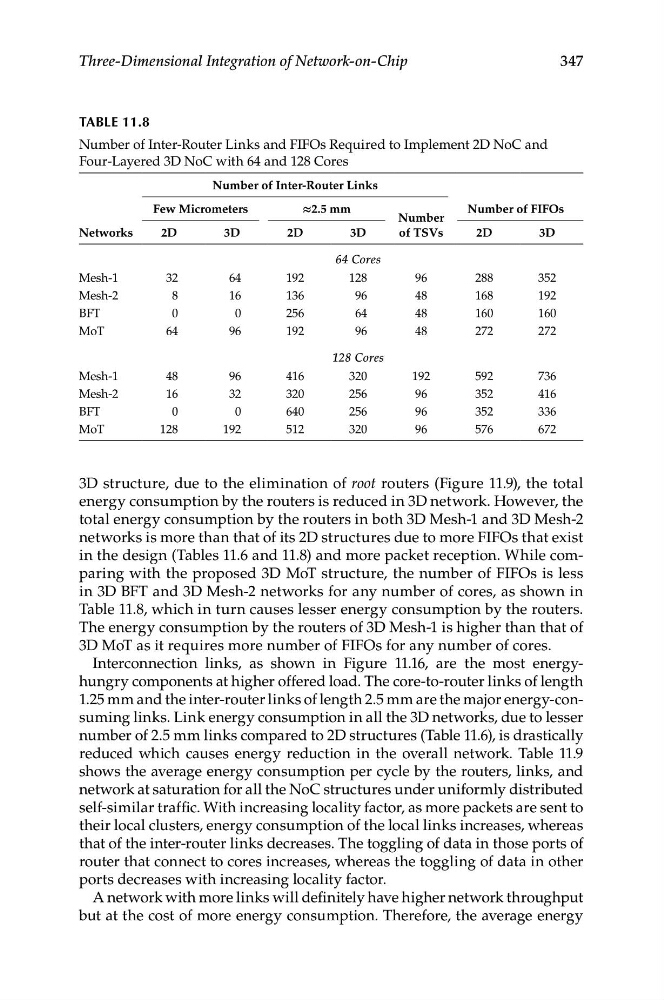
TABLe 11.8
Number of Inter-Router Links and FIFOs Required to Implement 2D NoC and
Four-Layered 3D NoC with 64 and 128 Cores
3D structure, due to the elimination of root routers (Figure 11.9), the total
energy consumption by the routers is reduced in 3D network. However, the
total energy consumption by the routers in both 3D Mesh-1 and 3D Mesh-2
networks is more than that of its 2D structures due to more FIFOs that exist
in the design (Tables 11.6 and 11.8) and more packet reception. While comparing with the proposed 3D MoT structure, the number of FIFOs is less
in 3D BFT and 3D Mesh-2 networks for any number of cores, as shown in
Table 11.8, which in turn causes lesser energy consumption by the routers.
The energy consumption by the routers of 3D Mesh-1 is higher than that of
3D MoT as it requires more number of FIFOs for any number of cores.
Interconnection links, as shown in Figure 11.16, are the most energyhungry components at higher offered load. The core-to-router links of length
1.25 mm and the inter-router links of length 2.5 mm are the major energy-consuming links. Link energy consumption in all the 3D networks, due to lesser
number of 2.5 mm links compared to 2D structures (Table 11.6), is drastically
reduced which causes energy reduction in the overall network. Table 11.9
shows the average energy consumption per cycle by the routers, links, and
network at saturation for all the NoC structures under uniformly distributed
self-similar traffic. With increasing locality factor, as more packets are sent to
their local clusters, energy consumption of the local links increases, whereas
that of the inter-router links decreases. The toggling of data in those ports of
router that connect to cores increases, whereas the toggling of data in other
ports decreases with increasing locality factor.
A network with more links will definitely have higher network throughput
but at the cost of more energy consumption. Therefore, the average energy