

340
Network-on-Chip
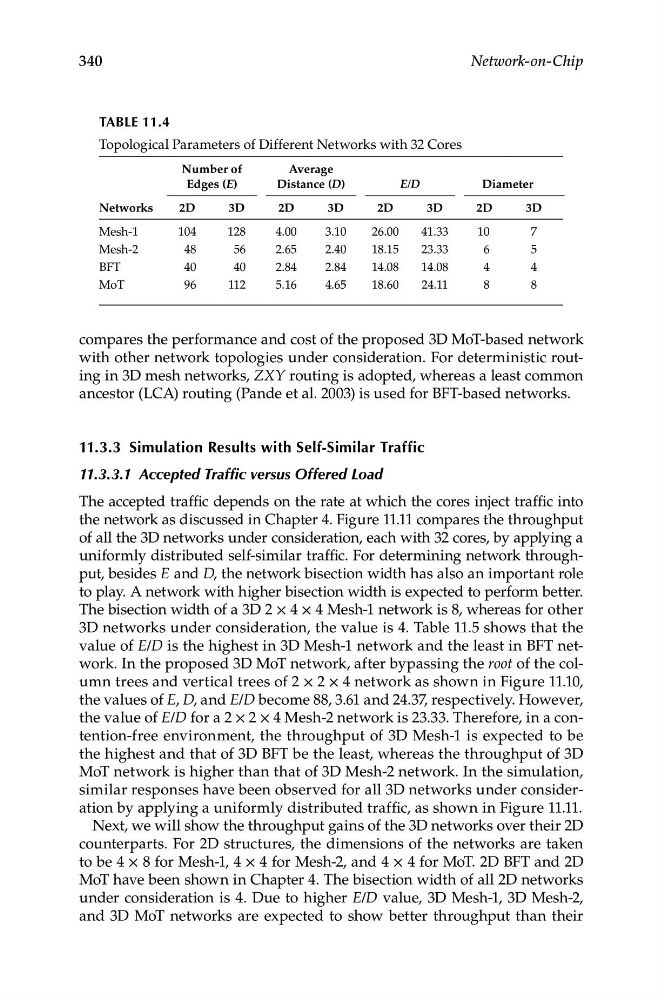
TABLe 11.4
Topological Parameters of Different Networks with 32 Cores
Number of
Edges (E)
Average
Distance (D)
E/D
Diameter
Networks
2D
3D
2D
3D
2D
3D
2D
3D
Mesh-1
104
128
4.00
3.10
26.00
41.33
10
7
Mesh-2
48
56
2.65
2.40
18.15
23.33
6
5
BFT
40
40
2.84
2.84
14.08
14.08
4
4
MoT
96
112
5.16
4.65
18.60
24.11
8
8
compares the performance and cost of the proposed 3D MoT-based network
with other network topologies under consideration. For deterministic routing in 3D mesh networks, ZXY routing is adopted, whereas a least common
ancestor (LCA) routing (Pande et al. 2003) is used for BFT-based networks.
11.3.3 Simulation results with Self-Similar Traffic
11.3.3.1 Accepted Traffic versus Offered Load
The accepted traffic depends on the rate at which the cores inject traffic into
the network as discussed in Chapter 4. Figure 11.11 compares the throughput
of all the 3D networks under consideration, each with 32 cores, by applying a
uniformly distributed self-similar traffic. For determining network throughput, besides E and D, the network bisection width has also an important role
to play. A network with higher bisection width is expected to perform better.
The bisection width of a 3D 2 × 4 × 4 Mesh-1 network is 8, whereas for other
3D networks under consideration, the value is 4. Table 11.5 shows that the
value of E/D is the highest in 3D Mesh-1 network and the least in BFT network. In the proposed 3D MoT network, after bypassing the root of the column trees and vertical trees of 2 × 2 × 4 network as shown in Figure 11.10,
the values of E, D, and E/D become 88, 3.61 and 24.37, respectively. However,
the value of E/D for a 2 × 2 × 4 Mesh-2 network is 23.33. Therefore, in a contention-free environment, the throughput of 3D Mesh-1 is expected to be
the highest and that of 3D BFT be the least, whereas the throughput of 3D
MoT network is higher than that of 3D Mesh-2 network. In the simulation,
similar responses have been observed for all 3D networks under consideration by applying a uniformly distributed traffic, as shown in Figure 11.11.
Next, we will show the throughput gains of the 3D networks over their 2D
counterparts. For 2D structures, the dimensions of the networks are taken
to be 4 × 8 for Mesh-1, 4 × 4 for Mesh-2, and 4 × 4 for MoT. 2D BFT and 2D
MoT have been shown in Chapter 4. The bisection width of all 2D networks
under consideration is 4. Due to higher E/D value, 3D Mesh-1, 3D Mesh-2,
and 3D MoT networks are expected to show better throughput than their