

323
Three-Dimensional Integration of Network-on-Chip
11.3 Design and Evaluation of 3D NoC Architecture
Similar to 2D NoC, mesh topology is a popular network structure in 3D
NoC. Pavlidis and Friedman (2007) showed a different NoC architecture on
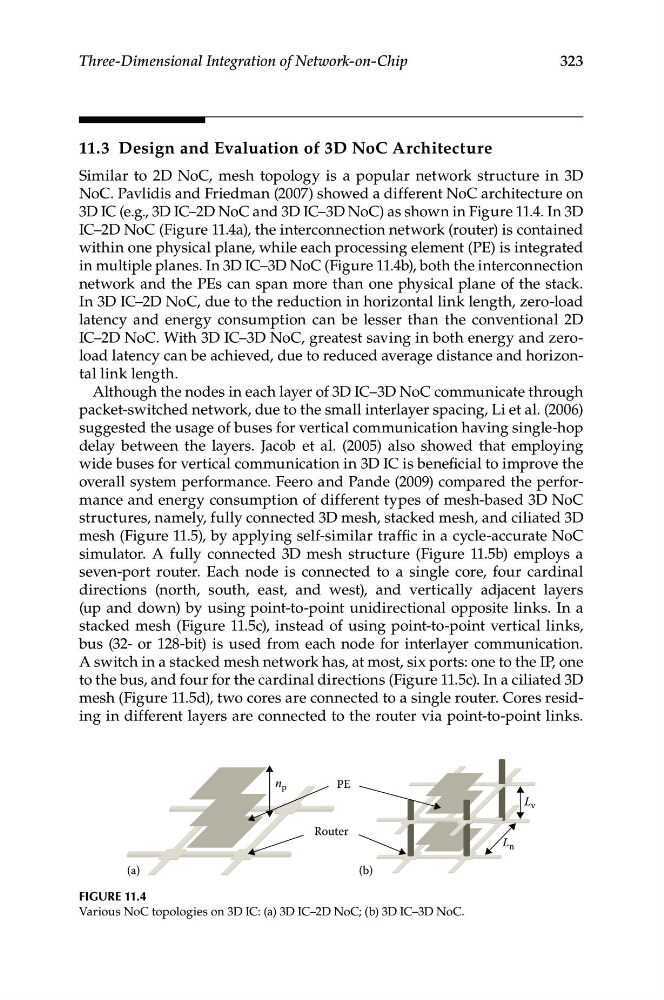
3D IC (e.g., 3D IC–2D NoC and 3D IC–3D NoC) as shown in Figure 11.4. In 3D
IC–2D NoC (Figure 11.4a), the interconnection network (router) is contained
within one physical plane, while each processing element (PE) is integrated
in multiple planes. In 3D IC–3D NoC (Figure 11.4b), both the interconnection
network and the PEs can span more than one physical plane of the stack.
In 3D IC–2D NoC, due to the reduction in horizontal link length, zero-load
latency and energy consumption can be lesser than the conventional 2D
IC–2D NoC. With 3D IC–3D NoC, greatest saving in both energy and zeroload latency can be achieved, due to reduced average distance and horizontal link length.
Although the nodes in each layer of 3D IC–3D NoC communicate through
packet-switched network, due to the small interlayer spacing, Li et al. (2006)
suggested the usage of buses for vertical communication having single-hop
delay between the layers. Jacob et al. (2005) also showed that employing
wide buses for vertical communication in 3D IC is beneficial to improve the
overall system performance. Feero and Pande (2009) compared the performance and energy consumption of different types of mesh-based 3D NoC
structures, namely, fully connected 3D mesh, stacked mesh, and ciliated 3D
mesh (Figure 11.5), by applying self-similar traffic in a cycle-accurate NoC
simulator. A fully connected 3D mesh structure (Figure 11.5b) employs a
seven-port router. Each node is connected to a single core, four cardinal
directions (north, south, east, and west), and vertically adjacent layers
(up and down) by using point-to-point unidirectional opposite links. In a
stacked mesh (Figure 11.5c), instead of using point-to-point vertical links,
bus (32- or 128-bit) is used from each node for interlayer communication.
A switch in a stacked mesh network has, at most, six ports: one to the IP, one
to the bus, and four for the cardinal directions (Figure 11.5c). In a ciliated 3D
mesh (Figure 11.5d), two cores are connected to a single router. Cores residing in different layers are connected to the router via point-to-point links.
(a)
(b)
Router
PE
n p
L n
L v
Figure 11.4
Various NoC topologies on 3D IC: (a) 3D IC–2D NoC; (b) 3D IC–3D NoC.