

R1
MUX
MUX
MUX
MUX
MUX
MUX
MUX
MUX
MUX
MUX
MUX
MUX
MUX
MUX
MUX
MUX
MUX
R5
R2
R3
R4
R8
To R3
To R4
To R15
To R16
To R7
To R8
: Core
R7
R6
R9
R12
R11
R10
R13
R16
R15
R14
MUX
MUX
293
Reconfigurable Network-on-Chip Design
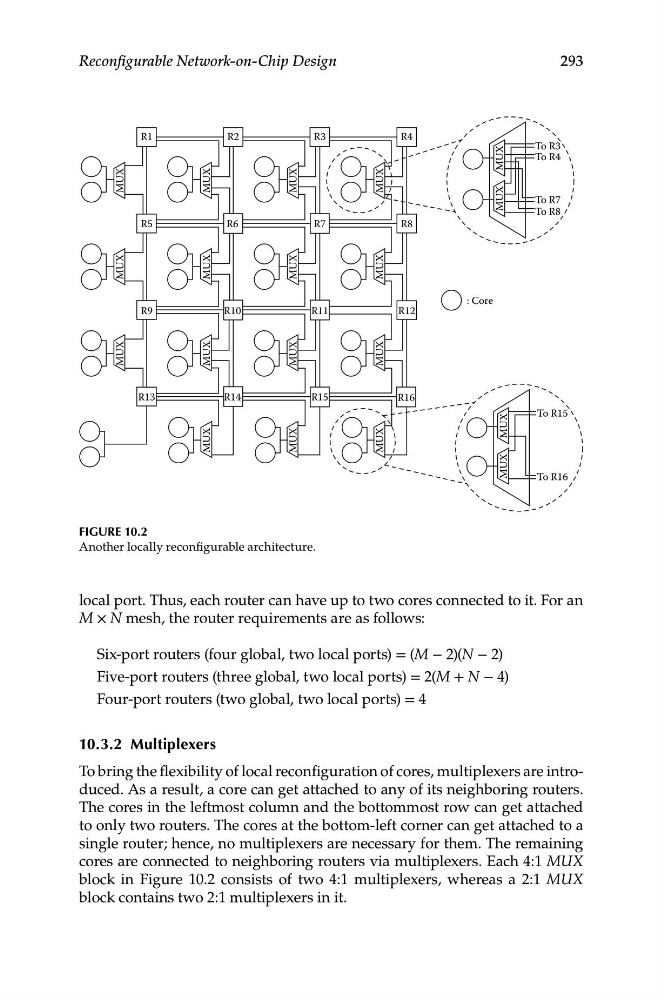
Figure 10.2
Another locally reconfigurable architecture.
local port. Thus, each router can have up to two cores connected to it. For an
M × N mesh, the router requirements are as follows:
Six-port routers (four global, two local ports) = (M − 2)(N − 2)
Five-port routers (three global, two local ports) = 2(M + N − 4)
Four-port routers (two global, two local ports) = 4
10.3.2 Multiplexers
To bring the flexibility of local reconfiguration of cores, multiplexers are introduced. As a result, a core can get attached to any of its neighboring routers.
The cores in the leftmost column and the bottommost row can get attached
to only two routers. The cores at the bottom-left corner can get attached to a
single router; hence, no multiplexers are necessary for them. The remaining
cores are connected to neighboring routers via multiplexers. Each 4:1 MUX
block in Figure 10.2 consists of two 4:1 multiplexers, whereas a 2:1 MUX
block contains two 2:1 multiplexers in it.