

R1
MUX
MUX
MUX
MUX
MUX
MUX
MUX
MUX
MUX
MUX
MUX
MUX
MUX
MUX
MUX
R5
R2
R3
R4
R8
R7
R6
R9
R12
R11
R10
R13
R16
R16
R14
: Core cluster
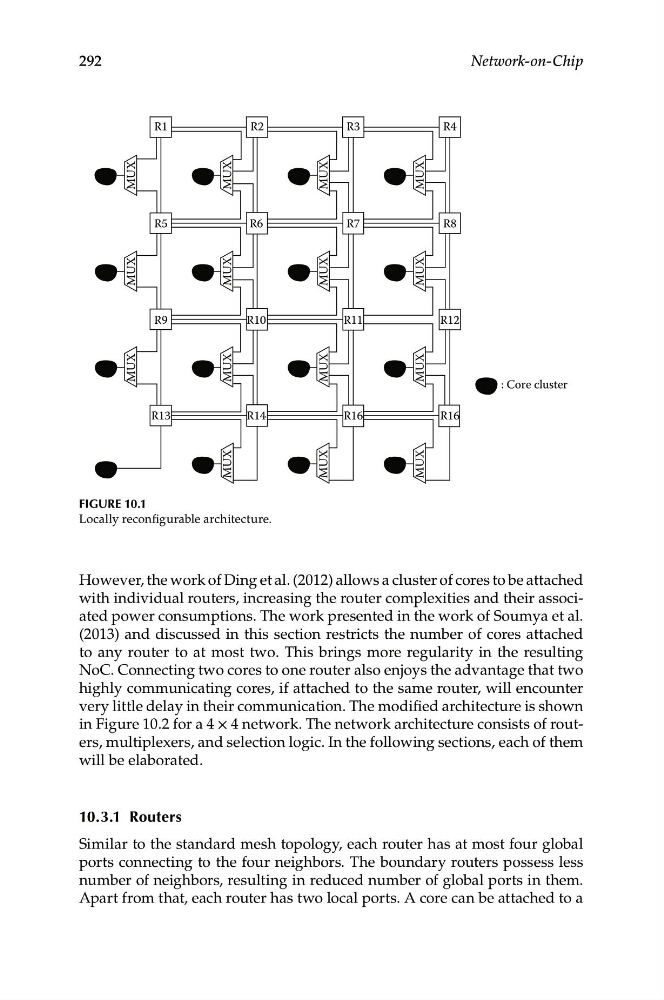
Figure 10.1
Locally reconfigurable architecture.
292
Network-on-Chip
However, the work of Ding et al. (2012) allows a cluster of cores to be attached
with individual routers, increasing the router complexities and their associated power consumptions. The work presented in the work of Soumya et al.
(2013) and discussed in this section restricts the number of cores attached
to any router to at most two. This brings more regularity in the resulting
NoC. Connecting two cores to one router also enjoys the advantage that two
highly communicating cores, if attached to the same router, will encounter
very little delay in their communication. The modified architecture is shown
in Figure 10.2 for a 4 × 4 network. The network architecture consists of routers, multiplexers, and selection logic. In the following sections, each of them
will be elaborated.
10.3.1 routers
Similar to the standard mesh topology, each router has at most four global
ports connecting to the four neighbors. The boundary routers possess less
number of neighbors, resulting in reduced number of global ports in them.
Apart from that, each router has two local ports. A core can be attached to a