

7
Introduction
the designer can quickly proceed to accurate estimation of area and power
consumption of the network, as it can be a significant portion of the overall
SoC cost budget.
The fourth dimension of research is related to application mapping. Mapping
of cores with regular and irregular sizes onto an underlying NoC platform
to achieve the required performance for a specific application is the major
issue of this dimension. Performance and energy-aware task scheduling for
heterogeneous NoC is another important problem of this class of research.
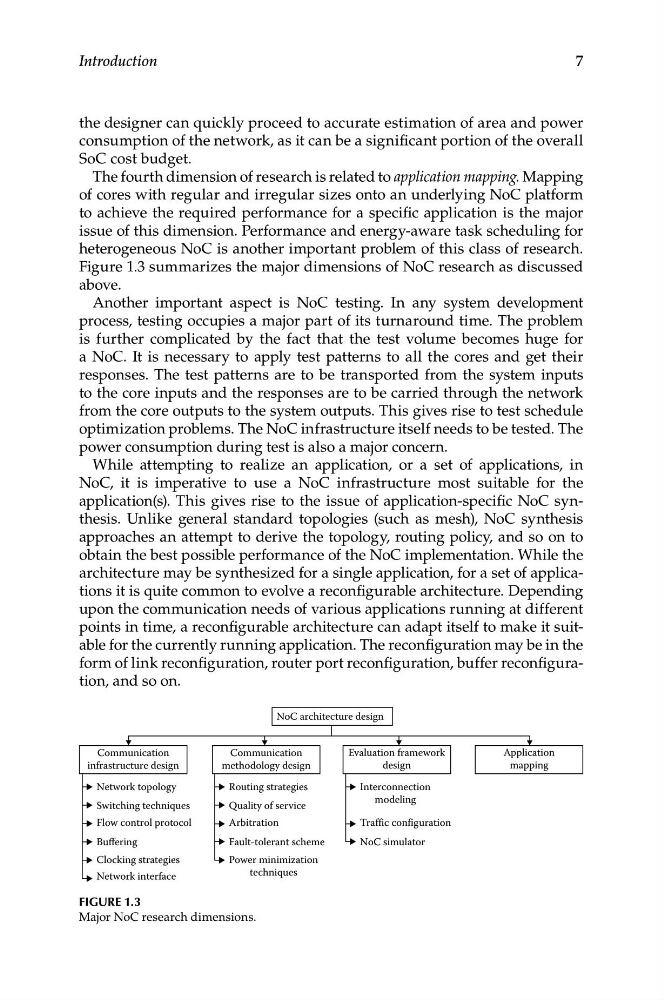
Figure 1.3 summarizes the major dimensions of NoC research as discussed
above.
Another important aspect is NoC testing. In any system development
process, testing occupies a major part of its turnaround time. The problem
is further complicated by the fact that the test volume becomes huge for
a NoC. It is necessary to apply test patterns to all the cores and get their
responses. The test patterns are to be transported from the system inputs
to the core inputs and the responses are to be carried through the network
from the core outputs to the system outputs. This gives rise to test schedule
optimization problems. The NoC infrastructure itself needs to be tested. The
power consumption during test is also a major concern.
While attempting to realize an application, or a set of applications, in
NoC, it is imperative to use a NoC infrastructure most suitable for the
application(s). This gives rise to the issue of application-specific NoC synthesis. Unlike general standard topologies (such as mesh), NoC synthesis
approaches an attempt to derive the topology, routing policy, and so on to
obtain the best possible performance of the NoC implementation. While the
architecture may be synthesized for a single application, for a set of applications it is quite common to evolve a reconfigurable architecture. Depending
upon the communication needs of various applications running at different
points in time, a reconfigurable architecture can adapt itself to make it suitable for the currently running application. The reconfiguration may be in the
form of link reconfiguration, router port reconfiguration, buffer reconfiguration, and so on.
Communication
infrastructure design
Communication
methodology design
NoC architecture design
Evaluation framework
design
Application
mapping
Network topology
Routing strategies
Interconnection
modeling
Traffic configuration
NoC simulator
Quality of service
Arbitration
Fault-tolerant scheme
Power minimization
techniques
Switching techniques
Flow control protocol
Buffering
Clocking strategies
Network interface
Figure 1.3
Major NoC research dimensions.
Introduction
the designer can quickly proceed to accurate estimation of area and power
consumption of the network, as it can be a significant portion of the overall
SoC cost budget.
The fourth dimension of research is related to application mapping. Mapping
of cores with regular and irregular sizes onto an underlying NoC platform
to achieve the required performance for a specific application is the major
issue of this dimension. Performance and energy-aware task scheduling for
heterogeneous NoC is another important problem of this class of research.
Figure 1.3 summarizes the major dimensions of NoC research as discussed
above.
Another important aspect is NoC testing. In any system development
process, testing occupies a major part of its turnaround time. The problem
is further complicated by the fact that the test volume becomes huge for
a NoC. It is necessary to apply test patterns to all the cores and get their
responses. The test patterns are to be transported from the system inputs
to the core inputs and the responses are to be carried through the network
from the core outputs to the system outputs. This gives rise to test schedule
optimization problems. The NoC infrastructure itself needs to be tested. The
power consumption during test is also a major concern.
While attempting to realize an application, or a set of applications, in
NoC, it is imperative to use a NoC infrastructure most suitable for the
application(s). This gives rise to the issue of application-specific NoC synthesis. Unlike general standard topologies (such as mesh), NoC synthesis
approaches an attempt to derive the topology, routing policy, and so on to
obtain the best possible performance of the NoC implementation. While the
architecture may be synthesized for a single application, for a set of applications it is quite common to evolve a reconfigurable architecture. Depending
upon the communication needs of various applications running at different
points in time, a reconfigurable architecture can adapt itself to make it suitable for the currently running application. The reconfiguration may be in the
form of link reconfiguration, router port reconfiguration, buffer reconfiguration, and so on.
Communication
infrastructure design
Communication
methodology design
NoC architecture design
Evaluation framework
design
Application
mapping
Network topology
Routing strategies
Interconnection
modeling
Traffic configuration
NoC simulator
Quality of service
Arbitration
Fault-tolerant scheme
Power minimization
techniques
Switching techniques
Flow control protocol
Buffering
Clocking strategies
Network interface
Figure 1.3
Major NoC research dimensions.