

230
Network-on-Chip
For smaller values of є, the above expression converges to P
9
burst word error ≈ 56∈ .
At this point, the metric of interest is the energy reduction due to coding
techniques compared to the uncoded case. Different coding schemes have
different number of bits after encoding. Hence, a fair comparison in terms
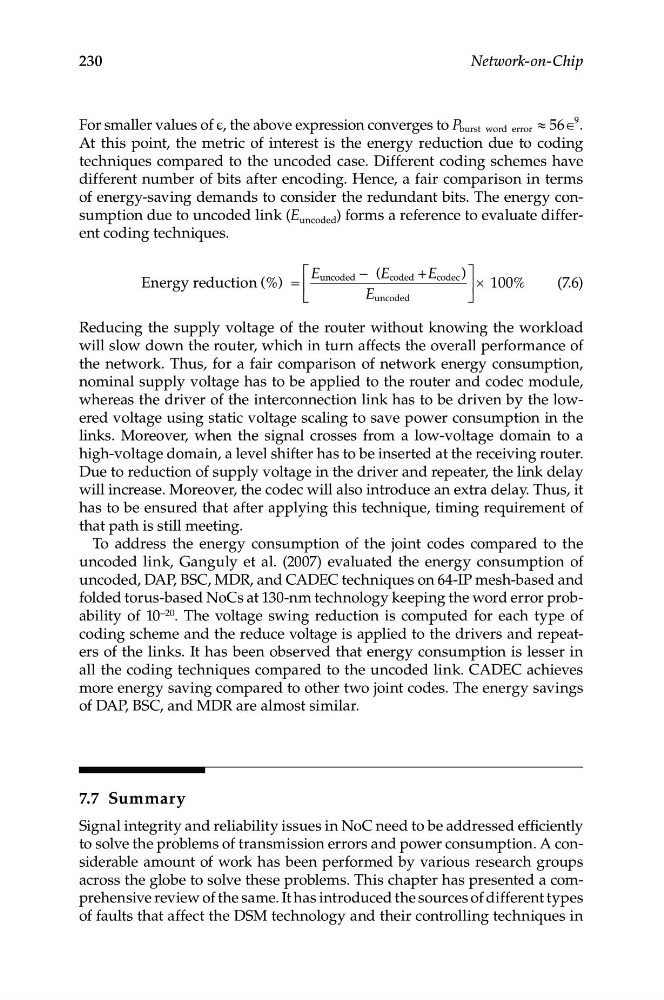
of energy-saving demands to consider the redundant bits. The energy consumption due to uncoded link (E uncoded ) forms a reference to evaluate different coding techniques.
⎡ E
%
uncoded − (E
Energy reduction ( ) =
coded + E codec ) ⎤ ×
⎢ ⎢
⎥ 100%
(7.6)
⎣
E uncoded
⎦
Reducing the supply voltage of the router without knowing the workload
will slow down the router, which in turn affects the overall performance of
the network. Thus, for a fair comparison of network energy consumption,
nominal supply voltage has to be applied to the router and codec module,
whereas the driver of the interconnection link has to be driven by the lowered voltage using static voltage scaling to save power consumption in the
links. Moreover, when the signal crosses from a low-voltage domain to a
high-voltage domain, a level shifter has to be inserted at the receiving router.
Due to reduction of supply voltage in the driver and repeater, the link delay
will increase. Moreover, the codec will also introduce an extra delay. Thus, it
has to be ensured that after applying this technique, timing requirement of
that path is still meeting.
To address the energy consumption of the joint codes compared to the
uncoded link, Ganguly et al. (2007) evaluated the energy consumption of
uncoded, DAP, BSC, MDR, and CADEC techniques on 64-IP mesh-based and
folded torus-based NoCs at 130-nm technology keeping the word error probability of 10 –20 . The voltage swing reduction is computed for each type of
coding scheme and the reduce voltage is applied to the drivers and repeaters of the links. It has been observed that energy consumption is lesser in
all the coding techniques compared to the uncoded link. CADEC achieves
more energy saving compared to other two joint codes. The energy savings
of DAP, BSC, and MDR are almost similar.
7.7 Summary
Signal integrity and reliability issues in NoC need to be addressed efficiently
to solve the problems of transmission errors and power consumption. A considerable amount of work has been performed by various research groups
across the globe to solve these problems. This chapter has presented a comprehensive review of the same. It has introduced the sources of different types
of faults that affect the DSM technology and their controlling techniques in
Network-on-Chip
For smaller values of є, the above expression converges to P
9
burst word error ≈ 56∈ .
At this point, the metric of interest is the energy reduction due to coding
techniques compared to the uncoded case. Different coding schemes have
different number of bits after encoding. Hence, a fair comparison in terms
of energy-saving demands to consider the redundant bits. The energy consumption due to uncoded link (E uncoded ) forms a reference to evaluate different coding techniques.
⎡ E
%
uncoded − (E
Energy reduction ( ) =
coded + E codec ) ⎤ ×
⎢ ⎢
⎥ 100%
(7.6)
⎣
E uncoded
⎦
Reducing the supply voltage of the router without knowing the workload
will slow down the router, which in turn affects the overall performance of
the network. Thus, for a fair comparison of network energy consumption,
nominal supply voltage has to be applied to the router and codec module,
whereas the driver of the interconnection link has to be driven by the lowered voltage using static voltage scaling to save power consumption in the
links. Moreover, when the signal crosses from a low-voltage domain to a
high-voltage domain, a level shifter has to be inserted at the receiving router.
Due to reduction of supply voltage in the driver and repeater, the link delay
will increase. Moreover, the codec will also introduce an extra delay. Thus, it
has to be ensured that after applying this technique, timing requirement of
that path is still meeting.
To address the energy consumption of the joint codes compared to the
uncoded link, Ganguly et al. (2007) evaluated the energy consumption of
uncoded, DAP, BSC, MDR, and CADEC techniques on 64-IP mesh-based and
folded torus-based NoCs at 130-nm technology keeping the word error probability of 10 –20 . The voltage swing reduction is computed for each type of
coding scheme and the reduce voltage is applied to the drivers and repeaters of the links. It has been observed that energy consumption is lesser in
all the coding techniques compared to the uncoded link. CADEC achieves
more energy saving compared to other two joint codes. The energy savings
of DAP, BSC, and MDR are almost similar.
7.7 Summary
Signal integrity and reliability issues in NoC need to be addressed efficiently
to solve the problems of transmission errors and power consumption. A considerable amount of work has been performed by various research groups
across the globe to solve these problems. This chapter has presented a comprehensive review of the same. It has introduced the sources of different types
of faults that affect the DSM technology and their controlling techniques in