

0
1
One set of 38 bits Parity from
77-bit input
38
38
38
38
38
38
38
Syndrome
detection
38
38
38
1
1
0
(38,32)
Hamming
decoder
0
Duplicating set
of 38 bits
first copy, p1
Parity from
second copy, p2
Hamming
encoding
32-bit input
38
Parity, bit 76
bit 1
(38,32)
77-bit output
38
32
Duplicating each bit
Hamming
encoding
DAP duplication
bit 0
bit 2
bit 3
bit 4
bit 5
bit 6
bit 7
bit 74
bit 75
(a)
Sent
parity, p0
Stage I
Stage II
32-bit
output
(b)
226
Network-on-Chip
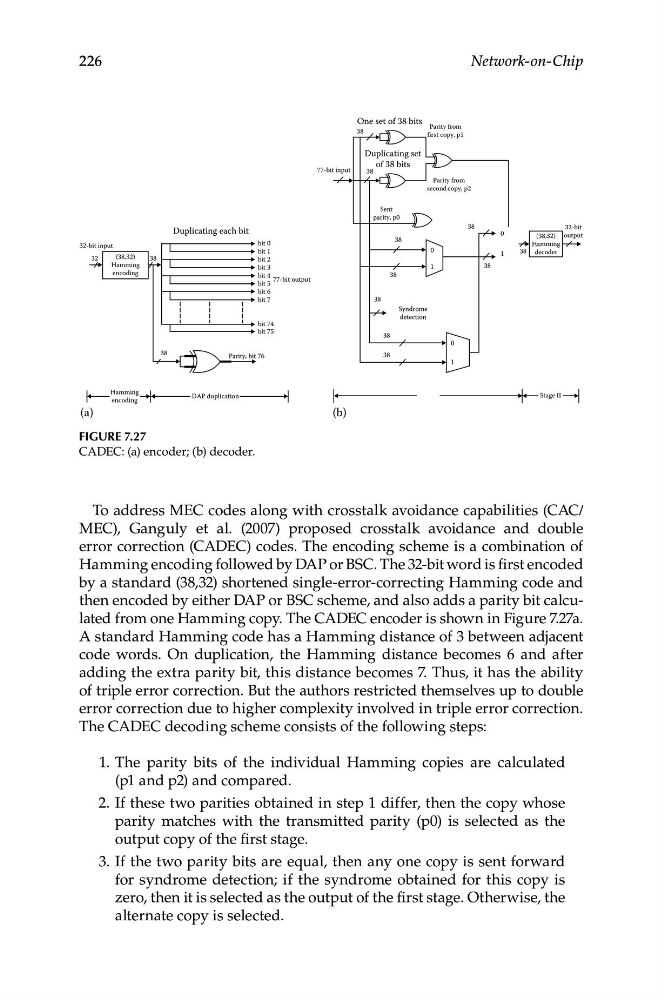
Figure 7.27
CADEC: (a) encoder; (b) decoder.
To address MEC codes along with crosstalk avoidance capabilities (CAC/
MEC), Ganguly et al. (2007) proposed crosstalk avoidance and double
error correction (CADEC) codes. The encoding scheme is a combination of
Hamming encoding followed by DAP or BSC. The 32-bit word is first encoded
by a standard (38,32) shortened single-error-correcting Hamming code and
then encoded by either DAP or BSC scheme, and also adds a parity bit calculated from one Hamming copy. The CADEC encoder is shown in Figure 7.27a.
A standard Hamming code has a Hamming distance of 3 between adjacent
code words. On duplication, the Hamming distance becomes 6 and after
adding the extra parity bit, this distance becomes 7. Thus, it has the ability
of triple error correction. But the authors restricted themselves up to double
error correction due to higher complexity involved in triple error correction.
The CADEC decoding scheme consists of the following steps:
1. The parity bits of the individual Hamming copies are calculated
(p1 and p2) and compared.
2. If these two parities obtained in step 1 differ, then the copy whose
parity matches with the transmitted parity (p0) is selected as the
output copy of the first stage.
3. If the two parity bits are equal, then any one copy is sent forward
for syndrome detection; if the syndrome obtained for this copy is
zero, then it is selected as the output of the first stage. Otherwise, the
alternate copy is selected.
1
One set of 38 bits Parity from
77-bit input
38
38
38
38
38
38
38
Syndrome
detection
38
38
38
1
1
0
(38,32)
Hamming
decoder
0
Duplicating set
of 38 bits
first copy, p1
Parity from
second copy, p2
Hamming
encoding
32-bit input
38
Parity, bit 76
bit 1
(38,32)
77-bit output
38
32
Duplicating each bit
Hamming
encoding
DAP duplication
bit 0
bit 2
bit 3
bit 4
bit 5
bit 6
bit 7
bit 74
bit 75
(a)
Sent
parity, p0
Stage I
Stage II
32-bit
output
(b)
226
Network-on-Chip
Figure 7.27
CADEC: (a) encoder; (b) decoder.
To address MEC codes along with crosstalk avoidance capabilities (CAC/
MEC), Ganguly et al. (2007) proposed crosstalk avoidance and double
error correction (CADEC) codes. The encoding scheme is a combination of
Hamming encoding followed by DAP or BSC. The 32-bit word is first encoded
by a standard (38,32) shortened single-error-correcting Hamming code and
then encoded by either DAP or BSC scheme, and also adds a parity bit calculated from one Hamming copy. The CADEC encoder is shown in Figure 7.27a.
A standard Hamming code has a Hamming distance of 3 between adjacent
code words. On duplication, the Hamming distance becomes 6 and after
adding the extra parity bit, this distance becomes 7. Thus, it has the ability
of triple error correction. But the authors restricted themselves up to double
error correction due to higher complexity involved in triple error correction.
The CADEC decoding scheme consists of the following steps:
1. The parity bits of the individual Hamming copies are calculated
(p1 and p2) and compared.
2. If these two parities obtained in step 1 differ, then the copy whose
parity matches with the transmitted parity (p0) is selected as the
output copy of the first stage.
3. If the two parity bits are equal, then any one copy is sent forward
for syndrome detection; if the syndrome obtained for this copy is
zero, then it is selected as the output of the first stage. Otherwise, the
alternate copy is selected.