

224
Network-on-Chip
Parity
b 0
b 0
b 1
b 1
b k−1
b k−1
BI
(a)
(b)
Metric
computation
Encoder
Duplication
Parity
Odd
Parity
2:1
MUX
2:1
MUX
2:1
MUX
Decoder
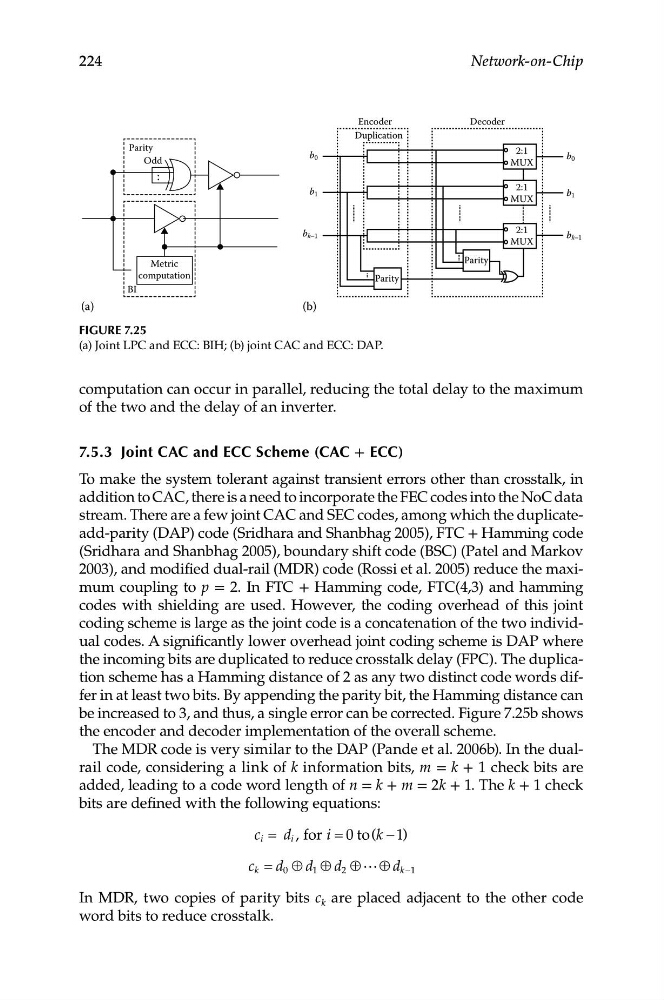
Figure 7.25
(a) Joint LPC and ECC: BIH; (b) joint CAC and ECC: DAP.
computation can occur in parallel, reducing the total delay to the maximum
of the two and the delay of an inverter.
7.5.3 Joint CAC and eCC Scheme (CAC + eCC)
To make the system tolerant against transient errors other than crosstalk, in
addition to CAC, there is a need to incorporate the FEC codes into the NoC data
stream. There are a few joint CAC and SEC codes, among which the duplicateadd-parity (DAP) code (Sridhara and Shanbhag 2005), FTC + Hamming code
(Sridhara and Shanbhag 2005), boundary shift code (BSC) (Patel and Markov
2003), and modified dual-rail (MDR) code (Rossi et al. 2005) reduce the maximum coupling to p = 2. In FTC + Hamming code, FTC(4,3) and hamming
codes with shielding are used. However, the coding overhead of this joint
coding scheme is large as the joint code is a concatenation of the two individual codes. A significantly lower overhead joint coding scheme is DAP where
the incoming bits are duplicated to reduce crosstalk delay (FPC). The duplication scheme has a Hamming distance of 2 as any two distinct code words differ in at least two bits. By appending the parity bit, the Hamming distance can
be increased to 3, and thus, a single error can be corrected. Figure 7.25b shows
the encoder and decoder implementation of the overall scheme.
The MDR code is very similar to the DAP (Pande et al. 2006b). In the dualrail code, considering a link of k information bits, m = k + 1 check bits are
added, leading to a code word length of n = k + m = 2k + 1. The k + 1 check
bits are defined with the following equations:
c i = d i , for i = 0 to (k − 1)
c k = d 0 ⊕ ⊕
d 1 d 2 ⊕ ⊕
d k −1
In MDR, two copies of parity bits c k are placed adjacent to the other code
word bits to reduce crosstalk.