

k
n
Nonlinear
CAC
LPC
p
p c
m c
n
m
ECC
LXC1
LXC2
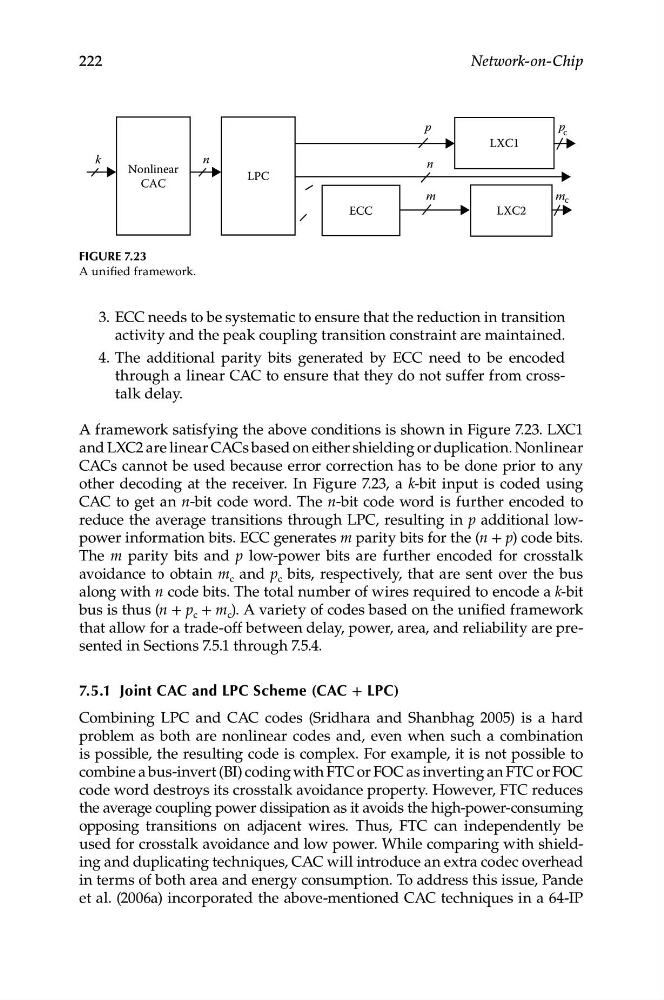
Figure 7.23
A unified framework.
222
Network-on-Chip
3. ECC needs to be systematic to ensure that the reduction in transition
activity and the peak coupling transition constraint are maintained.
4. The additional parity bits generated by ECC need to be encoded
through a linear CAC to ensure that they do not suffer from crosstalk delay.
A framework satisfying the above conditions is shown in Figure 7.23. LXC1
and LXC2 are linear CACs based on either shielding or duplication. Nonlinear
CACs cannot be used because error correction has to be done prior to any
other decoding at the receiver. In Figure 7.23, a k-bit input is coded using
CAC to get an n-bit code word. The n-bit code word is further encoded to
reduce the average transitions through LPC, resulting in p additional lowpower information bits. ECC generates m parity bits for the (n + p) code bits.
The m parity bits and p low-power bits are further encoded for crosstalk
avoidance to obtain m c and p c bits, respectively, that are sent over the bus
along with n code bits. The total number of wires required to encode a k-bit
bus is thus (n + p c + m c ). A variety of codes based on the unified framework
that allow for a trade-off between delay, power, area, and reliability are presented in Sections 7.5.1 through 7.5.4.
7.5.1 Joint CAC and LPC Scheme (CAC + LPC)
Combining LPC and CAC codes (Sridhara and Shanbhag 2005) is a hard
problem as both are nonlinear codes and, even when such a combination
is possible, the resulting code is complex. For example, it is not possible to
combine a bus-invert (BI) coding with FTC or FOC as inverting an FTC or FOC
code word destroys its crosstalk avoidance property. However, FTC reduces
the average coupling power dissipation as it avoids the high-power-consuming
opposing transitions on adjacent wires. Thus, FTC can independently be
used for crosstalk avoidance and low power. While comparing with shielding and duplicating techniques, CAC will introduce an extra codec overhead
in terms of both area and energy consumption. To address this issue, Pande
et al. (2006a) incorporated the above-mentioned CAC techniques in a 64-IP