

221
Signal Integrity and Reliability of Network-on-Chip
Router
Interleaver
Deinterleaver
Router
32
56
32
4
4
4
7
7
7
7
7
7
4
4
4
HC 1
(7,4)
HC 1
(4,7)
HC 2
(4,7)
HC 2
(7,4)
HC 8
(7,4)
HC 8
(4,7)
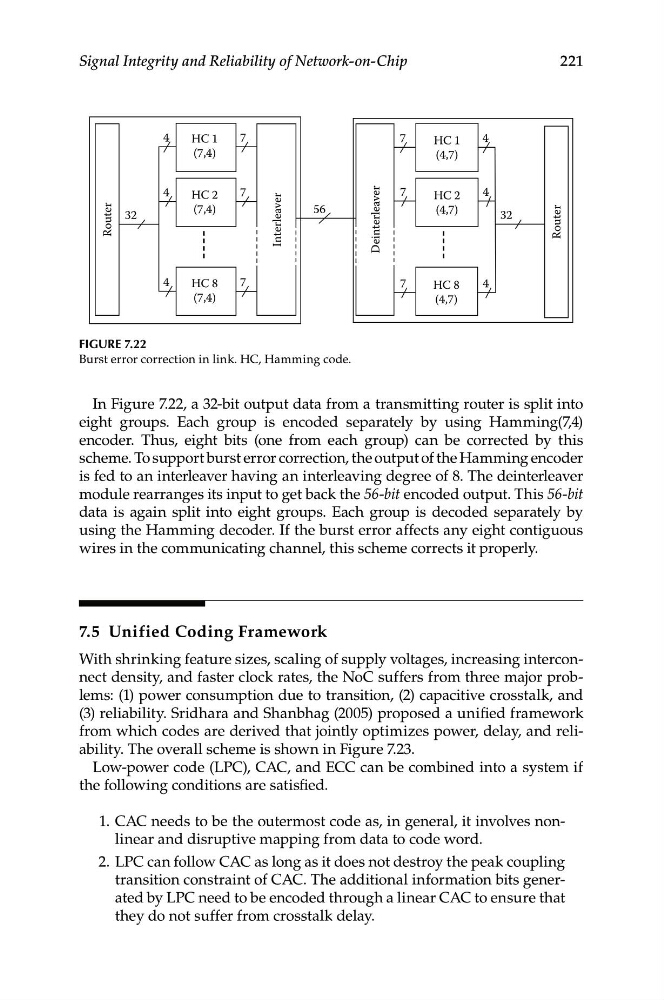
Figure 7.22
Burst error correction in link. HC, Hamming code.
In Figure 7.22, a 32-bit output data from a transmitting router is split into
eight groups. Each group is encoded separately by using Hamming(7,4)
encoder. Thus, eight bits (one from each group) can be corrected by this
scheme. To support burst error correction, the output of the Hamming encoder
is fed to an interleaver having an interleaving degree of 8. The deinterleaver
module rearranges its input to get back the 56-bit encoded output. This 56-bit
data is again split into eight groups. Each group is decoded separately by
using the Hamming decoder. If the burst error affects any eight contiguous
wires in the communicating channel, this scheme corrects it properly.
7.5 Unified Coding Framework
With shrinking feature sizes, scaling of supply voltages, increasing interconnect density, and faster clock rates, the NoC suffers from three major problems: (1) power consumption due to transition, (2) capacitive crosstalk, and
(3) reliability. Sridhara and Shanbhag (2005) proposed a unified framework
from which codes are derived that jointly optimizes power, delay, and reliability. The overall scheme is shown in Figure 7.23.
Low-power code (LPC), CAC, and ECC can be combined into a system if
the following conditions are satisfied.
1. CAC needs to be the outermost code as, in general, it involves nonlinear and disruptive mapping from data to code word.
2. LPC can follow CAC as long as it does not destroy the peak coupling
transition constraint of CAC. The additional information bits generated by LPC need to be encoded through a linear CAC to ensure that
they do not suffer from crosstalk delay.