

193
Signal Integrity and Reliability of Network-on-Chip
R
V A
C C1
C Cn
C C2
C G12
C G1n
C G2n
C G21
C G22
C G11
V B
R
R
R
R
R
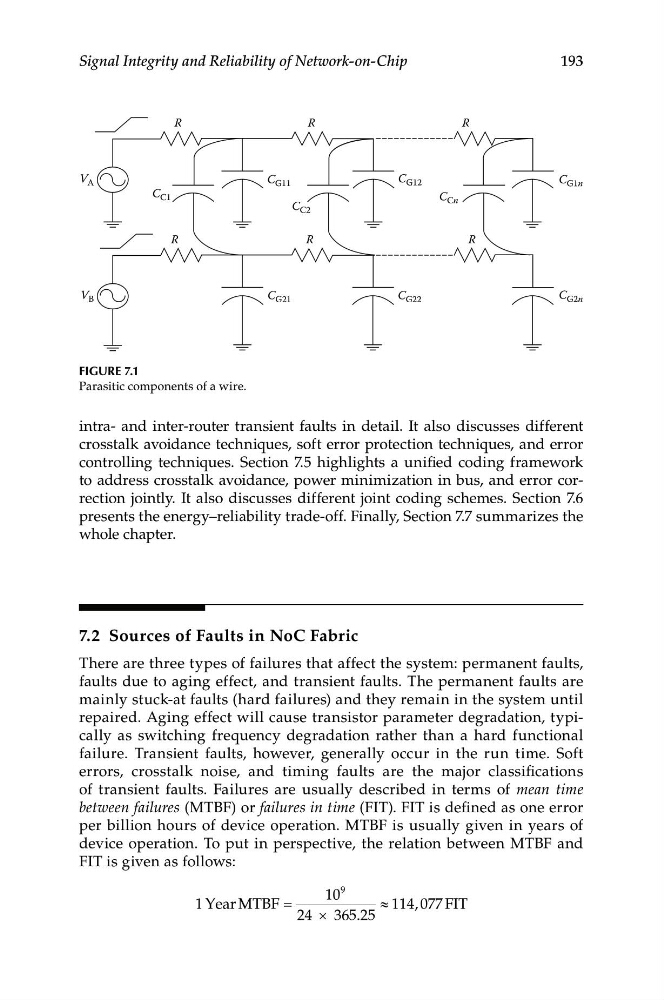
Figure 7.1
Parasitic components of a wire.
intra- and inter-router transient faults in detail. It also discusses different
crosstalk avoidance techniques, soft error protection techniques, and error
controlling techniques. Section 7.5 highlights a unified coding framework
to address crosstalk avoidance, power minimization in bus, and error correction jointly. It also discusses different joint coding schemes. Section 7.6
presents the energy–reliability trade-off. Finally, Section 7.7 summarizes the
whole chapter.
7.2 Sources of Faults in NoC Fabric
There are three types of failures that affect the system: permanent faults,
faults due to aging effect, and transient faults. The permanent faults are
mainly stuck-at faults (hard failures) and they remain in the system until
repaired. Aging effect will cause transistor parameter degradation, typically as switching frequency degradation rather than a hard functional
failure. Transient faults, however, generally occur in the run time. Soft
errors, crosstalk noise, and timing faults are the major classifications
of transient faults. Failures are usually described in terms of mean time
between failures (MTBF) or failures in time (FIT). FIT is defined as one error
per billion hours of device operation. MTBF is usually given in years of
device operation. To put in perspective, the relation between MTBF and
FIT is given as follows:
10
9
1 Year MTBF =
≈ 114 077
,
FIT
24 × 365 25
.
Signal Integrity and Reliability of Network-on-Chip
R
V A
C C1
C Cn
C C2
C G12
C G1n
C G2n
C G21
C G22
C G11
V B
R
R
R
R
R
Figure 7.1
Parasitic components of a wire.
intra- and inter-router transient faults in detail. It also discusses different
crosstalk avoidance techniques, soft error protection techniques, and error
controlling techniques. Section 7.5 highlights a unified coding framework
to address crosstalk avoidance, power minimization in bus, and error correction jointly. It also discusses different joint coding schemes. Section 7.6
presents the energy–reliability trade-off. Finally, Section 7.7 summarizes the
whole chapter.
7.2 Sources of Faults in NoC Fabric
There are three types of failures that affect the system: permanent faults,
faults due to aging effect, and transient faults. The permanent faults are
mainly stuck-at faults (hard failures) and they remain in the system until
repaired. Aging effect will cause transistor parameter degradation, typically as switching frequency degradation rather than a hard functional
failure. Transient faults, however, generally occur in the run time. Soft
errors, crosstalk noise, and timing faults are the major classifications
of transient faults. Failures are usually described in terms of mean time
between failures (MTBF) or failures in time (FIT). FIT is defined as one error
per billion hours of device operation. MTBF is usually given in years of
device operation. To put in perspective, the relation between MTBF and
FIT is given as follows:
10
9
1 Year MTBF =
≈ 114 077
,
FIT
24 × 365 25
.