

115
Evaluation of Network-on-Chip Architectures
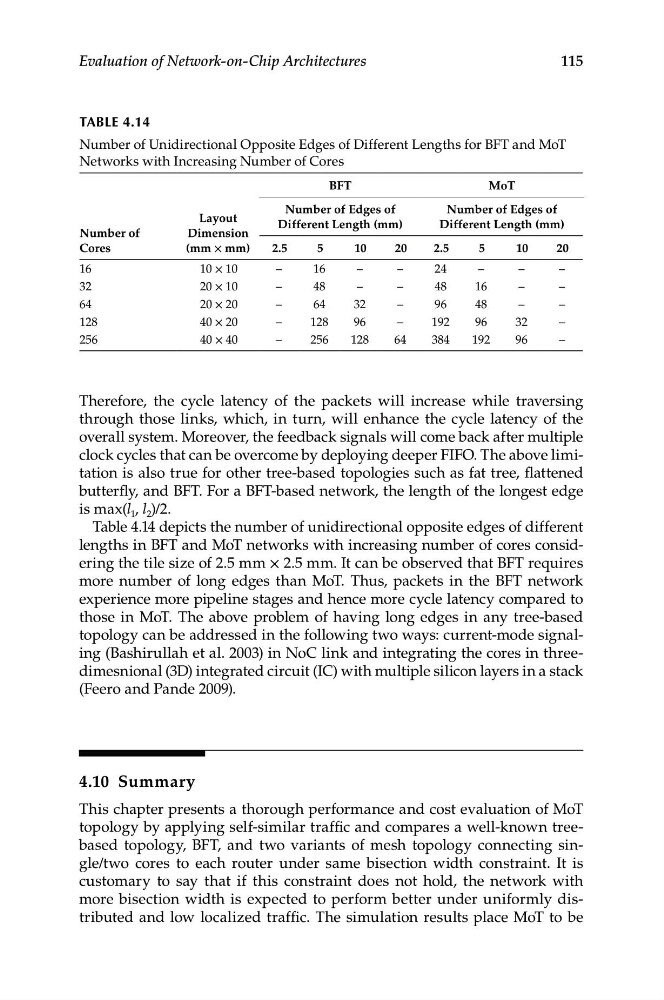
TABLe 4.14
Number of Unidirectional Opposite Edges of Different Lengths for BFT and MoT
Networks with Increasing Number of Cores
Number of
Cores
Layout
Dimension
(mm × mm)
BFT
MoT
Number of Edges of
Different Length (mm)
Number of Edges of
Different Length (mm)
2.5
5
10
20
2.5
5
10
20
16
10 × 10
–
16
–
–
24
–
–
–
32
20 × 10
–
48
–
–
48
16
–
–
64
20 × 20
–
64
32
–
96
48
–
–
128
40 × 20
–
128
96
–
192
96
32
–
256
40 × 40
–
256
128
64
384
192
96
–
Therefore, the cycle latency of the packets will increase while traversing
through those links, which, in turn, will enhance the cycle latency of the
overall system. Moreover, the feedback signals will come back after multiple
clock cycles that can be overcome by deploying deeper FIFO. The above limitation is also true for other tree-based topologies such as fat tree, flattened
butterfly, and BFT. For a BFT-based network, the length of the longest edge
is max(l 1 , l 2 )/2.
Table 4.14 depicts the number of unidirectional opposite edges of different
lengths in BFT and MoT networks with increasing number of cores considering the tile size of 2.5 mm × 2.5 mm. It can be observed that BFT requires
more number of long edges than MoT. Thus, packets in the BFT network
experience more pipeline stages and hence more cycle latency compared to
those in MoT. The above problem of having long edges in any tree-based
topology can be addressed in the following two ways: current-mode signaling (Bashirullah et al. 2003) in NoC link and integrating the cores in threedimesnional (3D) integrated circuit (IC) with multiple silicon layers in a stack
(Feero and Pande 2009).
4.10 Summary
This chapter presents a thorough performance and cost evaluation of MoT
topology by applying self-similar traffic and compares a well-known treebased topology, BFT, and two variants of mesh topology connecting single/two cores to each router under same bisection width constraint. It is
customary to say that if this constraint does not hold, the network with
more bisection width is expected to perform better under uniformly distributed and low localized traffic. The simulation results place MoT to be