

0
30
60
90
120
150
Energy consumption (μJ)
Network
Router
Link
0.002 0.004 0.006 0.008 0.010 0.012 0.014 0.016 0.018 0.020
Offered load (packets/cycle/IP)
93
Evaluation of Network-on-Chip Architectures
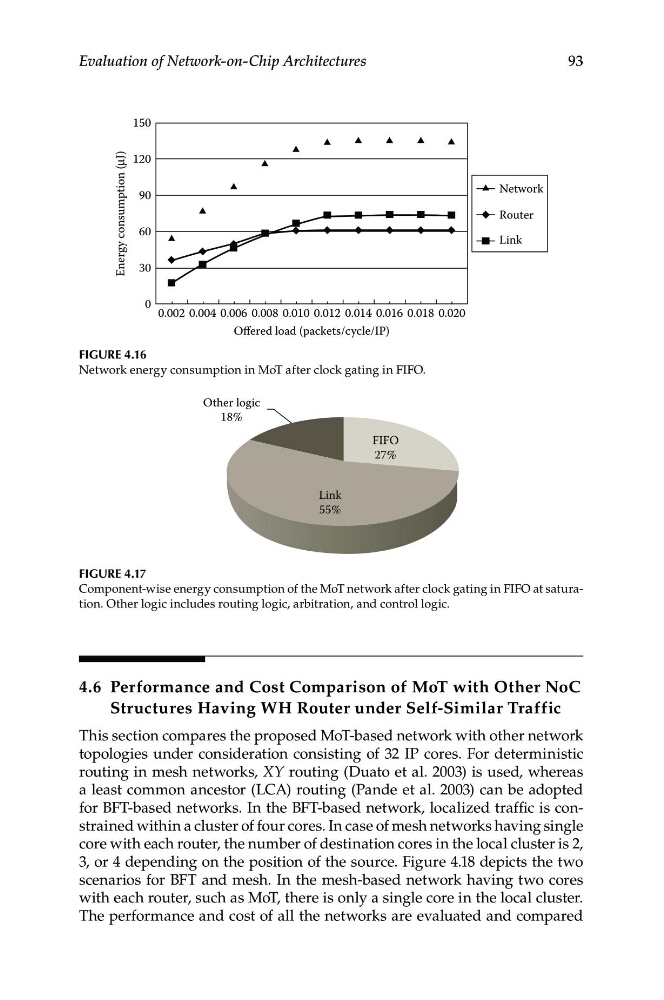
Figure 4.16
Network energy consumption in MoT after clock gating in FIFO.
Other logic
Link
55%
FIFO
27%
18%
Figure 4.17
Component-wise energy consumption of the MoT network after clock gating in FIFO at saturation. Other logic includes routing logic, arbitration, and control logic.
4.6 Performance and Cost Comparison of MoT with Other NoC
Structures Having WH Router under Self-Similar Traffic
This section compares the proposed MoT-based network with other network
topologies under consideration consisting of 32 IP cores. For deterministic
routing in mesh networks, XY routing (Duato et al. 2003) is used, whereas
a least common ancestor (LCA) routing (Pande et al. 2003) can be adopted
for BFT-based networks. In the BFT-based network, localized traffic is constrained within a cluster of four cores. In case of mesh networks having single
core with each router, the number of destination cores in the local cluster is 2,
3, or 4 depending on the position of the source. Figure 4.18 depicts the two
scenarios for BFT and mesh. In the mesh-based network having two cores
with each router, such as MoT, there is only a single core in the local cluster.
The performance and cost of all the networks are evaluated and compared
30
60
90
120
150
Energy consumption (μJ)
Network
Router
Link
0.002 0.004 0.006 0.008 0.010 0.012 0.014 0.016 0.018 0.020
Offered load (packets/cycle/IP)
93
Evaluation of Network-on-Chip Architectures
Figure 4.16
Network energy consumption in MoT after clock gating in FIFO.
Other logic
Link
55%
FIFO
27%
18%
Figure 4.17
Component-wise energy consumption of the MoT network after clock gating in FIFO at saturation. Other logic includes routing logic, arbitration, and control logic.
4.6 Performance and Cost Comparison of MoT with Other NoC
Structures Having WH Router under Self-Similar Traffic
This section compares the proposed MoT-based network with other network
topologies under consideration consisting of 32 IP cores. For deterministic
routing in mesh networks, XY routing (Duato et al. 2003) is used, whereas
a least common ancestor (LCA) routing (Pande et al. 2003) can be adopted
for BFT-based networks. In the BFT-based network, localized traffic is constrained within a cluster of four cores. In case of mesh networks having single
core with each router, the number of destination cores in the local cluster is 2,
3, or 4 depending on the position of the source. Figure 4.18 depicts the two
scenarios for BFT and mesh. In the mesh-based network having two cores
with each router, such as MoT, there is only a single core in the local cluster.
The performance and cost of all the networks are evaluated and compared