

Synthesis, Characterization, and Application of Biogenic …
57
Nowadays, silver NPs also show a wide range of applications in wastewater treatments, laundry detergents, and other cleaning stuffs (He et al. 2018; Rai et al. 2012).
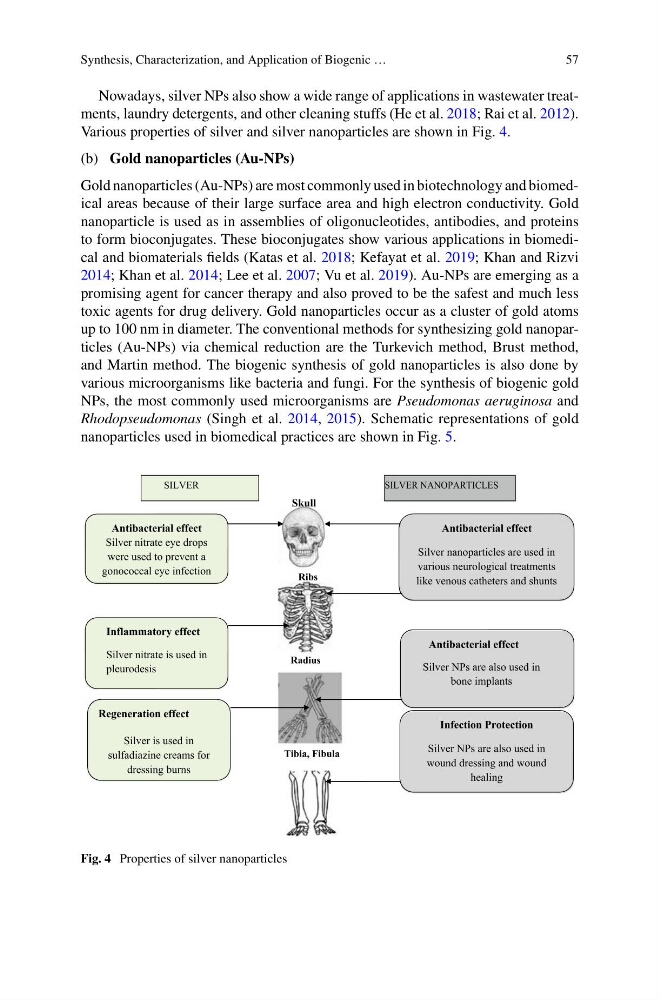
Various properties of silver and silver nanoparticles are shown in Fig. 4.
(b) Gold nanoparticles (Au-NPs)
Gold nanoparticles (Au-NPs) are most commonly used in biotechnology and biomedical areas because of their large surface area and high electron conductivity. Gold
nanoparticle is used as in assemblies of oligonucleotides, antibodies, and proteins
to form bioconjugates. These bioconjugates show various applications in biomedical and biomaterials fields (Katas et al. 2018; Kefayat et al. 2019; Khan and Rizvi
2014; Khan et al. 2014; Lee et al. 2007; Vu et al. 2019). Au-NPs are emerging as a
promising agent for cancer therapy and also proved to be the safest and much less
toxic agents for drug delivery. Gold nanoparticles occur as a cluster of gold atoms
up to 100 nm in diameter. The conventional methods for synthesizing gold nanoparticles (Au-NPs) via chemical reduction are the Turkevich method, Brust method,
and Martin method. The biogenic synthesis of gold nanoparticles is also done by
various microorganisms like bacteria and fungi. For the synthesis of biogenic gold
NPs, the most commonly used microorganisms are Pseudomonas aeruginosa and
Rhodopseudomonas (Singh et al. 2014, 2015). Schematic representations of gold
nanoparticles used in biomedical practices are shown in Fig. 5.
Fig. 4 Properties of silver nanoparticles
57
Nowadays, silver NPs also show a wide range of applications in wastewater treatments, laundry detergents, and other cleaning stuffs (He et al. 2018; Rai et al. 2012).
Various properties of silver and silver nanoparticles are shown in Fig. 4.
(b) Gold nanoparticles (Au-NPs)
Gold nanoparticles (Au-NPs) are most commonly used in biotechnology and biomedical areas because of their large surface area and high electron conductivity. Gold
nanoparticle is used as in assemblies of oligonucleotides, antibodies, and proteins
to form bioconjugates. These bioconjugates show various applications in biomedical and biomaterials fields (Katas et al. 2018; Kefayat et al. 2019; Khan and Rizvi
2014; Khan et al. 2014; Lee et al. 2007; Vu et al. 2019). Au-NPs are emerging as a
promising agent for cancer therapy and also proved to be the safest and much less
toxic agents for drug delivery. Gold nanoparticles occur as a cluster of gold atoms
up to 100 nm in diameter. The conventional methods for synthesizing gold nanoparticles (Au-NPs) via chemical reduction are the Turkevich method, Brust method,
and Martin method. The biogenic synthesis of gold nanoparticles is also done by
various microorganisms like bacteria and fungi. For the synthesis of biogenic gold
NPs, the most commonly used microorganisms are Pseudomonas aeruginosa and
Rhodopseudomonas (Singh et al. 2014, 2015). Schematic representations of gold
nanoparticles used in biomedical practices are shown in Fig. 5.
Fig. 4 Properties of silver nanoparticles