

58
S. Kakkar et al.
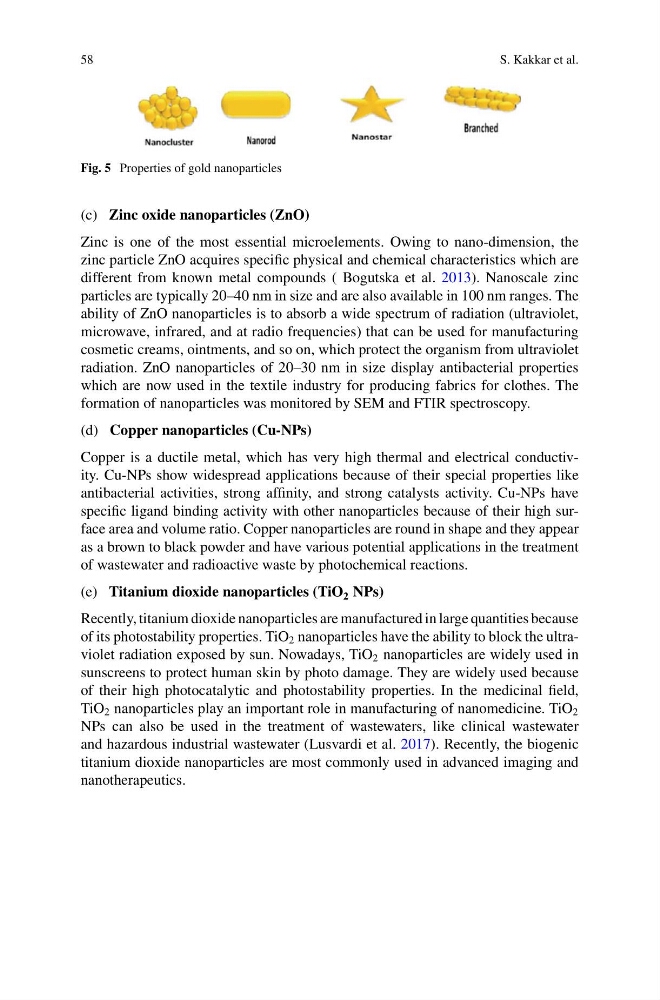
Fig. 5 Properties of gold nanoparticles
(c) Zinc oxide nanoparticles (ZnO)
Zinc is one of the most essential microelements. Owing to nano-dimension, the
zinc particle ZnO acquires specific physical and chemical characteristics which are
different from known metal compounds ( Bogutska et al. 2013). Nanoscale zinc
particles are typically 20–40 nm in size and are also available in 100 nm ranges. The
ability of ZnO nanoparticles is to absorb a wide spectrum of radiation (ultraviolet,
microwave, infrared, and at radio frequencies) that can be used for manufacturing
cosmetic creams, ointments, and so on, which protect the organism from ultraviolet
radiation. ZnO nanoparticles of 20–30 nm in size display antibacterial properties
which are now used in the textile industry for producing fabrics for clothes. The
formation of nanoparticles was monitored by SEM and FTIR spectroscopy.
(d) Copper nanoparticles (Cu-NPs)
Copper is a ductile metal, which has very high thermal and electrical conductivity. Cu-NPs show widespread applications because of their special properties like
antibacterial activities, strong affinity, and strong catalysts activity. Cu-NPs have
specific ligand binding activity with other nanoparticles because of their high surface area and volume ratio. Copper nanoparticles are round in shape and they appear
as a brown to black powder and have various potential applications in the treatment
of wastewater and radioactive waste by photochemical reactions.
(e) Titanium dioxide nanoparticles (TiO 2 NPs)
Recently, titanium dioxide nanoparticles are manufactured in large quantities because
of its photostability properties. TiO 2 nanoparticles have the ability to block the ultraviolet radiation exposed by sun. Nowadays, TiO 2 nanoparticles are widely used in
sunscreens to protect human skin by photo damage. They are widely used because
of their high photocatalytic and photostability properties. In the medicinal field,
TiO 2 nanoparticles play an important role in manufacturing of nanomedicine. TiO 2
NPs can also be used in the treatment of wastewaters, like clinical wastewater
and hazardous industrial wastewater (Lusvardi et al. 2017). Recently, the biogenic
titanium dioxide nanoparticles are most commonly used in advanced imaging and
nanotherapeutics.
S. Kakkar et al.
Fig. 5 Properties of gold nanoparticles
(c) Zinc oxide nanoparticles (ZnO)
Zinc is one of the most essential microelements. Owing to nano-dimension, the
zinc particle ZnO acquires specific physical and chemical characteristics which are
different from known metal compounds ( Bogutska et al. 2013). Nanoscale zinc
particles are typically 20–40 nm in size and are also available in 100 nm ranges. The
ability of ZnO nanoparticles is to absorb a wide spectrum of radiation (ultraviolet,
microwave, infrared, and at radio frequencies) that can be used for manufacturing
cosmetic creams, ointments, and so on, which protect the organism from ultraviolet
radiation. ZnO nanoparticles of 20–30 nm in size display antibacterial properties
which are now used in the textile industry for producing fabrics for clothes. The
formation of nanoparticles was monitored by SEM and FTIR spectroscopy.
(d) Copper nanoparticles (Cu-NPs)
Copper is a ductile metal, which has very high thermal and electrical conductivity. Cu-NPs show widespread applications because of their special properties like
antibacterial activities, strong affinity, and strong catalysts activity. Cu-NPs have
specific ligand binding activity with other nanoparticles because of their high surface area and volume ratio. Copper nanoparticles are round in shape and they appear
as a brown to black powder and have various potential applications in the treatment
of wastewater and radioactive waste by photochemical reactions.
(e) Titanium dioxide nanoparticles (TiO 2 NPs)
Recently, titanium dioxide nanoparticles are manufactured in large quantities because
of its photostability properties. TiO 2 nanoparticles have the ability to block the ultraviolet radiation exposed by sun. Nowadays, TiO 2 nanoparticles are widely used in
sunscreens to protect human skin by photo damage. They are widely used because
of their high photocatalytic and photostability properties. In the medicinal field,
TiO 2 nanoparticles play an important role in manufacturing of nanomedicine. TiO 2
NPs can also be used in the treatment of wastewaters, like clinical wastewater
and hazardous industrial wastewater (Lusvardi et al. 2017). Recently, the biogenic
titanium dioxide nanoparticles are most commonly used in advanced imaging and
nanotherapeutics.