

Nucleic Acid Based Nanoconstructs for Environmental Analysis …
593
SYBR Gold
M3WJ1 (1X) M3WJ1 (10X) M3WJ1 (100X)
0.00
0.05
0.10
0.15
0.20
MNP-immobilized
Absorbance
MNP-M3WJ1 (1X) MNP-M3WJ1 (10X) MNP-M3WJ1 (100X)
0.00
0.02
0.04
0.06
0.08
0.10
0.12
Absorbance
SYBR Gold
M3WJ2 (1X) M3WJ2 (10X) M3WJ2 (100X)
0.00
0.05
0.10
0.15
0.20
MNP-immobilized
Absorbance
MNP-M3WJ2 (1X) MNP-M3WJ2 (10X) MNP - M3WJ2 (100X)
0.00
0.02
0.04
0.06
0.08
0.10
0.12
Absorbance
(a)
(b)
(c)
(d)
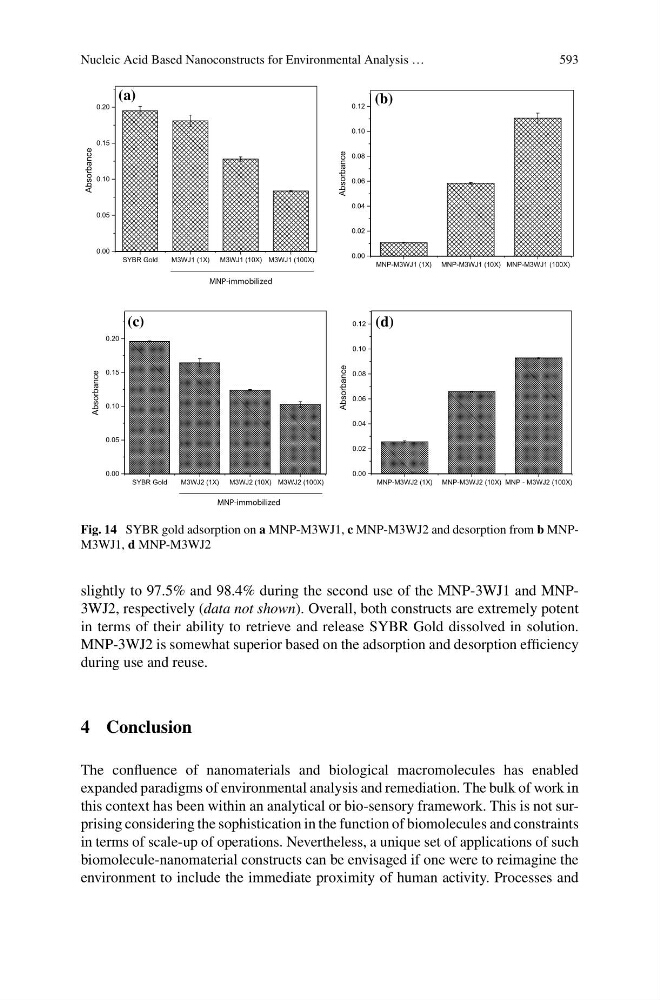
Fig. 14 SYBR gold adsorption on a MNP-M3WJ1, c MNP-M3WJ2 and desorption from b MNPM3WJ1, d MNP-M3WJ2
slightly to 97.5% and 98.4% during the second use of the MNP-3WJ1 and MNP3WJ2, respectively (data not shown). Overall, both constructs are extremely potent
in terms of their ability to retrieve and release SYBR Gold dissolved in solution.
MNP-3WJ2 is somewhat superior based on the adsorption and desorption efficiency
during use and reuse.
4 Conclusion
The confluence of nanomaterials and biological macromolecules has enabled
expanded paradigms of environmental analysis and remediation. The bulk of work in
this context has been within an analytical or bio-sensory framework. This is not surprising considering the sophistication in the function of biomolecules and constraints
in terms of scale-up of operations. Nevertheless, a unique set of applications of such
biomolecule-nanomaterial constructs can be envisaged if one were to reimagine the
environment to include the immediate proximity of human activity. Processes and