

592
A. Singhal et al.
SYBR Gold
ss1-ss1c (1X) ss1-ss1c (10X) ss1-ss1c (100X)
0.00
0.05
0.10
0.15
0.20
Absorbance
SYBR Gold
ss1-ss1c (1X) ss1-ss1c (10X) ss1-ss1c (100X)
0.00
0.05
0.10
0.15
0.20
Absorbance
MNP-immobilized
(a)
(b)
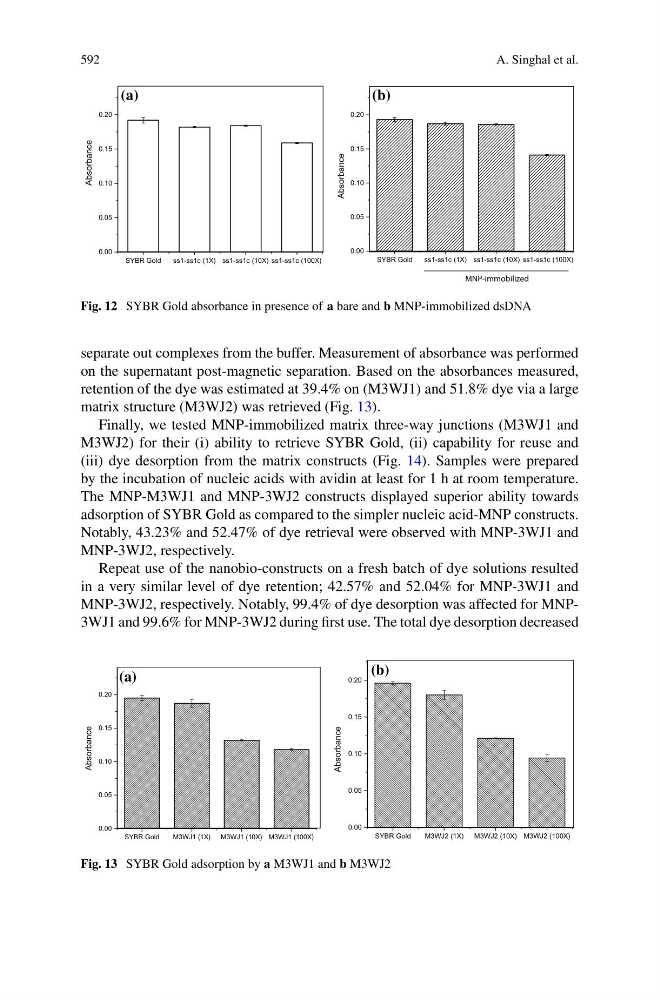
Fig. 12 SYBR Gold absorbance in presence of a bare and b MNP-immobilized dsDNA
separate out complexes from the buffer. Measurement of absorbance was performed
on the supernatant post-magnetic separation. Based on the absorbances measured,
retention of the dye was estimated at 39.4% on (M3WJ1) and 51.8% dye via a large
matrix structure (M3WJ2) was retrieved (Fig. 13).
Finally, we tested MNP-immobilized matrix three-way junctions (M3WJ1 and
M3WJ2) for their (i) ability to retrieve SYBR Gold, (ii) capability for reuse and
(iii) dye desorption from the matrix constructs (Fig. 14). Samples were prepared
by the incubation of nucleic acids with avidin at least for 1 h at room temperature.
The MNP-M3WJ1 and MNP-3WJ2 constructs displayed superior ability towards
adsorption of SYBR Gold as compared to the simpler nucleic acid-MNP constructs.
Notably, 43.23% and 52.47% of dye retrieval were observed with MNP-3WJ1 and
MNP-3WJ2, respectively.
Repeat use of the nanobio-constructs on a fresh batch of dye solutions resulted
in a very similar level of dye retention; 42.57% and 52.04% for MNP-3WJ1 and
MNP-3WJ2, respectively. Notably, 99.4% of dye desorption was affected for MNP3WJ1 and 99.6% for MNP-3WJ2 during first use. The total dye desorption decreased
SYBR Gold
M3WJ1 (1X) M3WJ1 (10X) M3WJ1 (100X)
0.00
0.05
0.10
0.15
0.20
Absorbance
SYBR Gold
M3WJ2 (1X) M3WJ2 (10X) M3WJ2 (100X)
0.00
0.05
0.10
0.15
0.20
Absorbance
(a)
(b)
Fig. 13 SYBR Gold adsorption by a M3WJ1 and b M3WJ2