

Nucleic Acid Based Nanoconstructs for Environmental Analysis …
585
13,000–13,500 rpm for 20–30 min at room temperature followed by measurement of
absorbance. Magnetic decantation for 5 min at room temperature was performed by
using a strong bar magnet. 100 μl of each sample was loaded in a clear 96 well plate.
The absorbance of supernatant corresponds to the absorbance of free dye in solution
and a decrease in absorbance in the presence of nanobio-construct is an indication
of retention by the construct.
Dye Desorption: After the adsorption of dye via nanobio-construct, the latter was
decanted out from the solution by use of magnetic bars. The construct was washed
twice with water and then incubated in desorption buffer (300 mM sodium acetate,
pH 5.2 with 200 mM NaCl) for 25–30 min at 4 °C at very low rpm. The supernatant
containing only dye was collected via nanobio-construct magnetic decantation and
the concentration of dye in supernatant equating dye desorption was calculated.
3 Results and Discussion
3.1 Development and Characterisation
of Nanobio-Constructs
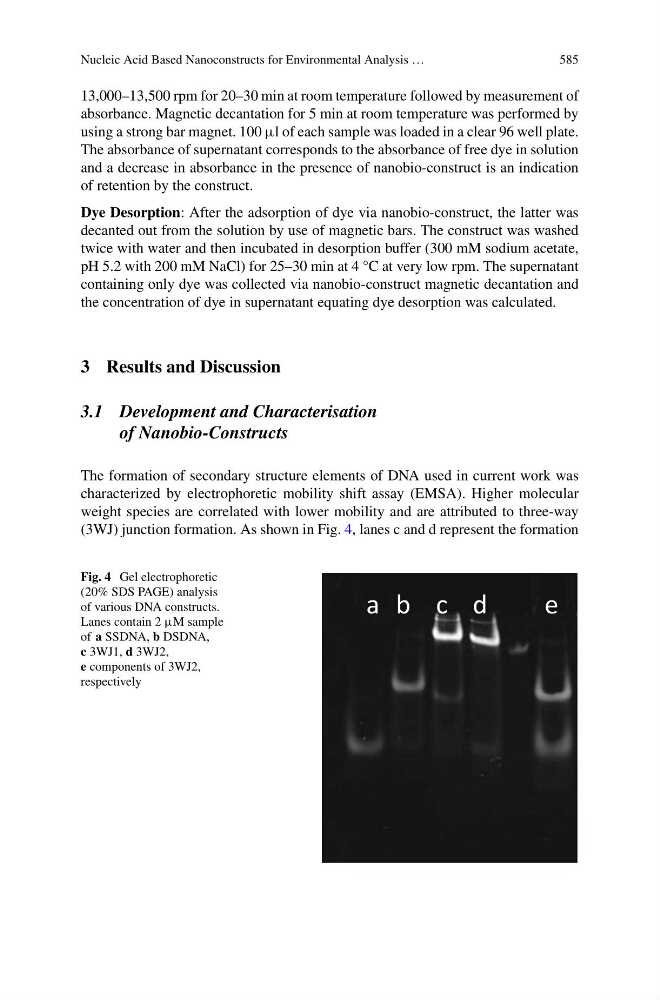
The formation of secondary structure elements of DNA used in current work was
characterized by electrophoretic mobility shift assay (EMSA). Higher molecular
weight species are correlated with lower mobility and are attributed to three-way
(3WJ) junction formation. As shown in Fig. 4, lanes c and d represent the formation
Fig. 4 Gel electrophoretic
(20% SDS PAGE) analysis
of various DNA constructs.
Lanes contain 2 μM sample
of a SSDNA, b DSDNA,
c 3WJ1, d 3WJ2,
e components of 3WJ2,
respectively
a b c d
e