

584
A. Singhal et al.
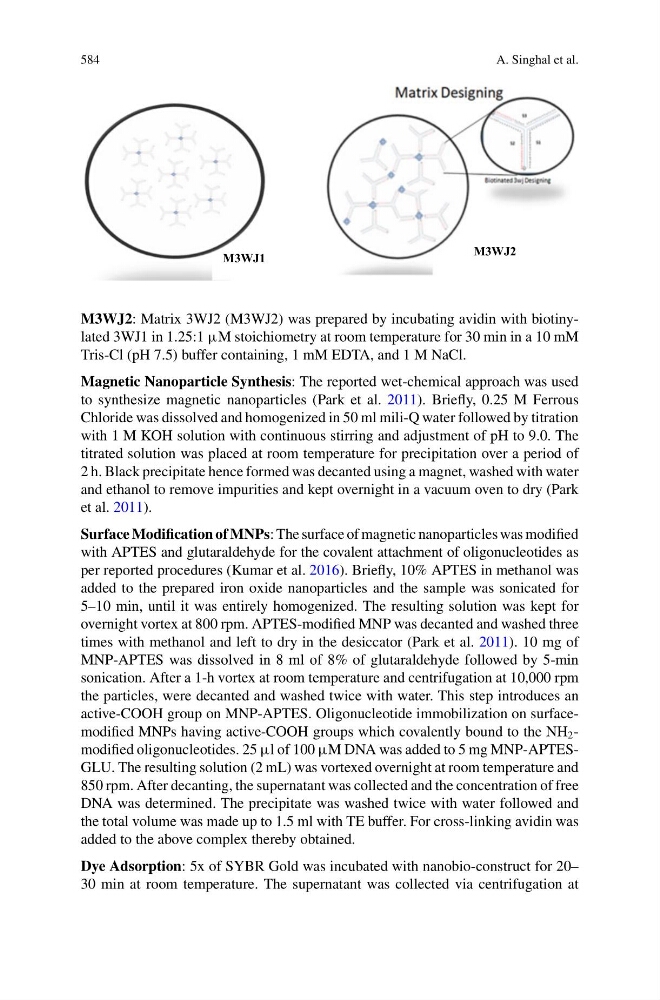
M3WJ1
M3WJ2
M3WJ2: Matrix 3WJ2 (M3WJ2) was prepared by incubating avidin with biotinylated 3WJ1 in 1.25:1 μM stoichiometry at room temperature for 30 min in a 10 mM
Tris-Cl (pH 7.5) buffer containing, 1 mM EDTA, and 1 M NaCl.
Magnetic Nanoparticle Synthesis: The reported wet-chemical approach was used
to synthesize magnetic nanoparticles (Park et al. 2011). Briefly, 0.25 M Ferrous
Chloride was dissolved and homogenized in 50 ml mili-Q water followed by titration
with 1 M KOH solution with continuous stirring and adjustment of pH to 9.0. The
titrated solution was placed at room temperature for precipitation over a period of
2 h. Black precipitate hence formed was decanted using a magnet, washed with water
and ethanol to remove impurities and kept overnight in a vacuum oven to dry (Park
et al. 2011).
Surface Modification of MNPs: The surface of magnetic nanoparticles was modified
with APTES and glutaraldehyde for the covalent attachment of oligonucleotides as
per reported procedures (Kumar et al. 2016). Briefly, 10% APTES in methanol was
added to the prepared iron oxide nanoparticles and the sample was sonicated for
5–10 min, until it was entirely homogenized. The resulting solution was kept for
overnight vortex at 800 rpm. APTES-modified MNP was decanted and washed three
times with methanol and left to dry in the desiccator (Park et al. 2011). 10 mg of
MNP-APTES was dissolved in 8 ml of 8% of glutaraldehyde followed by 5-min
sonication. After a 1-h vortex at room temperature and centrifugation at 10,000 rpm
the particles, were decanted and washed twice with water. This step introduces an
active-COOH group on MNP-APTES. Oligonucleotide immobilization on surfacemodified MNPs having active-COOH groups which covalently bound to the NH 2 -
modified oligonucleotides. 25 μl of 100 μM DNA was added to 5 mg MNP-APTESGLU. The resulting solution (2 mL) was vortexed overnight at room temperature and
850 rpm. After decanting, the supernatant was collected and the concentration of free
DNA was determined. The precipitate was washed twice with water followed and
the total volume was made up to 1.5 ml with TE buffer. For cross-linking avidin was
added to the above complex thereby obtained.
Dye Adsorption: 5x of SYBR Gold was incubated with nanobio-construct for 20–
30 min at room temperature. The supernatant was collected via centrifugation at