

Removal of Ni(II) and Zn(II) from Aqueous Media …
573
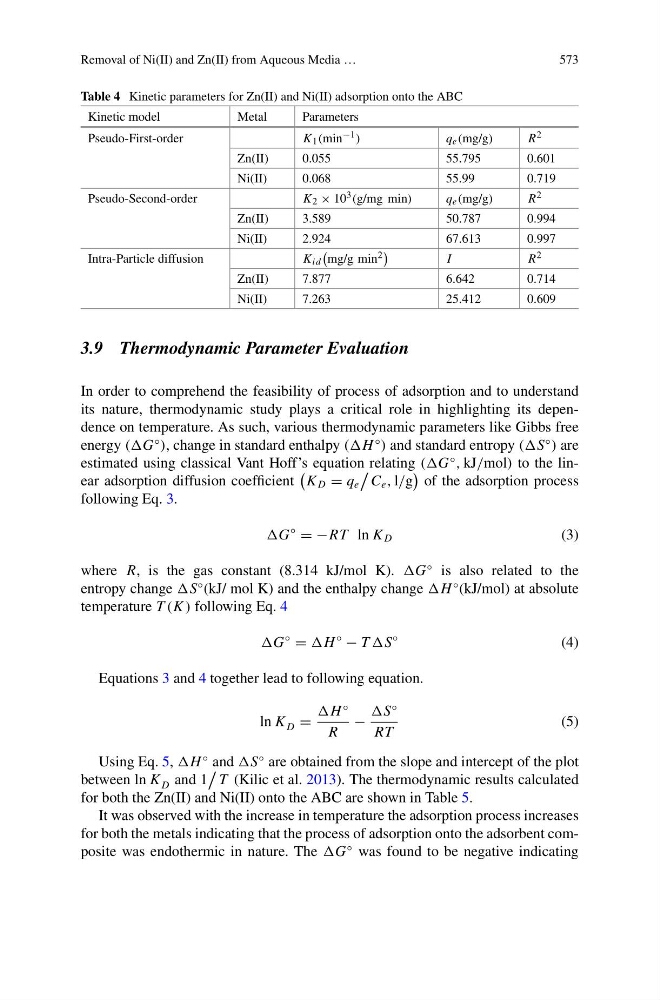
Table 4 Kinetic parameters for Zn(II) and Ni(II) adsorption onto the ABC
Kinetic model
Metal
Parameters
Pseudo-First-order
K 1 (min −1 )
q e (mg/g)
R 2
Zn(II)
0.055
55.795
0.601
Ni(II)
0.068
55.99
0.719
Pseudo-Second-order
K 2 × 10 3 (g/mg min)
q e (mg/g)
R 2
Zn(II)
3.589
50.787
0.994
Ni(II)
2.924
67.613
0.997
Intra-Particle diffusion
K id
mg/g min 2
I
R 2
Zn(II)
7.877
6.642
0.714
Ni(II)
7.263
25.412
0.609
3.9 Thermodynamic Parameter Evaluation
In order to comprehend the feasibility of process of adsorption and to understand
its nature, thermodynamic study plays a critical role in highlighting its dependence on temperature. As such, various thermodynamic parameters like Gibbs free
energy (G
◦
), change in standard enthalpy (H
◦
) and standard entropy (S
◦
) are
estimated using classical Vant Hoff’s equation relating (G
◦
, kJ/mol) to the linear adsorption diffusion coefficient
K D = q e
C e , l/g
of the adsorption process
following Eq. 3.
G
◦
= −RT ln K D
(3)
where R, is the gas constant (8.314 kJ/mol K). G
◦ is also related to the
entropy change S
◦ (kJ/ mol K) and the enthalpy change H
◦ (kJ/mol) at absolute
temperature T (K ) following Eq. 4
G
◦
= H
◦
− T S
◦
(4)
Equations 3 and 4 together lead to following equation.
ln K D =
H
◦
R
−
S
◦
RT
(5)
Using Eq. 5, H
◦ and S
◦ are obtained from the slope and intercept of the plot
between ln K D and 1
T (Kilic et al. 2013). The thermodynamic results calculated
for both the Zn(II) and Ni(II) onto the ABC are shown in Table 5.
It was observed with the increase in temperature the adsorption process increases
for both the metals indicating that the process of adsorption onto the adsorbent composite was endothermic in nature. The G
◦ was found to be negative indicating