

574
T. Rasool and W. Baba
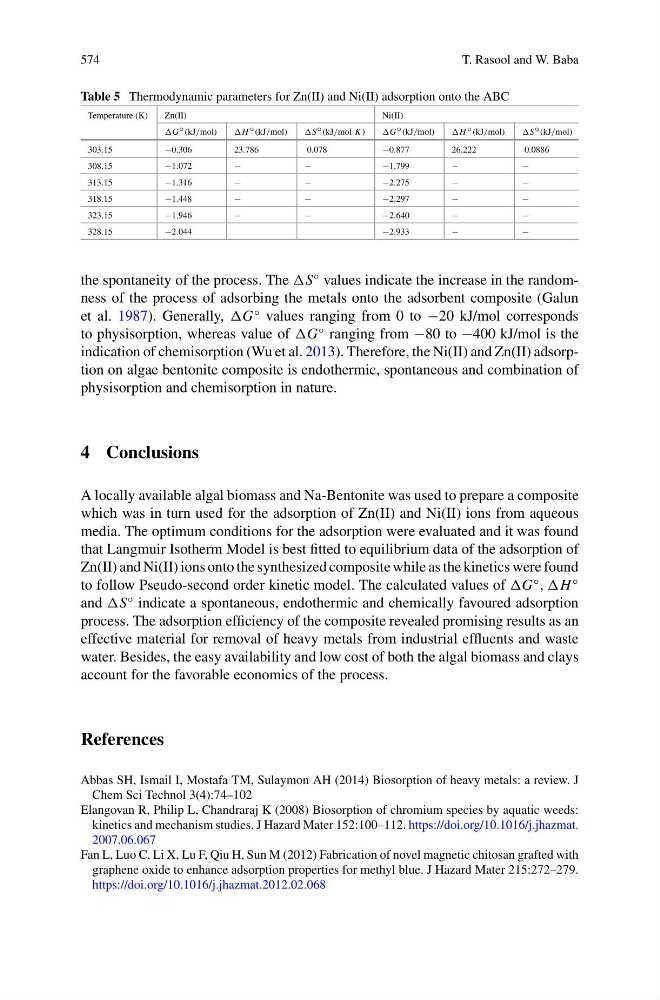
Table 5 Thermodynamic parameters for Zn(II) and Ni(II) adsorption onto the ABC
Temperature (K)
Zn(II)
Ni(II)
G ◦ (kJ/mol)
H ◦ (kJ/mol)
S ◦ (kJ/mol K )
G ◦ (kJ/mol)
H ◦ (kJ/mol)
S ◦ (kJ/mol)
303.15
−0.306
23.786
0.078
−0.877
26.222
0.0886
308.15
−1.072
−
−
−1.799
−
−
313.15
−1.316
−
−
−2.275
−
−
318.15
−1.448
−
−
−2.297
−
−
323.15
−1.946
−
−
−2.640
−
−
328.15
−2.044
−2.933
−
−
the spontaneity of the process. The S
◦ values indicate the increase in the randomness of the process of adsorbing the metals onto the adsorbent composite (Galun
et al. 1987). Generally, G
◦ values ranging from 0 to −20 kJ/mol corresponds
to physisorption, whereas value of G
◦ ranging from −80 to −400 kJ/mol is the
indication of chemisorption (Wu et al. 2013). Therefore, the Ni(II) and Zn(II) adsorption on algae bentonite composite is endothermic, spontaneous and combination of
physisorption and chemisorption in nature.
4 Conclusions
A locally available algal biomass and Na-Bentonite was used to prepare a composite
which was in turn used for the adsorption of Zn(II) and Ni(II) ions from aqueous
media. The optimum conditions for the adsorption were evaluated and it was found
that Langmuir Isotherm Model is best fitted to equilibrium data of the adsorption of
Zn(II) and Ni(II) ions onto the synthesized composite while as the kinetics were found
to follow Pseudo-second order kinetic model. The calculated values of G
◦
, ,H
◦
and S
◦ indicate a spontaneous, endothermic and chemically favoured adsorption
process. The adsorption efficiency of the composite revealed promising results as an
effective material for removal of heavy metals from industrial effluents and waste
water. Besides, the easy availability and low cost of both the algal biomass and clays
account for the favorable economics of the process.
References
Abbas SH, Ismail I, Mostafa TM, Sulaymon AH (2014) Biosorption of heavy metals: a review. J
Chem Sci Technol 3(4):74–102
Elangovan R, Philip L, Chandraraj K (2008) Biosorption of chromium species by aquatic weeds:
kinetics and mechanism studies. J Hazard Mater 152:100–112. https://doi.org/10.1016/j.jhazmat.
2007.06.067
Fan L, Luo C, Li X, Lu F, Qiu H, Sun M (2012) Fabrication of novel magnetic chitosan grafted with
graphene oxide to enhance adsorption properties for methyl blue. J Hazard Mater 215:272–279.
https://doi.org/10.1016/j.jhazmat.2012.02.068