

572
T. Rasool and W. Baba
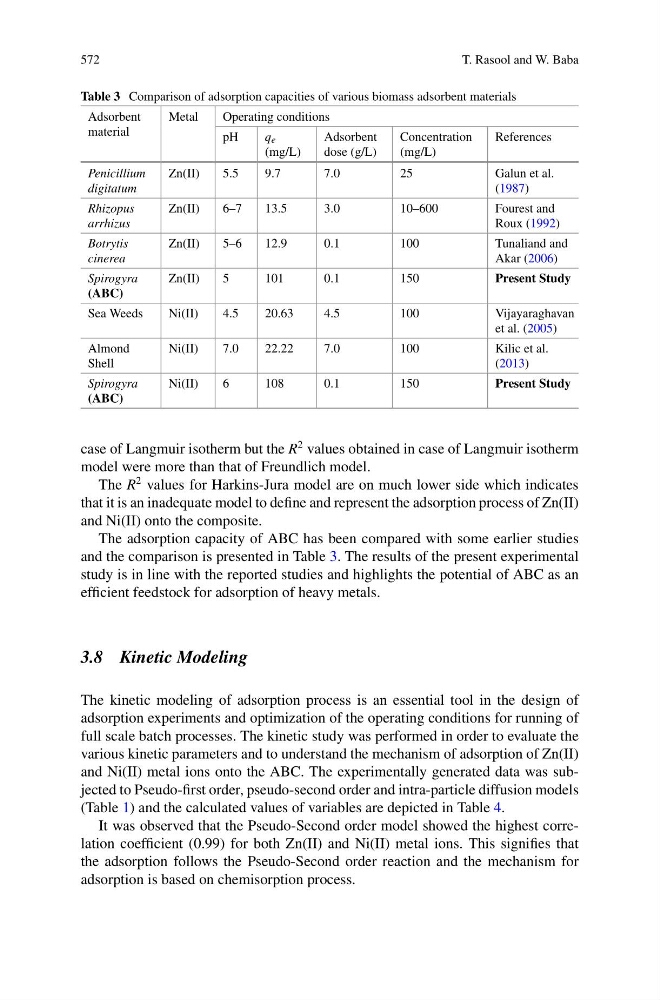
Table 3 Comparison of adsorption capacities of various biomass adsorbent materials
Adsorbent
material
Metal
Operating conditions
pH
q e
(mg/L)
Adsorbent
dose (g/L)
Concentration
(mg/L)
References
Penicillium
digitatum
Zn(II)
5.5
9.7
7.0
25
Galun et al.
(1987)
Rhizopus
arrhizus
Zn(II)
6–7
13.5
3.0
10–600
Fourest and
Roux (1992)
Botrytis
cinerea
Zn(II)
5–6
12.9
0.1
100
Tunaliand and
Akar (2006)
Spirogyra
(ABC)
Zn(II)
5
101
0.1
150
Present Study
Sea Weeds
Ni(II)
4.5
20.63
4.5
100
Vijayaraghavan
et al. (2005)
Almond
Shell
Ni(II)
7.0
22.22
7.0
100
Kilic et al.
(2013)
Spirogyra
(ABC)
Ni(II)
6
108
0.1
150
Present Study
case of Langmuir isotherm but the R
2 values obtained in case of Langmuir isotherm
model were more than that of Freundlich model.
The R
2 values for Harkins-Jura model are on much lower side which indicates
that it is an inadequate model to define and represent the adsorption process of Zn(II)
and Ni(II) onto the composite.
The adsorption capacity of ABC has been compared with some earlier studies
and the comparison is presented in Table 3. The results of the present experimental
study is in line with the reported studies and highlights the potential of ABC as an
efficient feedstock for adsorption of heavy metals.
3.8 Kinetic Modeling
The kinetic modeling of adsorption process is an essential tool in the design of
adsorption experiments and optimization of the operating conditions for running of
full scale batch processes. The kinetic study was performed in order to evaluate the
various kinetic parameters and to understand the mechanism of adsorption of Zn(II)
and Ni(II) metal ions onto the ABC. The experimentally generated data was subjected to Pseudo-first order, pseudo-second order and intra-particle diffusion models
(Table 1) and the calculated values of variables are depicted in Table 4.
It was observed that the Pseudo-Second order model showed the highest correlation coefficient (0.99) for both Zn(II) and Ni(II) metal ions. This signifies that
the adsorption follows the Pseudo-Second order reaction and the mechanism for
adsorption is based on chemisorption process.