

Synthesis and Characterization of Nanofluids …
35
the oxidation of ethylene glycol which is a component of the nanofluid’s basefluid
due to its degradation during the process (Dill 2005; Zhang and Kandlikar 2012).
Also, it has been known that the electrical conductivity of the coolant can cause the
occurrence of shunt current and electrolysis of the coolant on the electrical appliance
(Elhamid et al. 2004; Gershun et al. 2009). Such occurrence of shunt current leads
to the decrease in the efficiency of the appliance and can prove harmful to the user.
They have analysed the thermo-electrical conductivity (TEC) ratio of the nanofluid
which is advantageous at a higher value for its nanofluid application in fuel cell.
Thus, this shows that the significance of electrical conductivity is in determining the
feasibility of the application of a nanofluid for thermal applications in an electrically
active environment.
5 Particle Size Distribution of Nanofluids
Particle size distribution (PSD) as specified earlier is the amount of particles present
in the nanofluid classified according to their sizes. It gives the estimate of the variance
of the sizes of the particles dispersed in the nanofluid. Nanofluids containing particles
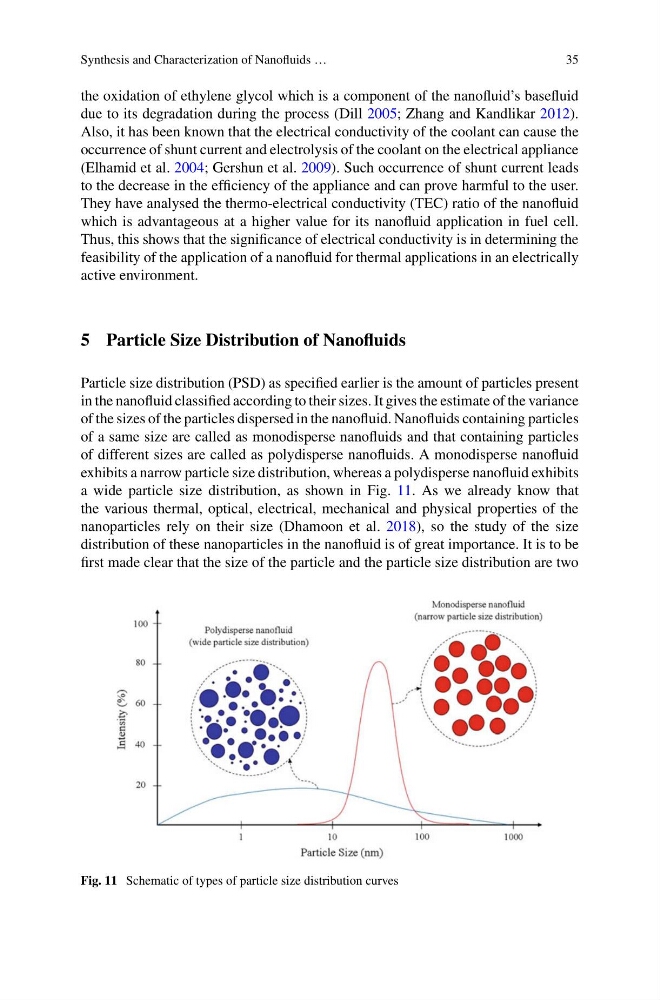
of a same size are called as monodisperse nanofluids and that containing particles
of different sizes are called as polydisperse nanofluids. A monodisperse nanofluid
exhibits a narrow particle size distribution, whereas a polydisperse nanofluid exhibits
a wide particle size distribution, as shown in Fig. 11. As we already know that
the various thermal, optical, electrical, mechanical and physical properties of the
nanoparticles rely on their size (Dhamoon et al. 2018), so the study of the size
distribution of these nanoparticles in the nanofluid is of great importance. It is to be
first made clear that the size of the particle and the particle size distribution are two
Fig. 11 Schematic of types of particle size distribution curves
35
the oxidation of ethylene glycol which is a component of the nanofluid’s basefluid
due to its degradation during the process (Dill 2005; Zhang and Kandlikar 2012).
Also, it has been known that the electrical conductivity of the coolant can cause the
occurrence of shunt current and electrolysis of the coolant on the electrical appliance
(Elhamid et al. 2004; Gershun et al. 2009). Such occurrence of shunt current leads
to the decrease in the efficiency of the appliance and can prove harmful to the user.
They have analysed the thermo-electrical conductivity (TEC) ratio of the nanofluid
which is advantageous at a higher value for its nanofluid application in fuel cell.
Thus, this shows that the significance of electrical conductivity is in determining the
feasibility of the application of a nanofluid for thermal applications in an electrically
active environment.
5 Particle Size Distribution of Nanofluids
Particle size distribution (PSD) as specified earlier is the amount of particles present
in the nanofluid classified according to their sizes. It gives the estimate of the variance
of the sizes of the particles dispersed in the nanofluid. Nanofluids containing particles
of a same size are called as monodisperse nanofluids and that containing particles
of different sizes are called as polydisperse nanofluids. A monodisperse nanofluid
exhibits a narrow particle size distribution, whereas a polydisperse nanofluid exhibits
a wide particle size distribution, as shown in Fig. 11. As we already know that
the various thermal, optical, electrical, mechanical and physical properties of the
nanoparticles rely on their size (Dhamoon et al. 2018), so the study of the size
distribution of these nanoparticles in the nanofluid is of great importance. It is to be
first made clear that the size of the particle and the particle size distribution are two
Fig. 11 Schematic of types of particle size distribution curves