

34
D. P. Barai et al.
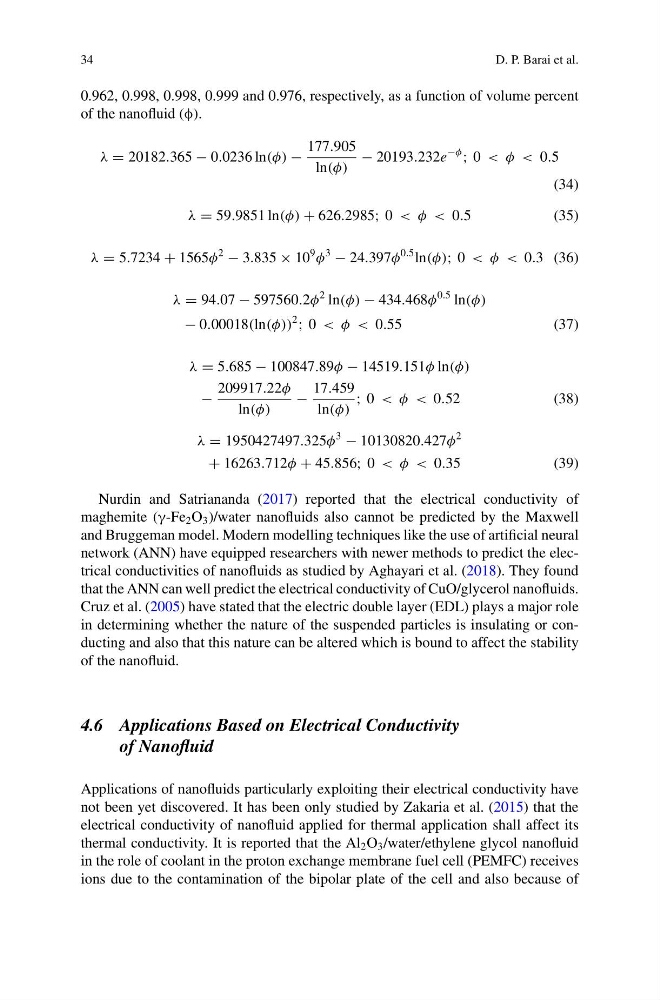
0.962, 0.998, 0.998, 0.999 and 0.976, respectively, as a function of volume percent
of the nanofluid (φ).
λ = 20182.365 − 0.0236 ln(φ) −
177.905
ln(φ)
− 20193.232e
−φ
; 0 < φ < 0.5
(34)
λ = 59.9851 ln(φ) + 626.2985; 0 < φ < 0.5
(35)
λ = 5.7234 + 1565φ
2
− 3.835 × 10
9
φ
3
− 24.397φ
0.5 ln(φ); 0 < φ < 0.3 (36)
λ = 94.07 − 597560.2φ
2 ln(φ) − 434.468φ
0.5 ln(φ)
− 0.00018(ln(φ))
2
; 0 < φ < 0.55
(37)
λ = 5.685 − 100847.89φ − 14519.151φ ln(φ)
−
209917.22φ
ln(φ)
−
17.459
ln(φ)
; 0 < φ < 0.52
(38)
λ = 1950427497.325φ
3
− 10130820.427φ
2
+ 16263.712φ + 45.856; 0 < φ < 0.35
(39)
Nurdin and Satriananda (2017) reported that the electrical conductivity of
maghemite (γ-Fe 2 O 3 )/water nanofluids also cannot be predicted by the Maxwell
and Bruggeman model. Modern modelling techniques like the use of artificial neural
network (ANN) have equipped researchers with newer methods to predict the electrical conductivities of nanofluids as studied by Aghayari et al. (2018). They found
that the ANN can well predict the electrical conductivity of CuO/glycerol nanofluids.
Cruz et al. (2005) have stated that the electric double layer (EDL) plays a major role
in determining whether the nature of the suspended particles is insulating or conducting and also that this nature can be altered which is bound to affect the stability
of the nanofluid.
4.6 Applications Based on Electrical Conductivity
of Nanofluid
Applications of nanofluids particularly exploiting their electrical conductivity have
not been yet discovered. It has been only studied by Zakaria et al. (2015) that the
electrical conductivity of nanofluid applied for thermal application shall affect its
thermal conductivity. It is reported that the Al 2 O 3 /water/ethylene glycol nanofluid
in the role of coolant in the proton exchange membrane fuel cell (PEMFC) receives
ions due to the contamination of the bipolar plate of the cell and also because of
D. P. Barai et al.
0.962, 0.998, 0.998, 0.999 and 0.976, respectively, as a function of volume percent
of the nanofluid (φ).
λ = 20182.365 − 0.0236 ln(φ) −
177.905
ln(φ)
− 20193.232e
−φ
; 0 < φ < 0.5
(34)
λ = 59.9851 ln(φ) + 626.2985; 0 < φ < 0.5
(35)
λ = 5.7234 + 1565φ
2
− 3.835 × 10
9
φ
3
− 24.397φ
0.5 ln(φ); 0 < φ < 0.3 (36)
λ = 94.07 − 597560.2φ
2 ln(φ) − 434.468φ
0.5 ln(φ)
− 0.00018(ln(φ))
2
; 0 < φ < 0.55
(37)
λ = 5.685 − 100847.89φ − 14519.151φ ln(φ)
−
209917.22φ
ln(φ)
−
17.459
ln(φ)
; 0 < φ < 0.52
(38)
λ = 1950427497.325φ
3
− 10130820.427φ
2
+ 16263.712φ + 45.856; 0 < φ < 0.35
(39)
Nurdin and Satriananda (2017) reported that the electrical conductivity of
maghemite (γ-Fe 2 O 3 )/water nanofluids also cannot be predicted by the Maxwell
and Bruggeman model. Modern modelling techniques like the use of artificial neural
network (ANN) have equipped researchers with newer methods to predict the electrical conductivities of nanofluids as studied by Aghayari et al. (2018). They found
that the ANN can well predict the electrical conductivity of CuO/glycerol nanofluids.
Cruz et al. (2005) have stated that the electric double layer (EDL) plays a major role
in determining whether the nature of the suspended particles is insulating or conducting and also that this nature can be altered which is bound to affect the stability
of the nanofluid.
4.6 Applications Based on Electrical Conductivity
of Nanofluid
Applications of nanofluids particularly exploiting their electrical conductivity have
not been yet discovered. It has been only studied by Zakaria et al. (2015) that the
electrical conductivity of nanofluid applied for thermal application shall affect its
thermal conductivity. It is reported that the Al 2 O 3 /water/ethylene glycol nanofluid
in the role of coolant in the proton exchange membrane fuel cell (PEMFC) receives
ions due to the contamination of the bipolar plate of the cell and also because of