

502
P. Joshi et al.
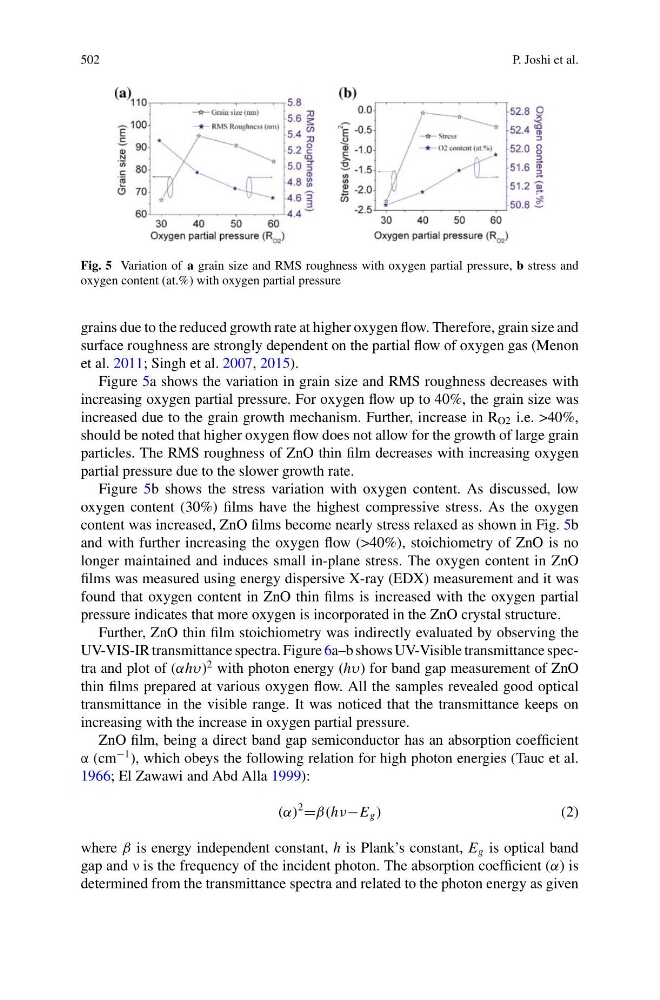
Fig. 5 Variation of a grain size and RMS roughness with oxygen partial pressure, b stress and
oxygen content (at.%) with oxygen partial pressure
grains due to the reduced growth rate at higher oxygen flow. Therefore, grain size and
surface roughness are strongly dependent on the partial flow of oxygen gas (Menon
et al. 2011; Singh et al. 2007, 2015).
Figure 5a shows the variation in grain size and RMS roughness decreases with
increasing oxygen partial pressure. For oxygen flow up to 40%, the grain size was
increased due to the grain growth mechanism. Further, increase in R O2 i.e. >40%,
should be noted that higher oxygen flow does not allow for the growth of large grain
particles. The RMS roughness of ZnO thin film decreases with increasing oxygen
partial pressure due to the slower growth rate.
Figure 5b shows the stress variation with oxygen content. As discussed, low
oxygen content (30%) films have the highest compressive stress. As the oxygen
content was increased, ZnO films become nearly stress relaxed as shown in Fig. 5b
and with further increasing the oxygen flow (>40%), stoichiometry of ZnO is no
longer maintained and induces small in-plane stress. The oxygen content in ZnO
films was measured using energy dispersive X-ray (EDX) measurement and it was
found that oxygen content in ZnO thin films is increased with the oxygen partial
pressure indicates that more oxygen is incorporated in the ZnO crystal structure.
Further, ZnO thin film stoichiometry was indirectly evaluated by observing the
UV-VIS-IR transmittance spectra. Figure 6a–b shows UV-Visible transmittance spectra and plot of (αhυ)
2 with photon energy (hυ) for band gap measurement of ZnO
thin films prepared at various oxygen flow. All the samples revealed good optical
transmittance in the visible range. It was noticed that the transmittance keeps on
increasing with the increase in oxygen partial pressure.
ZnO film, being a direct band gap semiconductor has an absorption coefficient
α (cm
−1 ), which obeys the following relation for high photon energies (Tauc et al.
1966; El Zawawi and Abd Alla 1999):
(α)
2
=β(hν−E g )
(2)
where β is energy independent constant, h is Plank’s constant, E g is optical band
gap and ν is the frequency of the incident photon. The absorption coefficient (α) is
determined from the transmittance spectra and related to the photon energy as given
P. Joshi et al.
Fig. 5 Variation of a grain size and RMS roughness with oxygen partial pressure, b stress and
oxygen content (at.%) with oxygen partial pressure
grains due to the reduced growth rate at higher oxygen flow. Therefore, grain size and
surface roughness are strongly dependent on the partial flow of oxygen gas (Menon
et al. 2011; Singh et al. 2007, 2015).
Figure 5a shows the variation in grain size and RMS roughness decreases with
increasing oxygen partial pressure. For oxygen flow up to 40%, the grain size was
increased due to the grain growth mechanism. Further, increase in R O2 i.e. >40%,
should be noted that higher oxygen flow does not allow for the growth of large grain
particles. The RMS roughness of ZnO thin film decreases with increasing oxygen
partial pressure due to the slower growth rate.
Figure 5b shows the stress variation with oxygen content. As discussed, low
oxygen content (30%) films have the highest compressive stress. As the oxygen
content was increased, ZnO films become nearly stress relaxed as shown in Fig. 5b
and with further increasing the oxygen flow (>40%), stoichiometry of ZnO is no
longer maintained and induces small in-plane stress. The oxygen content in ZnO
films was measured using energy dispersive X-ray (EDX) measurement and it was
found that oxygen content in ZnO thin films is increased with the oxygen partial
pressure indicates that more oxygen is incorporated in the ZnO crystal structure.
Further, ZnO thin film stoichiometry was indirectly evaluated by observing the
UV-VIS-IR transmittance spectra. Figure 6a–b shows UV-Visible transmittance spectra and plot of (αhυ)
2 with photon energy (hυ) for band gap measurement of ZnO
thin films prepared at various oxygen flow. All the samples revealed good optical
transmittance in the visible range. It was noticed that the transmittance keeps on
increasing with the increase in oxygen partial pressure.
ZnO film, being a direct band gap semiconductor has an absorption coefficient
α (cm
−1 ), which obeys the following relation for high photon energies (Tauc et al.
1966; El Zawawi and Abd Alla 1999):
(α)
2
=β(hν−E g )
(2)
where β is energy independent constant, h is Plank’s constant, E g is optical band
gap and ν is the frequency of the incident photon. The absorption coefficient (α) is
determined from the transmittance spectra and related to the photon energy as given