

A Comprehensive Characterization of Stress Relaxed ZnO …
501
basal plane is expanded to maintain the unit cell volume. This distortion in the unit
cell results in higher stress (−2.27 × 10
9 dyne/cm
2 ). This is probably due to the
extensive bombardment of energetic particles on the film surface at higher sputter
rate and excessive presence of metallic Zn in ZnO thin film. At higher R O2 = 40%,
XRD 2θ peak is shifted to lower 2θ angle and stress relaxed films were obtained.
With further increasing oxygen flow from 40 to 60%, ZnO thin film shows increase
in stress (−0.41 dyne/cm
2 ) due to the presence of excessive oxygen. At higher R O2 >
40%, XRD (002) peaks show shift towards lower 2θ angles (34.46°–34.38°), which
again indicates in-plane stress.
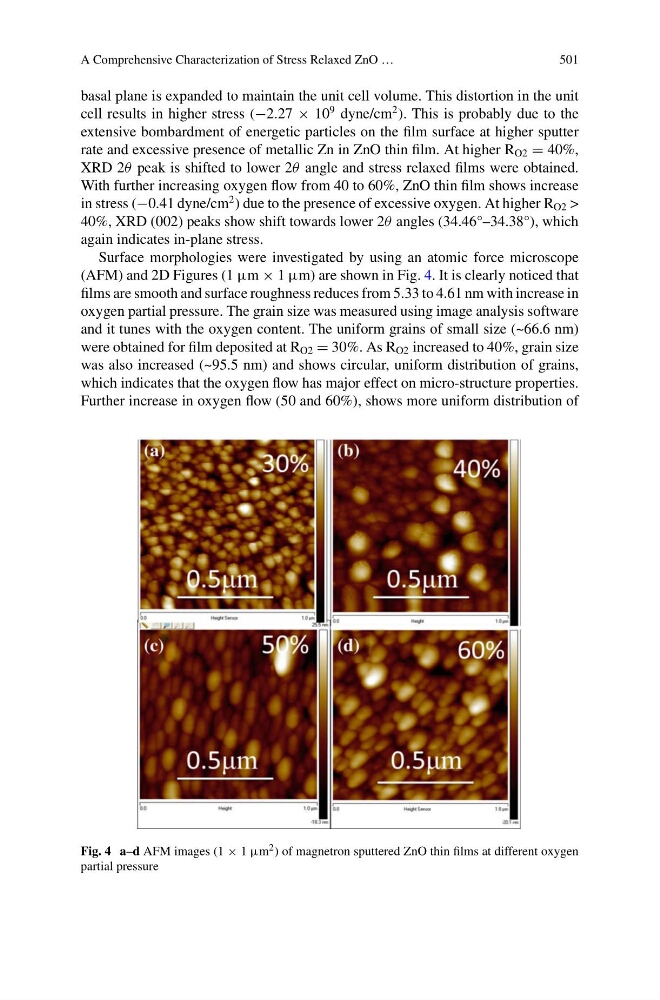
Surface morphologies were investigated by using an atomic force microscope
(AFM) and 2D Figures (1 μm × 1 μm) are shown in Fig. 4. It is clearly noticed that
films are smooth and surface roughness reduces from 5.33 to 4.61 nm with increase in
oxygen partial pressure. The grain size was measured using image analysis software
and it tunes with the oxygen content. The uniform grains of small size (~66.6 nm)
were obtained for film deposited at R O2 = 30%. As R O2 increased to 40%, grain size
was also increased (~95.5 nm) and shows circular, uniform distribution of grains,
which indicates that the oxygen flow has major effect on micro-structure properties.
Further increase in oxygen flow (50 and 60%), shows more uniform distribution of
Fig. 4 a–d AFM images (1 × 1 μm 2 ) of magnetron sputtered ZnO thin films at different oxygen
partial pressure
501
basal plane is expanded to maintain the unit cell volume. This distortion in the unit
cell results in higher stress (−2.27 × 10
9 dyne/cm
2 ). This is probably due to the
extensive bombardment of energetic particles on the film surface at higher sputter
rate and excessive presence of metallic Zn in ZnO thin film. At higher R O2 = 40%,
XRD 2θ peak is shifted to lower 2θ angle and stress relaxed films were obtained.
With further increasing oxygen flow from 40 to 60%, ZnO thin film shows increase
in stress (−0.41 dyne/cm
2 ) due to the presence of excessive oxygen. At higher R O2 >
40%, XRD (002) peaks show shift towards lower 2θ angles (34.46°–34.38°), which
again indicates in-plane stress.
Surface morphologies were investigated by using an atomic force microscope
(AFM) and 2D Figures (1 μm × 1 μm) are shown in Fig. 4. It is clearly noticed that
films are smooth and surface roughness reduces from 5.33 to 4.61 nm with increase in
oxygen partial pressure. The grain size was measured using image analysis software
and it tunes with the oxygen content. The uniform grains of small size (~66.6 nm)
were obtained for film deposited at R O2 = 30%. As R O2 increased to 40%, grain size
was also increased (~95.5 nm) and shows circular, uniform distribution of grains,
which indicates that the oxygen flow has major effect on micro-structure properties.
Further increase in oxygen flow (50 and 60%), shows more uniform distribution of
Fig. 4 a–d AFM images (1 × 1 μm 2 ) of magnetron sputtered ZnO thin films at different oxygen
partial pressure