

500
P. Joshi et al.
Fig. 2 Accumulated
curvature variation of bilayer
deposition ZnO/SiO 2 over Si
Substrate
film has shown large change in curvature due to the high compressive stress in ZnO
film.
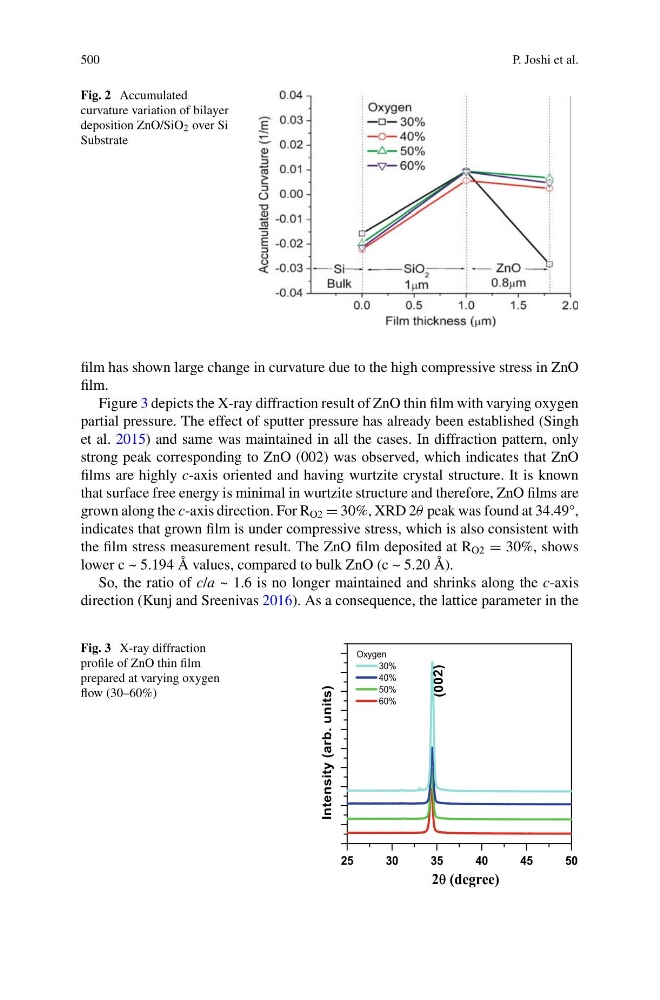
Figure 3 depicts the X-ray diffraction result of ZnO thin film with varying oxygen
partial pressure. The effect of sputter pressure has already been established (Singh
et al. 2015) and same was maintained in all the cases. In diffraction pattern, only
strong peak corresponding to ZnO (002) was observed, which indicates that ZnO
films are highly c-axis oriented and having wurtzite crystal structure. It is known
that surface free energy is minimal in wurtzite structure and therefore, ZnO films are
grown along the c-axis direction. For R O2 = 30%, XRD 2θ peak was found at 34.49°,
indicates that grown film is under compressive stress, which is also consistent with
the film stress measurement result. The ZnO film deposited at R O2 = 30%, shows
lower c ~ 5.194 Å values, compared to bulk ZnO (c ~ 5.20 Å).
So, the ratio of c/a ~ 1.6 is no longer maintained and shrinks along the c-axis
direction (Kunj and Sreenivas 2016). As a consequence, the lattice parameter in the
Fig. 3 X-ray diffraction
profile of ZnO thin film
prepared at varying oxygen
flow (30–60%)
P. Joshi et al.
Fig. 2 Accumulated
curvature variation of bilayer
deposition ZnO/SiO 2 over Si
Substrate
film has shown large change in curvature due to the high compressive stress in ZnO
film.
Figure 3 depicts the X-ray diffraction result of ZnO thin film with varying oxygen
partial pressure. The effect of sputter pressure has already been established (Singh
et al. 2015) and same was maintained in all the cases. In diffraction pattern, only
strong peak corresponding to ZnO (002) was observed, which indicates that ZnO
films are highly c-axis oriented and having wurtzite crystal structure. It is known
that surface free energy is minimal in wurtzite structure and therefore, ZnO films are
grown along the c-axis direction. For R O2 = 30%, XRD 2θ peak was found at 34.49°,
indicates that grown film is under compressive stress, which is also consistent with
the film stress measurement result. The ZnO film deposited at R O2 = 30%, shows
lower c ~ 5.194 Å values, compared to bulk ZnO (c ~ 5.20 Å).
So, the ratio of c/a ~ 1.6 is no longer maintained and shrinks along the c-axis
direction (Kunj and Sreenivas 2016). As a consequence, the lattice parameter in the
Fig. 3 X-ray diffraction
profile of ZnO thin film
prepared at varying oxygen
flow (30–60%)