

30
D. P. Barai et al.
model. A higher electrical conductivity of the suspension for the concentration higher
than 0.01 volume fraction was found, which was reportedly happening due to the
aggregation and networking of the MWCNTs which form electroconductive clusters
that behave as a pathway for electrical conductance. But this is not true for every
kind of nanoparticles as proposed by Chakraborty and Padhy (2008) as the reduction
in the density of particles due to their agglomeration shall reduce the electrical
conductivity or if the particles are naturally non-conductive. Ganguly et al. (2009)
also suggested that the Maxwell’s model cannot predict the electrical conductivity.
They have reported that the Maxwell model underpredicts the electrical conductivity
of water-based Al 2 O 3 nanofluids when compared to the experimental values. This
was due to the dependence of electrical conductivity of the Al 2 O 3 nanofluids on some
additional factors rather than only the physical properties of the fluid and particles.
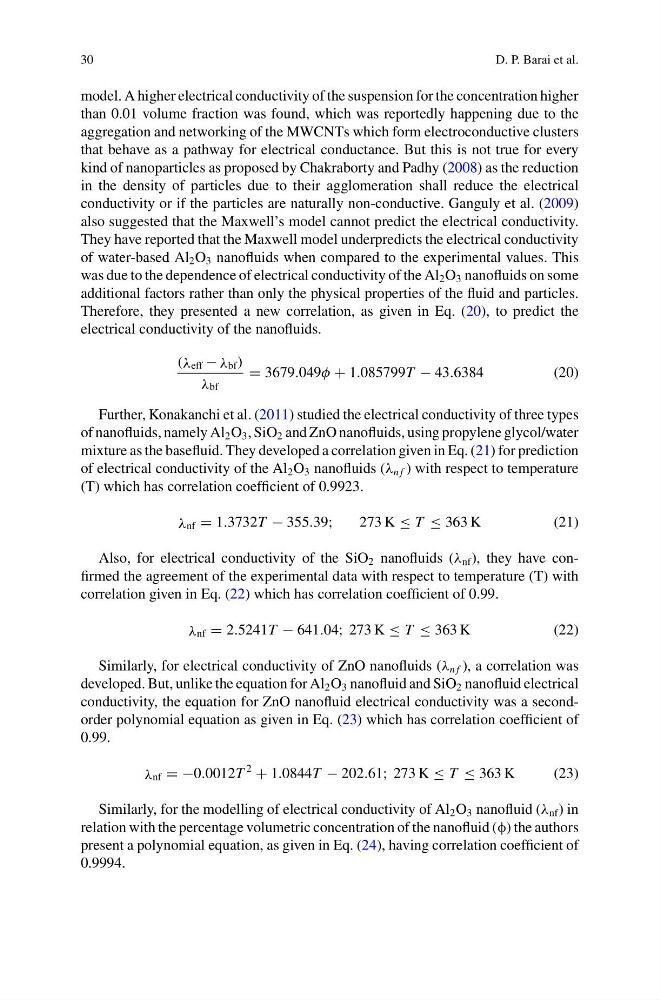
Therefore, they presented a new correlation, as given in Eq. (20), to predict the
electrical conductivity of the nanofluids.
(λ eff − λbf)
λbf
= 3679.049φ + 1.085799T − 43.6384
(20)
Further, Konakanchi et al. (2011) studied the electrical conductivity of three types
of nanofluids, namely Al 2 O 3 , SiO 2 and ZnO nanofluids, using propylene glycol/water
mixture as the basefluid. They developed a correlation given in Eq. (21) for prediction
of electrical conductivity of the Al 2 O 3 nanofluids (λ n f ) with respect to temperature
(T) which has correlation coefficient of 0.9923.
λnf = 1.3732T − 355.39;
273 K ≤ T ≤ 363 K
(21)
Also, for electrical conductivity of the SiO 2 nanofluids (λ nf ), they have confirmed the agreement of the experimental data with respect to temperature (T) with
correlation given in Eq. (22) which has correlation coefficient of 0.99.
λnf = 2.5241T − 641.04; 273 K ≤ T ≤ 363 K
(22)
Similarly, for electrical conductivity of ZnO nanofluids (λ n f ), a correlation was
developed. But, unlike the equation for Al 2 O 3 nanofluid and SiO 2 nanofluid electrical
conductivity, the equation for ZnO nanofluid electrical conductivity was a secondorder polynomial equation as given in Eq. (23) which has correlation coefficient of
0.99.
λnf = −0.0012T
2
+ 1.0844T − 202.61; 273 K ≤ T ≤ 363 K
(23)
Similarly, for the modelling of electrical conductivity of Al 2 O 3 nanofluid (λ nf ) in
relation with the percentage volumetric concentration of the nanofluid (φ) the authors
present a polynomial equation, as given in Eq. (24), having correlation coefficient of
0.9994.
D. P. Barai et al.
model. A higher electrical conductivity of the suspension for the concentration higher
than 0.01 volume fraction was found, which was reportedly happening due to the
aggregation and networking of the MWCNTs which form electroconductive clusters
that behave as a pathway for electrical conductance. But this is not true for every
kind of nanoparticles as proposed by Chakraborty and Padhy (2008) as the reduction
in the density of particles due to their agglomeration shall reduce the electrical
conductivity or if the particles are naturally non-conductive. Ganguly et al. (2009)
also suggested that the Maxwell’s model cannot predict the electrical conductivity.
They have reported that the Maxwell model underpredicts the electrical conductivity
of water-based Al 2 O 3 nanofluids when compared to the experimental values. This
was due to the dependence of electrical conductivity of the Al 2 O 3 nanofluids on some
additional factors rather than only the physical properties of the fluid and particles.
Therefore, they presented a new correlation, as given in Eq. (20), to predict the
electrical conductivity of the nanofluids.
(λ eff − λbf)
λbf
= 3679.049φ + 1.085799T − 43.6384
(20)
Further, Konakanchi et al. (2011) studied the electrical conductivity of three types
of nanofluids, namely Al 2 O 3 , SiO 2 and ZnO nanofluids, using propylene glycol/water
mixture as the basefluid. They developed a correlation given in Eq. (21) for prediction
of electrical conductivity of the Al 2 O 3 nanofluids (λ n f ) with respect to temperature
(T) which has correlation coefficient of 0.9923.
λnf = 1.3732T − 355.39;
273 K ≤ T ≤ 363 K
(21)
Also, for electrical conductivity of the SiO 2 nanofluids (λ nf ), they have confirmed the agreement of the experimental data with respect to temperature (T) with
correlation given in Eq. (22) which has correlation coefficient of 0.99.
λnf = 2.5241T − 641.04; 273 K ≤ T ≤ 363 K
(22)
Similarly, for electrical conductivity of ZnO nanofluids (λ n f ), a correlation was
developed. But, unlike the equation for Al 2 O 3 nanofluid and SiO 2 nanofluid electrical
conductivity, the equation for ZnO nanofluid electrical conductivity was a secondorder polynomial equation as given in Eq. (23) which has correlation coefficient of
0.99.
λnf = −0.0012T
2
+ 1.0844T − 202.61; 273 K ≤ T ≤ 363 K
(23)
Similarly, for the modelling of electrical conductivity of Al 2 O 3 nanofluid (λ nf ) in
relation with the percentage volumetric concentration of the nanofluid (φ) the authors
present a polynomial equation, as given in Eq. (24), having correlation coefficient of
0.9994.