

Synthesis and Characterization of Nanofluids …
31
λnf = −0.2996φ
2
+ 12.242φ + 3.5475; 1% ≤ φ ≤ 10%
(24)
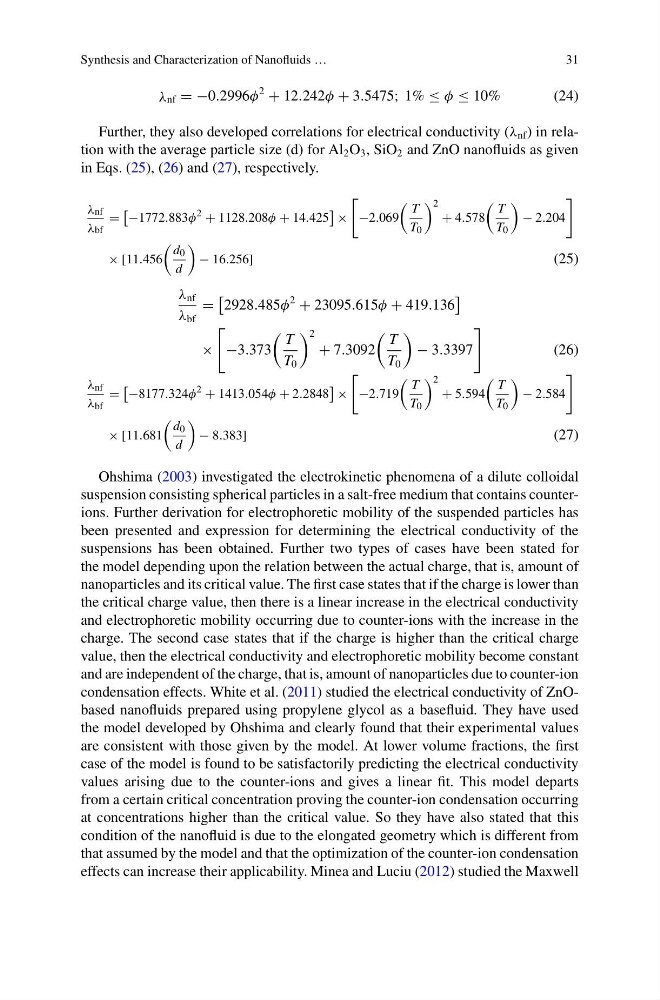
Further, they also developed correlations for electrical conductivity (λ nf ) in relation with the average particle size (d) for Al 2 O 3 , SiO 2 and ZnO nanofluids as given
in Eqs. (25), (26) and (27), respectively.
λnf
λbf
=
−1772.883φ
2 + 1128.208φ + 14.425
×
−2.069
T
T 0
2
+ 4.578
T
T 0
− 2.204
× [11.456
d 0
d
− 16.256]
(25)
λ nf
λ bf
=
2928.485φ
2
+ 23095.615φ + 419.136
×
−3.373
T
T 0
2
+ 7.3092
T
T 0
− 3.3397
(26)
λ nf
λ bf
=
−8177.324φ
2 + 1413.054φ + 2.2848
×
−2.719
T
T 0
2
+ 5.594
T
T 0
− 2.584
× [11.681
d 0
d
− 8.383]
(27)
Ohshima (2003) investigated the electrokinetic phenomena of a dilute colloidal
suspension consisting spherical particles in a salt-free medium that contains counterions. Further derivation for electrophoretic mobility of the suspended particles has
been presented and expression for determining the electrical conductivity of the
suspensions has been obtained. Further two types of cases have been stated for
the model depending upon the relation between the actual charge, that is, amount of
nanoparticles and its critical value. The first case states that if the charge is lower than
the critical charge value, then there is a linear increase in the electrical conductivity
and electrophoretic mobility occurring due to counter-ions with the increase in the
charge. The second case states that if the charge is higher than the critical charge
value, then the electrical conductivity and electrophoretic mobility become constant
and are independent of the charge, that is, amount of nanoparticles due to counter-ion
condensation effects. White et al. (2011) studied the electrical conductivity of ZnObased nanofluids prepared using propylene glycol as a basefluid. They have used
the model developed by Ohshima and clearly found that their experimental values
are consistent with those given by the model. At lower volume fractions, the first
case of the model is found to be satisfactorily predicting the electrical conductivity
values arising due to the counter-ions and gives a linear fit. This model departs
from a certain critical concentration proving the counter-ion condensation occurring
at concentrations higher than the critical value. So they have also stated that this
condition of the nanofluid is due to the elongated geometry which is different from
that assumed by the model and that the optimization of the counter-ion condensation
effects can increase their applicability. Minea and Luciu (2012) studied the Maxwell
31
λnf = −0.2996φ
2
+ 12.242φ + 3.5475; 1% ≤ φ ≤ 10%
(24)
Further, they also developed correlations for electrical conductivity (λ nf ) in relation with the average particle size (d) for Al 2 O 3 , SiO 2 and ZnO nanofluids as given
in Eqs. (25), (26) and (27), respectively.
λnf
λbf
=
−1772.883φ
2 + 1128.208φ + 14.425
×
−2.069
T
T 0
2
+ 4.578
T
T 0
− 2.204
× [11.456
d 0
d
− 16.256]
(25)
λ nf
λ bf
=
2928.485φ
2
+ 23095.615φ + 419.136
×
−3.373
T
T 0
2
+ 7.3092
T
T 0
− 3.3397
(26)
λ nf
λ bf
=
−8177.324φ
2 + 1413.054φ + 2.2848
×
−2.719
T
T 0
2
+ 5.594
T
T 0
− 2.584
× [11.681
d 0
d
− 8.383]
(27)
Ohshima (2003) investigated the electrokinetic phenomena of a dilute colloidal
suspension consisting spherical particles in a salt-free medium that contains counterions. Further derivation for electrophoretic mobility of the suspended particles has
been presented and expression for determining the electrical conductivity of the
suspensions has been obtained. Further two types of cases have been stated for
the model depending upon the relation between the actual charge, that is, amount of
nanoparticles and its critical value. The first case states that if the charge is lower than
the critical charge value, then there is a linear increase in the electrical conductivity
and electrophoretic mobility occurring due to counter-ions with the increase in the
charge. The second case states that if the charge is higher than the critical charge
value, then the electrical conductivity and electrophoretic mobility become constant
and are independent of the charge, that is, amount of nanoparticles due to counter-ion
condensation effects. White et al. (2011) studied the electrical conductivity of ZnObased nanofluids prepared using propylene glycol as a basefluid. They have used
the model developed by Ohshima and clearly found that their experimental values
are consistent with those given by the model. At lower volume fractions, the first
case of the model is found to be satisfactorily predicting the electrical conductivity
values arising due to the counter-ions and gives a linear fit. This model departs
from a certain critical concentration proving the counter-ion condensation occurring
at concentrations higher than the critical value. So they have also stated that this
condition of the nanofluid is due to the elongated geometry which is different from
that assumed by the model and that the optimization of the counter-ion condensation
effects can increase their applicability. Minea and Luciu (2012) studied the Maxwell