

Synthesis and Characterization of Nanofluids …
29
4.5 Models for Electrical Conductivity Prediction
Models present an additional insight to the variations of certain parameter with
respect to changes in other parameter and provide a prediction of the experimental
results for the same. Similar to thermal conductivity, there are model equations
which are derived for predicting the electrical conductivity as well. A classical model
developed by Maxwell (1881) for conductivity in heterogeneous media as given in
Eq. (18) is being used since long ago for the prediction of electrical conductivity of
nanofluids. This equation gives the relation between the effective conductivity of the
nanofluid (λ eff ) and conductivity of the basefluid (λ bf ) as a function of conductivity
ratio of the two phases (α) and volume fraction of the nanoparticles in the nanofluid
(φ). This correlation given by Maxwell is valid for spherical particles which are
randomly distributed in the dispersions. Also, it assumes that there is no formation
of aggregates and the distances between two particles is greater than their diameters.
λeff
λbf
= 1 +
3(α − 1)
(α + 2) − (α − 1)φ
(18)
Here, ‘α’ as given in Eq. (19) is the ratio of conductivity of the nanoparticles (λ p )
to the conductivity of the basefluid (λ b f ).
α =
λ p
λ bf
(19)
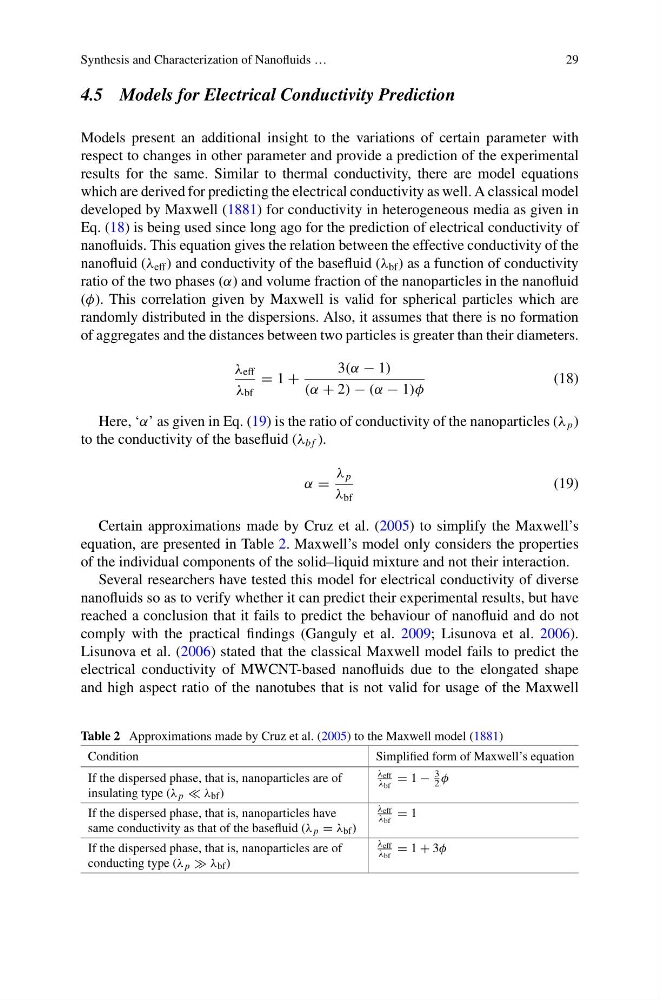
Certain approximations made by Cruz et al. (2005) to simplify the Maxwell’s
equation, are presented in Table 2. Maxwell’s model only considers the properties
of the individual components of the solid–liquid mixture and not their interaction.
Several researchers have tested this model for electrical conductivity of diverse
nanofluids so as to verify whether it can predict their experimental results, but have
reached a conclusion that it fails to predict the behaviour of nanofluid and do not
comply with the practical findings (Ganguly et al. 2009; Lisunova et al. 2006).
Lisunova et al. (2006) stated that the classical Maxwell model fails to predict the
electrical conductivity of MWCNT-based nanofluids due to the elongated shape
and high aspect ratio of the nanotubes that is not valid for usage of the Maxwell
Table 2 Approximations made by Cruz et al. (2005) to the Maxwell model (1881)
Condition
Simplified form of Maxwell’s equation
If the dispersed phase, that is, nanoparticles are of
insulating type (λ p λ bf )
λeff
λbf = 1 −
3
2 φ
If the dispersed phase, that is, nanoparticles have
same conductivity as that of the basefluid (λ p = λ bf )
λeff
λbf = 1
If the dispersed phase, that is, nanoparticles are of
conducting type (λ p λ bf )
λeff
λbf = 1 + 3φ
29
4.5 Models for Electrical Conductivity Prediction
Models present an additional insight to the variations of certain parameter with
respect to changes in other parameter and provide a prediction of the experimental
results for the same. Similar to thermal conductivity, there are model equations
which are derived for predicting the electrical conductivity as well. A classical model
developed by Maxwell (1881) for conductivity in heterogeneous media as given in
Eq. (18) is being used since long ago for the prediction of electrical conductivity of
nanofluids. This equation gives the relation between the effective conductivity of the
nanofluid (λ eff ) and conductivity of the basefluid (λ bf ) as a function of conductivity
ratio of the two phases (α) and volume fraction of the nanoparticles in the nanofluid
(φ). This correlation given by Maxwell is valid for spherical particles which are
randomly distributed in the dispersions. Also, it assumes that there is no formation
of aggregates and the distances between two particles is greater than their diameters.
λeff
λbf
= 1 +
3(α − 1)
(α + 2) − (α − 1)φ
(18)
Here, ‘α’ as given in Eq. (19) is the ratio of conductivity of the nanoparticles (λ p )
to the conductivity of the basefluid (λ b f ).
α =
λ p
λ bf
(19)
Certain approximations made by Cruz et al. (2005) to simplify the Maxwell’s
equation, are presented in Table 2. Maxwell’s model only considers the properties
of the individual components of the solid–liquid mixture and not their interaction.
Several researchers have tested this model for electrical conductivity of diverse
nanofluids so as to verify whether it can predict their experimental results, but have
reached a conclusion that it fails to predict the behaviour of nanofluid and do not
comply with the practical findings (Ganguly et al. 2009; Lisunova et al. 2006).
Lisunova et al. (2006) stated that the classical Maxwell model fails to predict the
electrical conductivity of MWCNT-based nanofluids due to the elongated shape
and high aspect ratio of the nanotubes that is not valid for usage of the Maxwell
Table 2 Approximations made by Cruz et al. (2005) to the Maxwell model (1881)
Condition
Simplified form of Maxwell’s equation
If the dispersed phase, that is, nanoparticles are of
insulating type (λ p λ bf )
λeff
λbf = 1 −
3
2 φ
If the dispersed phase, that is, nanoparticles have
same conductivity as that of the basefluid (λ p = λ bf )
λeff
λbf = 1
If the dispersed phase, that is, nanoparticles are of
conducting type (λ p λ bf )
λeff
λbf = 1 + 3φ